
What is a Debris Accumulation
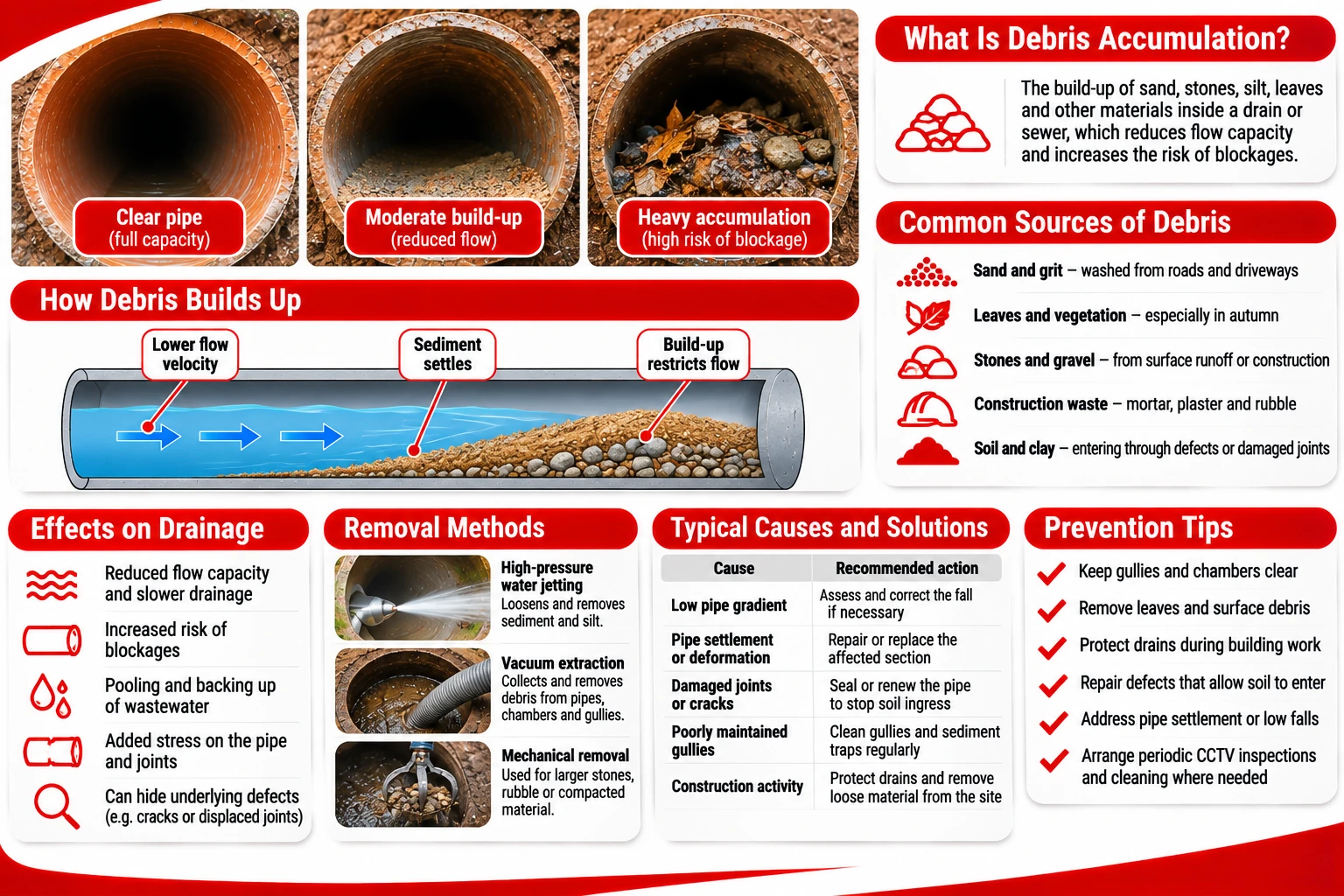
Debris accumulation is the gradual build-up of sand, silt, stones, soil, leaves and other solid materials inside a drainage pipe, sewer or inspection chamber. As these materials collect, they reduce the space available for water to flow and can eventually cause partial or complete blockages. The problem occurs in both foul and surface water drainage systems, although the types of debris and the reasons for accumulation can differ.
Unlike a single object obstructing a drain, debris accumulation usually develops over time. Small particles settle in areas where water velocity is insufficient to carry them away, while larger materials may become trapped at bends, junctions or existing pipe defects. Understanding where the debris originates is essential because removing the deposits without addressing their cause may result in repeated blockages.
What Types of Debris Accumulate in Drainage Systems?
Drainage systems carry water containing varying amounts of suspended and solid material. Under suitable flow conditions, much of this material moves through the network. However, heavier particles can settle when flow slows, particularly in pipes with inadequate gradients or sections where water regularly collects.
The composition of debris depends on the type of drainage system and its surroundings. Surface water drains commonly receive material washed from roads, roofs and paved areas, while foul drains may contain sediment mixed with organic waste.
Common materials found in drainage pipes include:
-
Sand and grit. Fine mineral particles washed from roads, driveways, construction sites and surrounding ground.
-
Silt and fine sediment. Small particles that settle in slow-moving water and form deposits along the pipe invert.
-
Stones and gravel. Coarser material entering through open gullies, damaged pipes or poorly protected drainage connections.
-
Leaves and vegetation. Organic debris carried into surface water drains, particularly during autumn.
-
Soil and clay. Material entering through defective joints, cracks or damaged sections of underground pipework.
-
Construction debris. Mortar fragments, plaster, rubble and other materials introduced during building or renovation work.
-
Mixed waste. Accumulations of sediment combined with grease, wipes, paper and other materials that can restrict drainage.
The pipe invert is the lowest internal surface of a drain, where sediment commonly settles. Deposits may initially form a shallow layer before increasing in depth and extending along the pipe.
Different materials behave differently in flowing water. Coarse stones require more energy to move than fine particles, while silt may remain suspended until water velocity falls sufficiently. Organic debris can also become trapped against existing deposits, creating a larger obstruction.
The distinction between loose debris and hardened deposits is important. Sand and silt can often be removed using conventional drainage cleaning equipment, whereas cementitious material, mineral scale or firmly bonded deposits may require specialist methods.
Why Does Debris Build Up Inside Drain Pipes?
Debris accumulation occurs when material enters a drainage system faster than it can be transported or removed. The main factors are sediment supply, water flow conditions and the physical condition of the pipe.
Gravity drainage systems rely on an appropriate gradient and sufficient flow to transport wastewater and solids. Where the gradient is too shallow, the pipe has settled or the flow is regularly low, particles may remain behind rather than moving towards the outlet.
Common causes include:
-
Insufficient pipe gradient. Low flow velocity can allow sediment to settle, particularly where the pipe receives limited water.
-
Pipe deformation or settlement. A sagging section can retain standing water and encourage deposits to accumulate.
-
Displaced joints. Misaligned pipe sections can create edges that trap sediment and larger particles.
-
Root intrusion. Roots entering through defects can intercept debris and gradually form an obstruction.
-
Damaged pipe walls. Cracks and missing sections may allow surrounding soil or gravel to enter the drain.
-
Poorly maintained gullies. Accumulated road grit, leaves and sediment may enter downstream pipework when gullies overflow or their sediment traps are ineffective.
-
Construction activity. Excavation, landscaping and building work can introduce unusually large quantities of loose material.
Changes in pipe diameter and direction can also affect sediment movement. Where a flow enters a larger pipe, its velocity may decrease under certain conditions, allowing particles to settle. Sharp changes in direction or poorly formed junctions may create local areas where material collects.
Debris accumulation is particularly common in surface water systems receiving runoff from roads and paved areas. Rainfall can wash sediment into drainage gullies, but the flow during smaller storms may not always be sufficient to transport the heavier particles through the entire network.
In foul drainage systems, repeated sediment deposits may indicate an underlying defect. For example, if soil continually enters through a cracked underground pipe, cleaning will remove the material temporarily but will not stop further ingress.
How Does Debris Accumulation Affect Drainage Performance?
The effect of debris depends on its volume, location and composition. A thin layer of sediment may have little immediate impact, while a deep deposit can significantly reduce the available flow area.
Accumulated material also increases internal roughness and can interfere with the movement of solids. This makes the pipe more vulnerable to additional obstructions, particularly during periods of low flow.
| Debris condition | Effect on the drainage system | Possible consequence |
|---|---|---|
| Thin sediment layer | Minor reduction in available flow area | Gradual build-up if conditions persist |
| Deep silt deposit | Reduced internal capacity | Slow drainage and localised surcharge |
| Stones or gravel at a bend | Physical obstruction to flow | Debris trapping and recurring blockages |
| Leaves and organic material | Partial restriction, especially at screens or outlets | Surface water backing up |
| Soil entering through a defect | Sediment accumulation and possible loss of external support | Structural deterioration and settlement |
| Mixed debris and grease | Sticky deposits that retain additional solids | Persistent foul drain blockages |
A useful example is a 150 mm diameter surface water pipe containing a 30 mm-deep sediment deposit along its bottom. Although the deposit occupies only part of the pipe, it reduces the space available for water and creates an uneven surface that can retain additional material.
The hydraulic effect cannot be determined from deposit depth alone. Pipe gradient, flow rate, sediment shape and roughness all influence the resulting capacity.
In severe cases, debris can cause wastewater to back up through connected fixtures or surface water to overflow from gullies and inspection chambers. The consequences are particularly noticeable during heavy rainfall, when drainage systems must carry substantially greater flows.
Persistent accumulation can also conceal structural defects. Sediment may cover cracks, displaced joints or missing pipe material, making it difficult to assess the pipe’s condition until cleaning has been completed.
How Is Debris Accumulation Identified and Measured?
Debris accumulation is commonly identified through inspection chambers, drainage gullies and CCTV drain surveys. The most appropriate inspection method depends on the pipe diameter, accessibility and whether the deposits obstruct the passage of equipment.
During CCTV inspection, sediment usually appears as material lying along the pipe invert. Fine silt may form a relatively smooth deposit, while stones, gravel and mixed debris produce a more irregular surface.
A drainage engineer may record the depth and extent of deposits, together with their approximate location. In suitable circumstances, the deposit can be described as a proportion of the pipe diameter.
For example, a sediment layer extending approximately 25% of the internal diameter represents a substantial accumulation. However, the proportion visible on camera may be an estimate rather than a precise measurement, particularly when water obscures the lower section of the pipe.
An inspection should establish:
-
The type and approximate quantity of accumulated material.
-
The length of pipe affected by the deposits.
-
Whether the obstruction is localised or extends across several sections.
-
The presence of standing water or evidence of inadequate gradient.
-
Any visible cracks, displaced joints or root intrusion.
-
Whether the debris appears to be entering from a particular connection or damaged section.
In the UK, CCTV inspection of drains and sewers can be recorded using conventions associated with BS EN 13508-2 and relevant industry guidance. Consistent defect recording helps distinguish deposits from structural defects and supports decisions about cleaning and repair.
Where a pipe is heavily obstructed, preliminary cleaning may be required before the full internal condition can be assessed. A post-cleaning CCTV survey can then reveal defects that were previously hidden beneath sediment.
How Is Debris Removed from Drainage Pipes and Chambers?
The appropriate cleaning method depends on the type of debris, the size of the drainage system and the condition of the pipework. Loose sediment can often be removed hydraulically, while larger stones and construction materials may require mechanical extraction.
High-pressure water jetting is widely used to mobilise and remove sediment from suitable drainage pipes. The jetting nozzle directs water towards deposits, helping loosen material and move it towards an accessible collection point.
However, simply pushing debris further downstream is not always appropriate. Large quantities of sediment can settle again or create a new blockage elsewhere in the network.
Common cleaning methods include:
-
High-pressure water jetting. Suitable for many loose sediment deposits and mixed accumulations in compatible pipes.
-
Vacuum extraction. Used to remove silt, grit and other material from gullies, chambers and accessible drainage sections.
-
Mechanical removal. Appropriate for certain stones, rubble and larger objects that cannot be removed effectively by jetting.
-
Manual chamber cleaning. May be used for accessible deposits where a safe working method has been established.
-
Combined jetting and vacuum equipment. Allows deposits to be loosened and collected rather than simply transferred downstream.
Cleaning equipment must be selected according to pipe condition. Excessive jetting pressure or aggressive mechanical tools can damage weakened pipework, particularly where joints are displaced or structural defects are present.
Inspection chambers and gullies may require separate cleaning even after the connecting pipes have been cleared. Sediment retained in these structures can be carried back into the drainage system during subsequent rainfall.
Where significant debris is removed, the collected material must be managed and disposed of appropriately. Drainage sediment may contain contaminants, particularly when recovered from roads, industrial areas or foul sewer systems.
How Can Repeated Debris Accumulation Be Prevented?
Preventing debris accumulation requires controlling the entry of solids and maintaining drainage conditions that allow material to move through the system.
For surface water drainage, regular gully and chamber maintenance is particularly important. Sediment traps are designed to retain some heavier particles before they enter downstream pipework, but they lose effectiveness when filled.
Preventative measures include:
-
Inspect and clean road gullies and sediment traps according to local conditions.
-
Remove leaves and loose material from accessible drainage inlets.
-
Protect drainage openings during construction and landscaping work.
-
Investigate repeated sediment deposits at the same location.
-
Repair damaged joints and pipe walls that allow soil to enter.
-
Correct significant pipe settlement or deformation where it causes persistent accumulation.
-
Arrange targeted cleaning where inspections show deposits approaching problematic levels.
Maintenance frequency should reflect the amount of debris entering the system. A gully beside a heavily trafficked road or construction site may require more attention than one serving a relatively clean roof drainage area.
Where deposits repeatedly appear in the same section, further investigation is more useful than repeatedly clearing the pipe without identifying the cause. Persistent silt accumulation may indicate inadequate gradient, while recurring soil or gravel deposits can suggest a structural opening.
Not every accumulation requires immediate intervention. A small, stable deposit in a pipe with satisfactory flow may be monitored, while a substantial restriction, repeated blockage or evidence of soil entering through damaged pipework warrants closer assessment.
Debris accumulation is both a maintenance issue and a potential indicator of underlying drainage defects. Removing the material restores available flow capacity, but long-term performance depends on controlling sediment entry, maintaining suitable pipe conditions and repairing defects that allow deposits to return.