What is a Drain Clearance
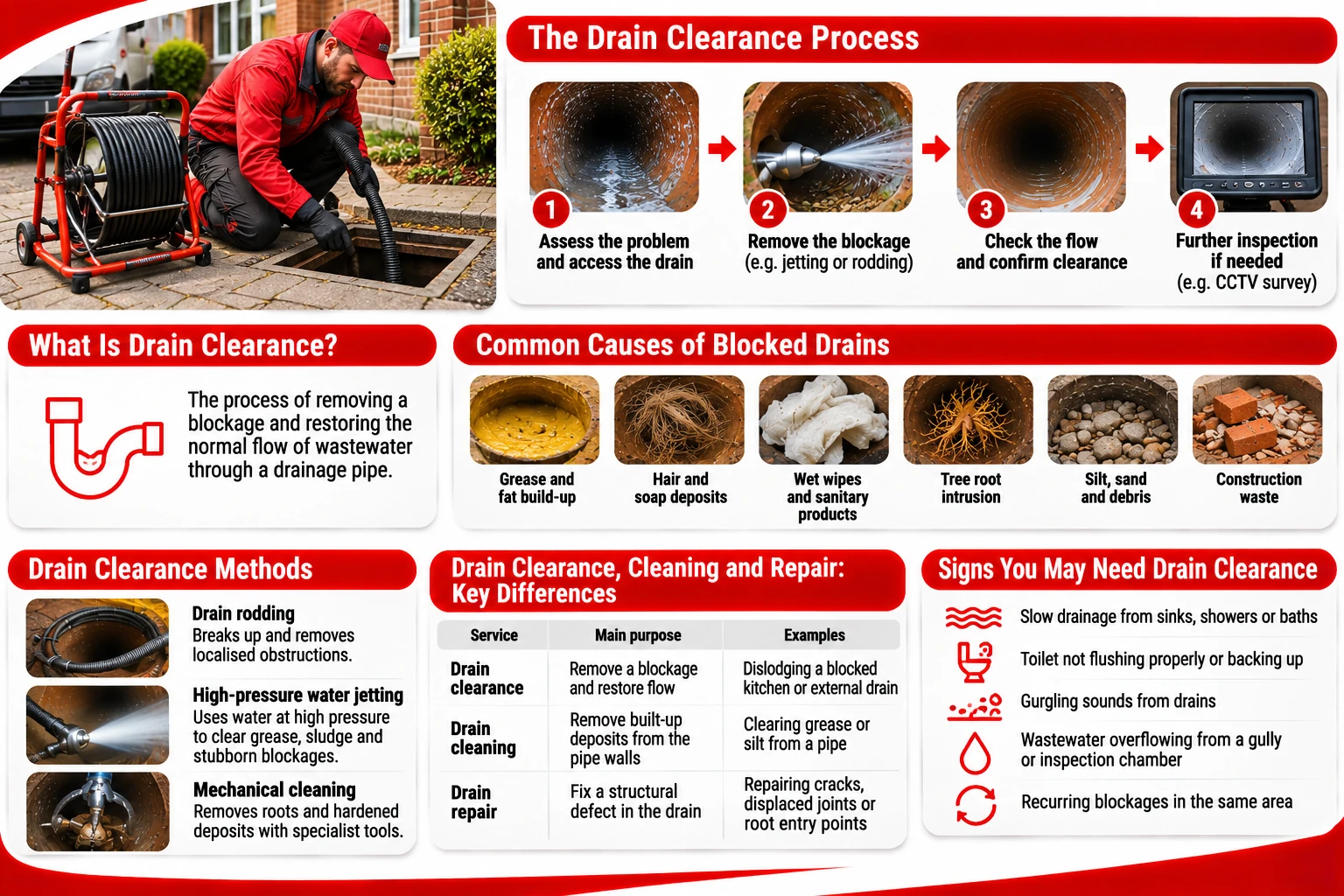
Drain clearance is the process of removing an obstruction from a drainage pipe to restore the normal flow of wastewater or surface water. It is carried out when grease, waste, sediment, roots or other materials restrict the movement of water through a drain. The work may involve manual tools, mechanical equipment or high-pressure water jetting, depending on the type and location of the blockage.
Drain clearance is different from routine drain cleaning and structural drain repair. Clearance focuses on removing a restriction that is preventing the drainage system from functioning correctly. Cleaning may involve removing deposits from the internal pipe walls, while repair addresses defects such as cracks, displaced joints or collapsed sections. Although these activities can form part of the same job, clearing a blockage does not necessarily resolve the underlying cause.
What Causes Drain Blockages That Require Clearance?
A drainage blockage develops when material accumulates inside a pipe or an object prevents water and solids from passing through. Some obstructions form gradually over months or years, while others occur suddenly when an unsuitable item enters the system.
The location and composition of the blockage depend on the drainage system. Kitchen waste pipes commonly experience grease and food-related deposits, whereas underground drains may become obstructed by roots, sediment or materials entering through damaged joints.
Common causes of blocked drains include:
-
Fat, oil and grease. Cooking residues can accumulate on pipe walls and combine with food particles and other solids to form persistent deposits.
-
Wet wipes and sanitary products. These materials may remain intact in wastewater and become trapped at bends, junctions or existing defects.
-
Hair and soap deposits. Bathroom waste pipes can develop restrictions where hair combines with soap residue and other material.
-
Tree root intrusion. Roots entering through defective joints or cracks can intercept waste and gradually obstruct the pipe.
-
Silt, sand and gravel. Sediment carried into surface water drains may settle in areas with insufficient flow velocity.
-
Construction debris. Mortar, plaster, rubble and other building materials can cause particularly difficult obstructions.
-
Foreign objects. Toys, cleaning cloths and other items accidentally entering drainage pipework can create localised blockages.
-
Structural defects. Displaced joints, deformation and partial collapse can restrict the pipe or provide surfaces where debris accumulates.
Not every slow-draining fixture has an obstruction in the underground drain. The restriction may be located in a trap, a short waste pipe or another part of the plumbing system.
Similarly, wastewater backing up into several fixtures may indicate a problem in a shared downstream section rather than separate blockages at each outlet. Identifying the affected part of the system helps avoid unnecessary cleaning work.
How Is Professional Drain Clearance Carried Out?
Professional drain clearance begins with assessing the symptoms and identifying a suitable access point. The engineer may inspect a gully, rodding eye or inspection chamber to establish where wastewater is accumulating and which section of pipe is likely to be obstructed.
The cleaning method is selected according to the material causing the blockage, pipe diameter, accessibility and condition of the drainage system. There is no single technique suitable for every obstruction.
The main clearance methods are:
| Clearance method | Suitable applications | Important limitations |
|---|---|---|
| Drain rodding | Localised obstructions and some soft deposits | Limited effectiveness against extensive grease, scale or solid debris |
| High-pressure water jetting | Grease, sludge, sediment and many mixed blockages | Pressure and nozzle selection must suit the pipe condition |
| Mechanical drain cleaning | Selected compacted deposits, roots and persistent obstructions | Incorrect tools can damage pipe walls or joints |
| Manual extraction | Accessible foreign objects and debris | Requires suitable access to the obstruction |
| Vacuum extraction | Silt, sludge and debris in gullies or chambers | Usually combined with other methods for material deeper inside pipes |
| Specialist cutting equipment | Certain root masses or hardened deposits | Requires assessment of the pipe and obstruction before use |
Drain rodding involves introducing connected flexible rods into a pipe through a suitable access point. The rods are advanced towards the obstruction, where an appropriate attachment may be used to break up or dislodge the material.
Rodding is often effective for relatively simple blockages in accessible drainage runs. However, it may not remove deposits adhering to the entire internal circumference of a pipe.
High-pressure water jetting uses water delivered through a specialised nozzle to loosen deposits and help transport debris towards an accessible removal point. Different nozzles produce different jet patterns, allowing the equipment to be adapted to the task.
Jetting pressure alone does not determine cleaning effectiveness. Water flow rate, nozzle design, hose movement, pipe diameter and the nature of the obstruction also influence the result.
Where a pipe contains large stones or construction rubble, the material may need to be extracted rather than pushed downstream. Moving a substantial obstruction further into the network can create a new blockage in a less accessible location.
Mechanical cutting equipment may be considered for root intrusion or selected hardened deposits. Its use requires particular care where the pipe is cracked, displaced or otherwise structurally weakened.
What Happens During a Drain Clearance Visit?
The procedure varies according to the severity of the blockage and the available access. A straightforward obstruction may be removed without extensive investigation, while recurring problems or signs of structural damage may justify a more detailed assessment.
A typical professional visit involves the following stages:
-
Initial assessment. The engineer identifies the affected fixtures, drainage points and symptoms.
-
Access inspection. Suitable chambers, gullies or access fittings are checked to help establish the likely location of the restriction.
-
Equipment selection. A clearance method is chosen based on the suspected obstruction and pipe conditions.
-
Blockage removal. The engineer uses appropriate equipment to dislodge, break up or extract the material.
-
Flow verification. Water is discharged through the affected system, where appropriate, to check whether drainage has been restored.
-
Further investigation. CCTV inspection may be recommended if the blockage recurs, the pipe remains restricted or structural damage is suspected.
The location of standing wastewater can provide useful diagnostic information. For example, if an upstream inspection chamber contains backed-up wastewater while a downstream chamber is clear, the obstruction may be located between them.
This is not a definitive test in every drainage arrangement. Branch connections, multiple restrictions and variations in flow can affect the observed water levels.
During clearance, the engineer should also consider whether the pipe can safely accommodate the selected equipment. A severely fractured or partially collapsed drain may be unsuitable for aggressive mechanical cleaning.
Once the obstruction has been removed, the system should be checked for satisfactory discharge. However, a successful flow test does not prove that the entire pipe is structurally sound or completely free from deposits.
Drain Clearance, Drain Cleaning and Drain Repair: What’s the Difference?
These terms describe related but distinct activities. Understanding the difference is important because a drain that flows normally immediately after clearance may still contain defects or deposits that cause future problems.
Drain clearance removes an obstruction that is preventing wastewater from passing through the system. The immediate objective is to restore drainage.
Drain cleaning involves removing accumulated material from the internal surfaces of pipes or drainage structures. It may be carried out after a blockage or as planned maintenance, particularly where grease, sediment or other deposits build up repeatedly.
Drain repair addresses physical defects affecting the pipe or its connections. These may include cracks, displaced joints, root entry points, deformation and collapsed sections.
For example, tree roots entering through a defective joint may cause a blockage. Cutting and removing the roots can restore flow, but the opening through which they entered may remain.
Without an appropriate repair, roots may grow back into the drainage system. Repeated clearance alone may therefore provide only temporary relief.
A similar situation occurs where a pipe has settled and developed a low point. Sediment may be removed successfully, but the underlying alignment problem can continue to encourage deposits.
The appropriate response depends on the condition of the pipe and the frequency of the problem. An isolated blockage caused by a foreign object may require no structural work, while repeated blockages at the same location warrant further investigation.
CCTV inspection can help distinguish these situations by revealing visible defects and residual deposits. It is particularly useful when the cause cannot be established through clearance alone.
When Is Drain Clearance Urgent, and How Can Further Blockages Be Prevented?
Drain clearance becomes urgent when wastewater cannot discharge safely or when an obstruction creates an immediate risk of sewage escaping into a property.
A completely blocked toilet serving the only available sanitary facility may require prompt attention. Sewage backing up through a shower, floor drain or external chamber can also create hygiene and property damage risks.
Signs that professional clearance may be necessary include:
-
Wastewater repeatedly backing up into sinks, showers or toilets.
-
Several fixtures draining slowly at the same time.
-
Sewage overflowing from an inspection chamber or external drain.
-
Persistent gurgling accompanied by poor drainage.
-
Repeated blockages in the same section of pipe.
-
An obstruction that cannot be removed safely using simple household methods.
If sewage is backing up, the use of connected toilets, sinks and appliances should be reduced until the problem is assessed. Continuing to discharge water into a blocked system can increase the amount of wastewater escaping from the lowest available opening.
Chemical drain cleaners require particular caution. They may be unsuitable for some pipe materials and can create additional hazards for anyone subsequently working on the drainage system. Different cleaning chemicals must never be mixed.
Prevention depends on controlling what enters the drainage system and addressing defects that encourage material to accumulate.
In kitchens, cooking fats and oils should be collected for appropriate disposal rather than poured into sinks. Food scraps should also be kept out of waste pipes wherever practicable.
In bathrooms, wipes, sanitary products and other non-flushable materials should be disposed of in bins. Hair traps can help reduce the amount of material entering shower and bath waste pipes.
External drainage requires different precautions. Leaves, soil and loose debris should be removed from accessible gullies and drainage inlets, particularly where nearby vegetation or construction activity increases the amount of material entering the system.
Regular cleaning may be appropriate for drainage systems with a known history of grease or sediment accumulation. However, there is no universal cleaning interval suitable for every property. Maintenance frequency should reflect actual conditions and previous inspection findings.
Repeated blockages should not automatically be treated as routine maintenance problems. If the same drain requires frequent clearance, the cause may be a structural defect, poor alignment or an unsuitable connection.
Drain clearance is successful when the obstruction has been removed and the affected drainage system can discharge wastewater satisfactorily. Where recurring blockages or visible defects remain, further investigation is needed to determine whether cleaning, maintenance or structural repair will provide a lasting solution.