
What is a Dropped Joint
A dropped joint is a drainage pipe defect in which one pipe section has settled below the adjoining section, creating a vertical step at the connection. This misalignment interrupts the smooth internal profile of the drain and can restrict wastewater flow, trap solid material and contribute to recurring blockages. Dropped joints are most commonly identified during CCTV drain inspections, particularly in underground drainage systems where changes in pipe alignment cannot be observed from the surface.
The significance of a dropped joint depends on the size and direction of the displacement, the pipe diameter, the condition of the joint and the way wastewater moves through the affected section. A relatively small step may have little immediate effect, while a substantial displacement can create a persistent obstruction or allow wastewater to accumulate. Unlike a blockage caused solely by grease or debris, a dropped joint is a physical alignment defect that cannot be permanently corrected through drain cleaning alone.
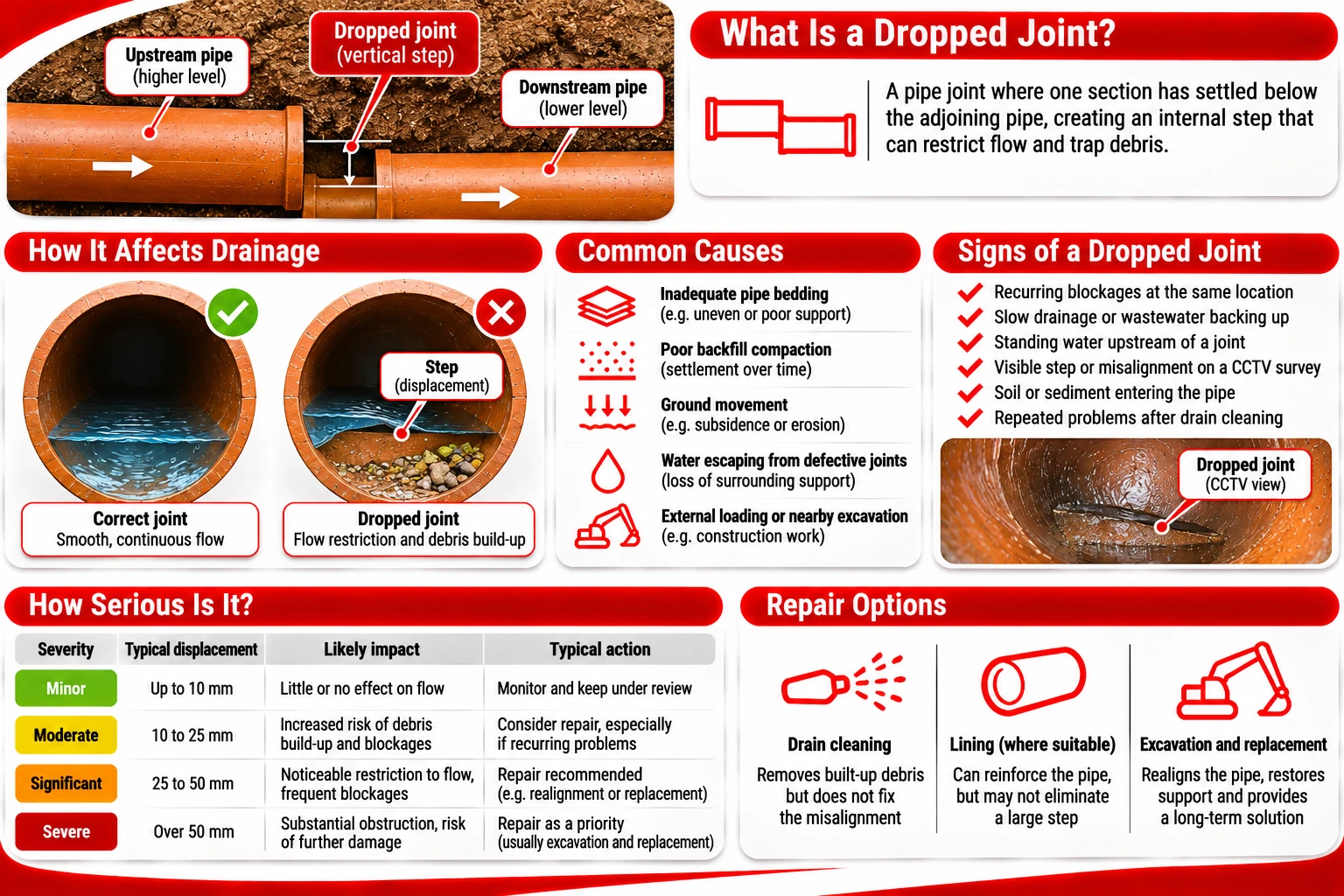
What Is a Dropped Joint and How Does It Affect Drainage?
Underground drainage pipes are normally installed with their internal channels aligned to provide a continuous route for wastewater. In gravity drainage systems, the pipe invert, which is the lowest internal point of the pipe, should follow the designed fall towards the downstream connection. A dropped joint occurs when movement or settlement causes one pipe section to sit lower than the adjacent section, creating a discontinuity at the joint.
The direction of the displacement is important. If the downstream pipe has dropped below the upstream section, wastewater encounters a downward step as it passes through the connection. Although water may continue flowing, the misalignment can disturb the flow pattern and expose the joint to additional turbulence. The displaced connection may also provide an opening through which surrounding material can enter if the seal has been compromised.
A different hydraulic problem occurs when the downstream pipe invert is higher than the upstream invert. In that arrangement, wastewater must rise over the internal step before continuing downstream, potentially causing water to accumulate behind the joint. This condition is particularly likely to retain sediment and other solid material.
Both arrangements involve vertical misalignment, but they should not be treated as hydraulically identical. The term dropped joint is sometimes used informally for different forms of vertical displacement, so a technical inspection report should describe which pipe section has moved and how the internal channel has been affected.
Several characteristics determine the practical significance of the defect:
-
Vertical displacement. The difference in level between the adjoining pipe inverts.
-
Pipe diameter. The same displacement represents a greater proportion of the available opening in a smaller pipe.
-
Direction of flow. Whether wastewater encounters a raised obstruction or a downward step.
-
Joint opening. Whether displacement has created a gap between the pipe sections.
-
Pipe material. The way rigid and flexible pipes respond to settlement and joint movement differs.
-
Existing deposits. Sediment, grease or other material may increase the restriction created by the misalignment.
-
Condition of surrounding ground. Loss of bedding support or soil movement may allow the displacement to progress.
For example, a 20 mm vertical displacement represents approximately 18% of the nominal diameter of a 110 mm pipe. This illustrates why relatively modest movements can be significant in domestic drainage systems. However, the percentage alone does not determine whether a joint requires repair, because the direction of the step, effective opening, flow conditions and structural condition must also be considered.
A dropped joint should also be distinguished from a displaced joint involving horizontal movement. A horizontal displacement shifts the pipe sections sideways, while a dropped joint specifically involves a change in vertical alignment. Some joints exhibit both types of movement, and the inspection record should describe the observed geometry rather than relying on a single general term.
Why Do Underground Drain Joints Drop?
Dropped joints usually develop because the pipe sections no longer have adequate or consistent support. Underground drains depend on correctly prepared bedding, suitable backfill and stable surrounding ground to maintain their alignment. If one section settles more than the adjoining section, movement becomes concentrated at the connection.
Differential settlement is one of the most common mechanisms. This occurs when the ground beneath adjacent pipe sections moves by different amounts, causing one section to change position relative to the other. The movement may develop gradually over several years or occur more quickly following disturbance of the surrounding ground.
Poor installation can increase the risk. A pipe laid on uneven bedding or over an inadequately compacted trench may initially appear correctly aligned but subsequently settle as the supporting material consolidates. Rigid pipes can be particularly vulnerable to concentrated movement at joints where the surrounding support is inconsistent.
Other contributing factors include:
-
Inadequate pipe bedding. Uneven or poorly prepared bedding can leave sections of the pipe insufficiently supported.
-
Poor backfill compaction. Settlement of trench material may alter the position of the pipe after installation.
-
Ground movement. Changes in soil conditions, erosion or localised subsidence can cause differential settlement.
-
Water escaping from defective joints. Leakage may contribute to the movement of fine soil particles and progressive loss of support.
-
External loading. Vehicle movements, construction activity or changes in ground loading can affect inadequately protected pipework.
-
Nearby excavation. Disturbance of soil around an existing drain may reduce lateral or vertical support.
-
Deterioration of existing connections. Ageing or damaged joints may become less capable of accommodating movement without losing alignment.
The relationship between joint displacement and leakage can be particularly important. A defective connection may allow water to escape into the surrounding ground, potentially washing away fine material where conditions permit. As support is lost, the pipe can settle further, increasing the displacement and potentially worsening the leakage.
However, a dropped joint does not automatically prove that soil has been washed away or that the pipe is leaking. A CCTV survey may reveal the misalignment without showing the condition of the external bedding. Additional investigation is necessary where ground instability, void formation or significant leakage is suspected.
Pipe age and construction method can influence the likelihood of joint movement. Older vitrified clay drainage systems often contain relatively short rigid pipe sections connected by numerous joints. Modern plastic drainage systems commonly use flexible joints and different pipe lengths, but they can still experience deformation or displacement where installation and ground support are inadequate.
A dropped joint may also develop near a change in construction conditions. For example, a pipe passing from well-compacted ground into a section of disturbed fill may experience different settlement behaviour. Connections close to foundations, inspection chambers or other rigid structures can be vulnerable where the adjoining pipe and surrounding ground move differently.
Signs of a Dropped Joint and How It Is Identified
A dropped joint does not always produce immediate symptoms. Wastewater may continue to pass through a partially displaced connection, particularly when the pipe carries relatively small flows. Problems often become noticeable when solid material begins accumulating at the step or when the defect becomes more severe.
Recurring blockages are one of the more common indications. Cleaning may temporarily restore drainage, but the same section can repeatedly collect paper, sediment or other material because the internal obstruction remains. The frequency of these blockages depends on the nature of the discharge, the pipe gradient and the geometry of the displaced joint.
Other possible symptoms include slow drainage, wastewater backing up during periods of heavy use and standing water within a pipe section. Where a joint has opened sufficiently to allow wastewater escape, surrounding ground may become affected, although surface signs are not always present.
The following table distinguishes symptoms from the observations needed to confirm the defect.
| Symptom or observation | Possible connection to a dropped joint | What needs to be checked |
|---|---|---|
| Repeated blockage at the same location | The internal step may retain paper, debris or sediment | CCTV footage after suitable cleaning |
| Slow wastewater discharge | The displaced connection may restrict the effective opening | Joint alignment, deposits and downstream conditions |
| Standing water upstream of a joint | A raised downstream invert may obstruct gravity flow | Direction of displacement and pipe levels |
| Visible vertical step on CCTV | One pipe section is misaligned relative to the other | Extent, direction and condition of the connection |
| Soil or sediment entering the pipe | An opened joint may provide an entry route | Joint integrity and possible external ground movement |
| Recurring defects following clearance | Cleaning removes deposits but not the structural misalignment | Repeat CCTV findings and repair suitability |
| Surface settlement near a drain | Ground support may have been disturbed | Ground conditions and other possible causes |
None of these symptoms is unique to a dropped joint. Similar drainage problems can result from root intrusion, grease accumulation, pipe deformation, inadequate gradient or other structural defects. The diagnosis therefore depends on identifying the actual misalignment rather than relying on the symptoms alone.
CCTV drain inspection is the principal method used to examine the internal condition of a suspected dropped joint. A camera introduced through an accessible chamber or suitable access point can show the change in alignment and any associated deposits, gaps or damage. The surveyor can record the defect’s position along the pipe and examine the surrounding sections for additional deterioration.
For a reliable assessment, the pipe may need to be cleaned before inspection. Heavy sediment deposits can conceal the lower part of a joint, while standing water may prevent the camera from showing the complete internal profile. Where visibility is restricted, the report should identify the limitation rather than assume the joint is structurally sound.
A conventional CCTV image can show that a step exists, but accurately measuring its height may require suitable calibrated equipment or additional surveying. Camera perspective, lens distortion and the position of the camera head can affect visual estimates. The apparent size of a displacement should not automatically be treated as a precise measurement.
Where the joint is being assessed for excavation or repair, locating equipment may be used to establish its approximate position from the surface. A compatible sonde fitted to inspection equipment can help trace the relevant section, although location accuracy depends on depth, equipment and site conditions.
How Serious Is a Dropped Joint and When Does It Need Repair?
The severity of a dropped joint is determined by more than the visible difference in pipe levels. An engineer must consider whether the displacement restricts flow, compromises the joint seal, indicates progressive settlement or threatens the structural integrity of the surrounding pipework.
A minor, stable displacement may not require immediate excavation if the pipe remains serviceable and there is no evidence of leakage or repeated obstruction. In such cases, monitoring may be appropriate, particularly where the defect is accessible for future inspection. However, a joint that repeatedly causes blockages or shows evidence of continuing movement requires closer attention.
The condition of adjacent pipe sections is also important. A dropped joint accompanied by circumferential cracking, fractured pipe walls or significant joint separation is more concerning than a small alignment change in otherwise intact pipework. These additional defects may indicate that the pipe has experienced movement beyond what the connection can accommodate.
The following circumstances generally justify a more detailed engineering assessment:
-
A substantial internal step restricts the available drainage channel.
-
Wastewater or sediment repeatedly accumulates immediately upstream of the joint.
-
The connection has opened sufficiently to raise concerns about leakage or infiltration.
-
Cracks, fractures or other structural defects are present near the displacement.
-
Repeat surveys indicate that the misalignment is increasing.
-
The affected drain runs beneath a building, highway or other sensitive structure.
-
There is evidence of ground settlement or possible loss of support around the pipe.
The location of the defect can influence repair priority. A dropped joint in an accessible garden may be relatively straightforward to expose, while a similar defect beneath a building extension could require more complex investigation and repair planning. The consequences of failure and the practicality of intervention should therefore form part of the assessment.
Drainage condition grading systems may record joint displacement as a structural defect, but there is no single universal displacement measurement that automatically requires replacement in every pipe. The assessment must follow the applicable inspection methodology and consider the actual service conditions.
It is also important to distinguish a dropped joint from a general loss of pipe gradient. A drain may contain a localised step at one connection while the remainder of the pipeline maintains an appropriate fall. Conversely, settlement affecting a longer section may create a low point or backfall that cannot be corrected simply by repairing one joint.
Where accurate pipe levels are necessary, a drainage level survey may be required alongside CCTV findings. This can help establish whether the problem is confined to the connection or forms part of a wider alignment defect.
Can a Dropped Joint Be Repaired Without Excavation?
The appropriate repair method depends on the degree of displacement, the condition of the adjoining pipes and whether the original alignment can be restored without disturbing the surrounding ground. Some associated defects may be suitable for trenchless rehabilitation, but a significant vertical step presents particular challenges.
High-pressure water jetting or mechanical drain cleaning can remove material trapped at the joint. These methods may improve flow temporarily, but they do not reposition the pipe sections or restore the original invert alignment. Where the internal step remains, the same accumulation problem may return.
Drain lining can address certain structural defects by installing a new lining within an existing pipe. However, lining generally follows the geometry of the host pipe and does not automatically eliminate a substantial vertical displacement. A liner installed through a misaligned connection may retain an internal irregularity, while severe steps can prevent equipment or lining materials from passing through the pipe.
Localised patch repairs may be considered for suitable joint defects, but their ability to address a dropped joint depends on the geometry and structural condition. A patch cannot be assumed to restore the correct pipe levels where one section has physically settled.
Excavation and replacement are often considered where the joint requires realignment or the surrounding bedding must be reconstructed. This approach allows the damaged section to be exposed, removed and replaced at the appropriate level, provided the wider drainage arrangement supports the proposed correction.
A typical excavation repair may involve:
-
Locating the affected joint and checking nearby underground services.
-
Establishing a safe excavation method appropriate to the depth and ground conditions.
-
Exposing the displaced connection and examining the surrounding pipework.
-
Assessing the condition of the bedding and identifying any loss of support.
-
Removing damaged pipe sections and preparing suitable replacement bedding.
-
Installing replacement pipework with appropriate alignment and joint connections.
-
Checking the repaired section before backfilling and reinstating the surface.
The repair should not focus solely on replacing the visibly displaced connection. If poor bedding, erosion or unstable ground caused the original movement, those conditions may need to be addressed to reduce the risk of recurrence.
Excavation also provides an opportunity to inspect the external condition of the pipe, which cannot be established fully from CCTV footage. This may reveal unsupported sections, damaged seals or localised ground movement that influenced the original failure.
Following repair, the pipe should be checked to confirm that the connection is correctly aligned and that wastewater can pass through the section. Depending on the work undertaken, appropriate testing and a post-repair CCTV inspection may be used to verify the result.
A dropped joint is therefore a structural alignment problem rather than simply a blockage. Its effects range from a minor interruption in the pipe profile to a significant restriction associated with leakage, settlement or repeated drainage failure. Accurate diagnosis requires attention to the direction of displacement, the condition of the joint and the behaviour of the surrounding drainage system. Where repair is necessary, the selected method must address the physical misalignment and any underlying loss of support, not merely remove the material collecting at the defect.