
What is a Gully Seal
A gully seal is a standing volume of water retained inside a trapped drainage gully to prevent foul air and sewer gases from passing through the drainage system into the surrounding environment. It works as a hydraulic barrier between the connected pipework and the gully opening. Wastewater can flow through the trap, but the retained water interrupts the direct air passage that would otherwise allow unpleasant odours to escape.
Gully seals are commonly associated with external drainage gullies serving kitchens, utility rooms, rainwater pipes and other suitable drainage connections. They are particularly important where a gully discharges into a foul or combined drainage system. However, not every external gully contains a water seal. Many surface water gullies, including certain road drainage arrangements, use different designs depending on their purpose and the network to which they connect.
The seal is usually formed by the internal geometry of the gully rather than a separate mechanical valve. A properly designed trapped gully retains water after discharge has stopped, maintaining the barrier until the next flow enters. If the water level falls below the effective sealing depth, gases may pass through the trap and become noticeable around the gully.
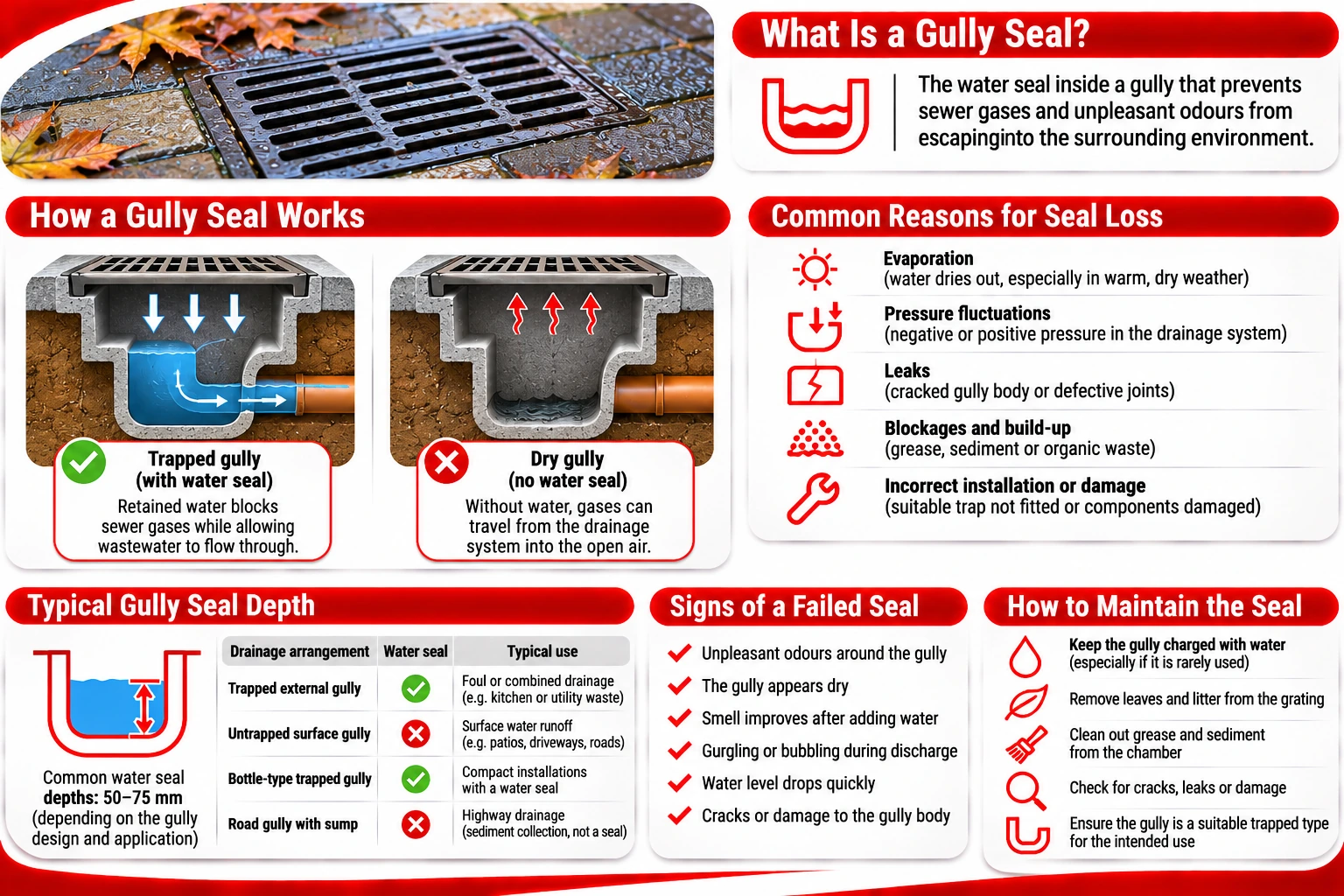
How Does a Gully Water Seal Work?
A gully seal operates on the same basic principle as the water trap beneath a sink or other sanitary appliance. The drainage fitting contains a shaped waterway that retains a quantity of water after the incoming flow has drained away. This retained water blocks the direct route between the drainage system and the atmosphere.
In a typical trapped gully, wastewater enters through the upper opening and passes into the gully body. The outlet arrangement forces the flow to travel through a submerged passage before reaching the connecting drain. When discharge stops, the water settles at a level determined by the internal trap geometry.
The retained water forms a barrier across the passage through which sewer gases would otherwise travel. Gas pressure must overcome or displace this water barrier before air can pass through the trap.
The essential parts of a trapped gully include:
-
Inlet opening. The point where wastewater or surface water enters the gully.
-
Gully body. The chamber that receives incoming water and contains the trap arrangement.
-
Water seal. The retained water that interrupts the air passage from the connected drain.
-
Trap weir or outlet geometry. The internal arrangement that determines the retained water level.
-
Outlet connection. The pipe carrying discharged water towards the drainage network.
-
Removable grating or cover. Where fitted, this provides access and may prevent larger debris entering the gully.
The grating and the water seal perform different functions. The grating helps prevent large objects from entering the drainage system, while the water seal prevents gases from travelling through the trapped waterway. A gully may have a grating without a water seal, or a water seal beneath a suitable inlet arrangement.
The depth of the water seal is an important design characteristic. It represents the effective vertical depth of water maintaining the barrier between the drainage atmosphere and the external opening. It should not be confused with the total depth of the gully chamber or the amount of water stored below the outlet.
For example, a gully chamber may contain water considerably deeper than the effective trap seal. Sediment can accumulate in the lower part of the chamber without necessarily increasing the seal depth.
The seal remains effective only while enough water is retained. Under normal operating conditions, incoming wastewater replenishes the water in the trap. However, evaporation, pressure fluctuations or physical defects can reduce the retained volume.
Gully Seal Depth and the Difference Between Trapped and Untrapped Gullies
The required water seal depth depends on the drainage fitting, its intended application and the relevant design requirements. A universal minimum should not be assumed for every external gully because different products and drainage arrangements have different specifications.
In UK sanitary drainage, 50 mm and 75 mm water seals are commonly encountered in suitable trap arrangements. However, these values should not be applied indiscriminately to all gullies. The correct depth must be established from the relevant product specification and drainage design.
A deeper water seal can provide greater resistance to pressure differences before the barrier is displaced. Nevertheless, the trap must also be correctly designed and installed to maintain adequate flow and allow cleaning.
The following table distinguishes common gully and trap arrangements.
| Drainage arrangement | Water seal present? | Main purpose | Important consideration |
|---|---|---|---|
| Trapped external waste gully | Yes | Receives suitable wastewater while preventing foul air escaping | Seal must remain charged with water |
| Untrapped surface water gully | No | Collects runoff and directs it into the drainage network | Odour protection depends on the wider system design |
| Bottle-type trapped gully | Yes | Provides a compact trapped waterway in suitable applications | Internal components may require cleaning |
| Traditional trapped yard gully | Yes | Receives external drainage flows through a water-sealed arrangement | Sediment and debris can accumulate in the chamber |
| Road gully with sediment sump | Not necessarily | Collects highway runoff and retains some sediment | A sump alone does not establish that the gully is trapped |
| Sanitary appliance trap | Yes | Prevents foul air entering a building through an appliance outlet | Different fitting from an external gully |
A sediment sump is sometimes mistaken for a water seal. A sump is a lower section of a gully where heavier material can settle before water leaves through the outlet. Although the sump may retain water, it does not necessarily create a hydraulic barrier across the route taken by gases.
The distinction depends on the internal flow path. If air can travel directly from the outlet pipe to the gully opening without passing through retained water, the arrangement is not functioning as a water-sealed trap.
The drainage network connected to the gully also matters. A gully discharging into a separate surface water system may have different requirements from one connected to a foul sewer. The presence of a trap should therefore be assessed as part of the complete drainage arrangement rather than as an isolated component.
Building Regulations Approved Document H provides guidance on drainage and waste disposal in England. Relevant British and European standards, including applicable parts of BS EN 12056 for gravity drainage systems inside buildings and BS EN 1253 for gullies in buildings, may also inform the design of particular installations. The precise requirements depend on the location and type of fitting, and not every external gully falls within the scope of the same standard.
Why Does a Gully Seal Fail or Lose Water?
A gully seal can stop functioning when the retained water falls below the level needed to maintain the hydraulic barrier. This is commonly described as loss of trap seal. The resulting opening allows air from the connected drainage system to pass through the gully, potentially carrying unpleasant odours.
One of the simplest causes is evaporation. Water gradually evaporates from an exposed gully, particularly during warm, dry weather. A gully that receives little or no regular discharge may lose enough water for the seal to become ineffective.
This is more likely where a gully serves an infrequently used outlet or receives seasonal drainage. A trapped gully connected to a frequently used kitchen waste pipe is normally replenished more often than one serving an outlet that remains unused for long periods.
Pressure fluctuations within the drainage system can also affect the seal. Negative pressure may draw water out of a trap, while positive pressure may force water towards the inlet. The effect depends on the trap design, available seal depth and the magnitude and duration of the pressure change.
Common causes of seal loss or failure include:
-
Evaporation. Water is gradually lost from a gully that receives little or no regular flow.
-
Siphonage. Negative pressure within the drainage system removes some of the retained water.
-
Back pressure. Positive pressure displaces water within the trap and may cause bubbling or seal disturbance.
-
Leakage. A cracked gully body or defective joint allows water to escape below the required seal level.
-
Incorrect installation. Unsuitable levels or an inappropriate fitting prevent the intended water seal from forming.
-
Blockage or heavy deposits. Accumulated material interferes with the trap waterway or contributes to abnormal drainage conditions.
-
Physical damage. Broken internal components or deterioration of the gully body compromise the trap arrangement.
Not all unpleasant smells around a gully indicate a failed water seal. Organic material trapped beneath a grating can decompose and produce odours even when the hydraulic barrier remains intact.
Grease, food waste and sediment may accumulate in the gully chamber, particularly where kitchen wastewater enters the drain. Bacterial decomposition of this material can create localised smells that are unrelated to gases escaping from the downstream sewer.
A blocked outlet may also produce foul-smelling standing wastewater. In this situation, the problem is not necessarily a loss of water seal. The gully may contain too much water because discharge is restricted.
The behaviour of the water level can help distinguish these conditions. A gully that repeatedly becomes dry may have a seal retention problem, whereas one that remains unusually full or overflows may have an obstruction farther downstream.
How to Identify a Failed Gully Seal
A failed gully seal is often suspected when unpleasant drainage odours are noticeable around an external gully, particularly after a period of dry weather or following discharge from connected appliances. However, smell alone is not sufficient to establish the cause.
The first step is to identify whether the gully is designed to contain a water seal. Some external drainage fittings are untrapped, so the absence of standing water does not automatically indicate a defect.
Where a trapped gully is present, the retained water level should be assessed in relation to its internal geometry. The inspection should also consider whether the gully contains sediment, grease or other material capable of producing localised odours.
Typical observations include:
-
The gully appears dry despite being designed as a trapped fitting.
-
Drainage odours become stronger after prolonged periods without water discharge.
-
The smell temporarily disappears after water is added to the gully.
-
The retained water level falls unusually quickly after replenishment.
-
Bubbling or gurgling occurs when connected appliances discharge.
-
Odours are accompanied by slow drainage, standing wastewater or overflow.
-
Cracks, displaced components or other visible defects are present in the gully body.
A simple replenishment check can provide useful information. Where it is safe and appropriate, clean water can be added to a suspected dry trap to restore the normal water level. If the odour subsequently disappears, loss of seal is a plausible explanation.
However, this does not establish why the seal was lost. If the problem returns quickly, further investigation may be required to distinguish evaporation from leakage or pressure-related seal depletion.
The timing of the problem can also be informative. Odours developing after several weeks of non-use may be consistent with evaporation, while seal loss immediately after a large discharge may suggest pressure effects within the drainage system.
A drainage engineer may inspect the gully construction, check the connected pipework and investigate abnormal pressure or flow conditions. CCTV inspection can be useful where structural defects or downstream restrictions are suspected, but it does not directly measure every cause of trap seal loss.
Where odours persist despite an apparently intact water seal, the investigation may need to extend beyond the gully. Nearby defective drains, leaking joints or other sources of foul air can produce similar symptoms.
Maintaining and Restoring a Gully Water Seal
Maintaining a gully seal involves keeping the trap charged with water, preventing excessive accumulation of waste and ensuring that the fitting remains structurally sound. The appropriate maintenance depends on the type of gully and how frequently it receives discharge.
For a trapped gully that is rarely used, periodic replenishment with clean water may help prevent evaporation-related seal loss. However, repeatedly adding water is not an adequate long-term solution where the trap is leaking or being emptied by abnormal pressure conditions.
The gully should also be kept reasonably clear of material that could interfere with the waterway. Leaves, sediment and grease can restrict discharge or create odours independently of the seal.
Practical maintenance measures include:
-
Checking that a trapped gully retains water during periods of normal use.
-
Replenishing infrequently used traps where evaporation is a recognised problem.
-
Removing accessible leaves and litter from the grating.
-
Arranging suitable cleaning when sediment or grease accumulates inside the chamber.
-
Investigating recurring gurgling, bubbling or rapid changes in water level.
-
Checking for visible cracks, displacement or deterioration of the gully body.
-
Repairing defective pipework or trap components where leakage is identified.
Cleaning should be carried out with regard to the gully’s construction. Some trapped gullies contain removable components, while others have integral water-seal arrangements that should not be dismantled without understanding how they operate.
After cleaning, the trap should be refilled to its normal operating level. Otherwise, the maintenance process itself may leave the water seal temporarily ineffective.
Where the gully body is cracked and leaking, replacement may be necessary. Repairing the visible surface without addressing the underlying defect may not restore reliable seal retention.
If pressure fluctuations repeatedly remove water from the trap, the connected drainage system may need to be assessed. The cause could involve ventilation arrangements, pipe configuration or other conditions affecting air pressure during discharge.
It is important not to assume that fitting a deeper trap will automatically resolve every pressure-related problem. The replacement must be suitable for the application, and the underlying drainage conditions should be considered.
Where a gully is connected to a foul or combined drainage system, persistent odours should be investigated rather than masked with cleaning chemicals or fragrances. Chemical products do not restore a missing hydraulic barrier or repair a damaged trap.
Gully Seal Problems Compared with Other Drainage Odours
External drainage odours can arise from several sources, and identifying the correct mechanism is essential before choosing a remedy. A failed water seal is only one possible explanation.
A dry trap typically allows air from the connected drainage system to escape through an otherwise open passage. By contrast, a dirty gully may produce odours from decomposing waste within the chamber itself.
A blocked gully may retain contaminated wastewater for longer than intended, creating smells alongside slow drainage or overflow. Structural damage can also allow foul air to escape from locations other than the gully opening.
The main differences can be summarised as follows:
| Problem | Typical condition | Likely investigation |
|---|---|---|
| Dry gully seal | Trapped gully contains insufficient water | Check evaporation, leakage and pressure effects |
| Dirty gully chamber | Water seal present but organic waste has accumulated | Inspect and clean chamber |
| Blocked gully outlet | Water level rises or discharge becomes restricted | Check outlet and connected drain |
| Damaged gully body | Cracks or defective joints may permit leakage | Assess structural condition and watertightness |
| Untrapped gully | No hydraulic barrier incorporated in the design | Confirm whether the arrangement is appropriate |
| Nearby drainage leak | Odours persist despite an intact gully seal | Investigate surrounding drainage pipework |
A gully seal should be understood as one part of a wider drainage system. Its performance depends on the trap geometry, retained water level and conditions within the connected pipework.
When the seal is intact, it provides a simple and effective barrier against foul air. When the seal is lost, identifying whether the cause is evaporation, leakage, pressure disturbance or an unsuitable installation is more useful than repeatedly treating the smell. Correctly designed, maintained and inspected trapped gullies help protect external areas from unpleasant drainage odours while allowing wastewater to discharge through the intended route.