
What is a Drain Access Point
A drain access point is a designated opening or fitting that allows a drainage system to be inspected, cleaned, tested or maintained without dismantling the surrounding pipework. Access points are essential in underground drainage because most pipes are buried beneath buildings, driveways, gardens or other surfaces. Without suitable access, even a relatively straightforward blockage may require unnecessary excavation or the removal of connected plumbing fixtures.
In UK drainage systems, access can be provided through inspection chambers, manholes, rodding eyes, access fittings and other purpose-designed openings. These components serve different functions and are not interchangeable in every situation. Their position, dimensions and construction depend on the drainage layout, pipe diameter, depth and intended maintenance method.
A properly designed drainage system should allow engineers to reach sections where blockages are likely to occur, investigate defects and carry out routine maintenance. However, an access point does not necessarily permit entry into the drainage system. Many openings are designed exclusively for inspection cameras, drain rods, jetting hoses or testing equipment.
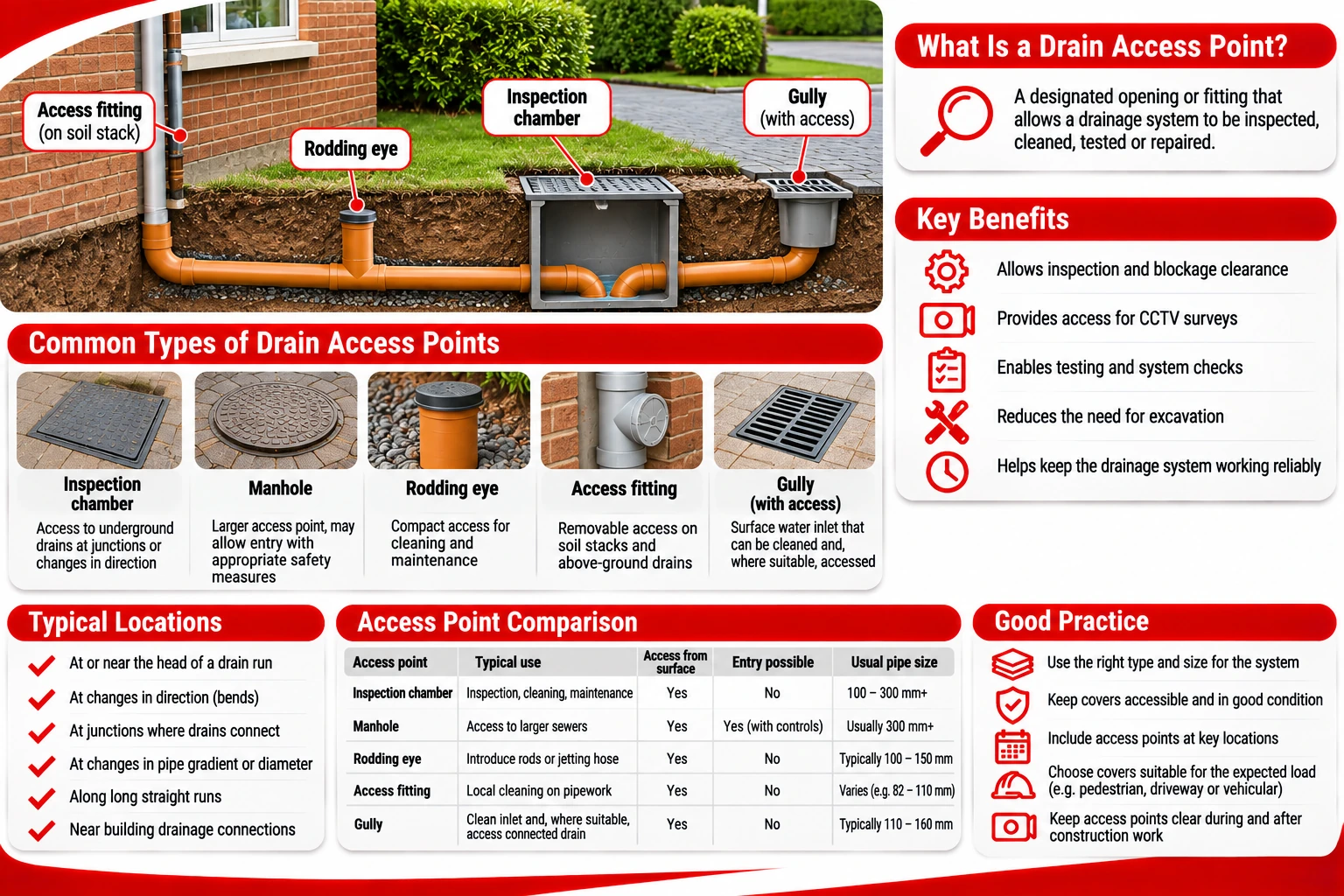
Types of Drain Access Points and Their Functions
The term drain access point describes a function rather than a single type of drainage component. Different access arrangements are used depending on whether the pipework is located inside a building, immediately outside it or within a larger underground drainage network.
An inspection chamber provides access to underground pipe connections through a removable cover. Smaller chambers are generally intended for inspection and maintenance from the surface, while larger manholes may be designed to accommodate personnel entry under appropriate safety arrangements.
Rodding eyes provide a more compact form of access. They are normally connected to a drain through a purpose-made fitting and allow cleaning equipment to be introduced into the pipe.
Access fittings are also incorporated into soil stacks and other above-ground drainage pipework. These usually have removable covers that allow maintenance without cutting into the pipe.
| Access point | Typical location | Main function | Important limitation |
|---|---|---|---|
| Inspection chamber | Underground drainage junctions and changes in layout | Inspection, cleaning and maintenance | Usually intended for work from the surface |
| Manhole | Larger or deeper drainage systems | Access to underground drains or sewers | Entry requires suitable confined-space controls |
| Rodding eye | Underground drain runs, often near bends or changes in direction | Introduction of drain rods or other suitable equipment | Provides limited visibility and working space |
| Access fitting | Soil stacks and above-ground drainage pipework | Local cleaning and inspection | Access is restricted by fitting dimensions |
| Cleaning eye | Selected pipe fittings and drainage arrangements | Removal of local obstructions | May not provide access in both directions |
| Gully with removable components | External drainage receiving surface water or wastewater | Cleaning the gully and, where suitable, access to connected pipework | The trap may prevent equipment reaching downstream pipes |
A gully should not automatically be treated as a full drain access point. Although removable gratings and traps allow the gully itself to be cleaned, the arrangement may not provide practical access to the connected underground drain.
Similarly, a manhole cover and an inspection chamber are not the same component. The cover closes the opening, while the chamber is the structure beneath it that provides access to the drainage system.
The choice of access point also affects the equipment that can be used. A small rodding eye may be suitable for introducing flexible cleaning rods, but it may not accommodate a larger CCTV camera or specialist cutting equipment.
For this reason, drainage access should be considered during system design rather than added only after maintenance problems arise.
Where Should Drain Access Points Be Installed?
Access points should be positioned so that the drainage system can be maintained effectively throughout its service life. Their location is influenced by the pipe layout, changes in direction, connections and the length of pipe between accessible openings.
In England, Approved Document H provides guidance on access arrangements for drainage systems. The applicable requirements depend on the type of access fitting, pipe diameter and drainage configuration. The guidance should be considered alongside relevant standards, building control requirements and manufacturer instructions.
Access is particularly important at locations where changes in the drainage layout can make cleaning or inspection more difficult.
Typical locations include:
-
At or near the head of a drain run, where suitable access is needed to clean downstream sections.
-
At changes in direction that cannot be adequately maintained from another access point.
-
At junctions where multiple drainage branches connect.
-
At changes in pipe gradient or diameter where the arrangement requires additional maintenance access.
-
Along extended straight runs where the distance between existing access points becomes excessive.
-
Near building drainage connections where access is needed for testing or future maintenance.
Not every bend or junction requires a separate chamber. Some changes can be served by an appropriately positioned rodding eye or another access point, provided the arrangement permits effective maintenance.
The distance between access points is not governed by one universal figure. UK guidance distinguishes between different types of access and drainage configurations, and the permissible spacing depends on those circumstances.
For example, a straight drain accessible from suitable chambers at both ends presents different maintenance conditions from a drain with several bends and only one small access fitting.
Access arrangements should also account for the direction in which cleaning equipment can travel. A fitting that permits rods to enter a downstream pipe may not provide equivalent access to an upstream branch.
When planning access, the designer should consider:
-
Whether the entire relevant pipe run can be inspected and cleaned using suitable equipment.
-
Whether bends and junctions create restrictions that cannot be reached from existing openings.
-
Whether the access point will remain available after landscaping, paving or construction.
-
Whether the cover and chamber are suitable for the expected surface loading.
-
Whether maintenance can be carried out safely without unnecessary entry into confined spaces.
Access points located beneath driveways or vehicle routes require appropriate covers and supporting structures. The cover selection must reflect the actual loading conditions rather than simply the depth of the drainage pipe.
Access must also remain practical after the property is completed. A chamber concealed beneath permanent flooring or an inaccessible structure may technically exist but provide little benefit when a blockage occurs.
How Drain Access Points Are Used for Inspection, Cleaning and Testing
A drain access point allows maintenance equipment to enter the drainage system without excavating the pipe. The procedure depends on the type of access, the condition of the drainage system and the problem being investigated.
For blockage removal, an engineer may open an inspection chamber to determine whether wastewater is backing up upstream of a restriction. The observed water level can help identify which section requires investigation.
If the chamber is full while a downstream chamber remains clear, the obstruction may lie between the two access points. This observation is useful but not conclusive, because connected branches, flow conditions and other restrictions can affect water levels.
Drain rods can be introduced through suitable access fittings to dislodge certain localised obstructions. High-pressure water jetting equipment may also be introduced through a chamber or other appropriate opening.
CCTV inspection uses access points to introduce a camera into the drainage system. Depending on the equipment and pipe configuration, the engineer may inspect the pipe in one or both directions.
Common activities supported by drain access points include:
-
Blockage clearance using rods, jetting equipment or other suitable tools.
-
CCTV surveys to identify cracks, displaced joints, root intrusion and sediment deposits.
-
Drainage testing using appropriate plugs and testing equipment.
-
Removal of accumulated material from chambers and accessible pipe sections.
-
Investigation of suspected misconnections or defective junctions.
-
Inspection of completed repairs and newly installed drainage sections.
Access points are particularly valuable when problems occur repeatedly. If the same section becomes blocked several times, a CCTV survey can help establish whether the cause is a structural defect, inadequate gradient, root intrusion or material entering the system.
Testing is another important function. During construction or investigation, suitable access openings may be used to isolate sections of drainage pipework for air or water testing, subject to the relevant procedure.
However, not every access fitting is suitable for every testing method. The fitting must allow the equipment to be installed correctly and must withstand the conditions involved.
Access points can also support certain trenchless repair operations. For example, some pipe lining systems can be installed through existing chambers, although the available opening, pipe geometry and repair equipment determine whether this is feasible.
A small access point does not guarantee that a damaged section can be repaired without excavation. Large equipment, severe pipe deformation or inaccessible junctions may make additional access necessary.
Design, Construction and Safety Requirements
The performance of a drain access point depends on more than its position. Its dimensions, cover, seals, structural support and connection to the drainage system must all be appropriate for the installation.
Inspection chambers may be manufactured from plastic or constructed using other suitable materials. The selected system must be compatible with the drainage pipework and the expected installation conditions.
Chamber bases should provide suitable channels for wastewater to pass through without unnecessary obstruction. Poorly formed channels can encourage sediment accumulation or create areas where solids become trapped.
Important construction considerations include:
-
Watertight connections between the chamber and adjoining pipes.
-
Suitable chamber dimensions for the intended maintenance activities.
-
Appropriate cover strength for pedestrian, landscaped or trafficked areas.
-
Correct installation depth and surrounding support.
-
Secure, accessible covers that can be removed using suitable equipment.
-
Protection against unwanted surface water or groundwater entry where required.
Cover classifications are commonly considered with reference to BS EN 124, which addresses covers and gratings for vehicular and pedestrian areas. The appropriate class depends on the installation location and expected loading.
An access cover in a private garden will generally experience different loads from one located in a road or heavily trafficked commercial yard. The complete installation, including the frame and supporting structure, must be suitable for those conditions.
Safety is particularly important when dealing with underground chambers. Drainage systems may contain hazardous atmospheres, including oxygen-deficient air, hydrogen sulphide or flammable gases.
Opening a cover does not make the chamber safe to enter. Entry into a manhole or other confined space may require a formal risk assessment, atmospheric monitoring, ventilation, rescue arrangements and personnel trained for the work.
For ordinary domestic drainage maintenance, inspection and cleaning should normally be carried out from the surface wherever practicable.
There is also a risk of sudden wastewater movement when a blockage is released. Engineers must account for the possibility of stored wastewater discharging rapidly through an access opening.
Members of the public should not enter drainage chambers or attempt to remove heavy covers without appropriate equipment and precautions.
Common Access Problems and How to Prevent Them
A drainage system may contain correctly positioned access points that become difficult or impossible to use over time. This often happens after property alterations, resurfacing or landscaping.
One common problem is a buried inspection chamber. A driveway may be resurfaced or a garden redesigned without preserving the position of the chamber cover.
When a blockage occurs, the engineer must first locate the concealed opening. This can increase the time and cost of maintenance and may require removal of paving or other finishes.
Other access-related problems include:
-
Covers that have become seized, damaged or difficult to lift.
-
Chambers obstructed by soil, vegetation or accumulated debris.
-
Broken chamber channels that interfere with wastewater flow.
-
Poorly sealed covers allowing unwanted water or debris to enter.
-
Access fittings installed in locations that are difficult to reach.
-
Inadequate access to sections containing multiple bends or junctions.
Routine maintenance should include checking that accessible covers remain visible and usable. Damaged frames, defective seals and unstable chamber structures should be investigated before they develop into more serious problems.
When extending a property or altering external surfaces, existing drainage access should be identified before construction begins. Any proposed relocation or modification must preserve suitable access to the drainage system and comply with the applicable requirements.
A CCTV survey can sometimes help locate a concealed chamber or establish the arrangement of underground drainage connections. Camera equipment with a suitable sonde can assist in identifying the approximate position of an accessible pipe section from the surface.
However, locating equipment does not replace accurate drainage records or guarantee that every buried structure will be identified.
A well-positioned drain access point can substantially reduce the disruption associated with drainage maintenance. Its main value lies in allowing engineers to inspect and maintain pipework that would otherwise be difficult to reach. Effective drainage design therefore requires not only correctly sized pipes and suitable gradients, but also reliable access that remains available throughout the system’s working life.