
What is a Drain Excavation Repair
Drain excavation repair is a method of repairing damaged underground drainage pipes by digging through the ground to expose the affected section. Also known as open-cut drain repair, it allows engineers to inspect the pipe directly, remove damaged components and install replacement pipework where necessary. The method is commonly used when a drain has collapsed, suffered severe structural damage or cannot be repaired effectively using trenchless techniques.
Unlike drain lining, which rehabilitates a pipe from the inside, excavation provides physical access to the pipe and the surrounding ground. This makes it possible to correct problems involving pipe alignment, inadequate bedding, displaced joints and significant deformation. However, excavation also disturbs the surface above the drain, so the extent of the work must be carefully planned to avoid unnecessary disruption and damage to nearby structures or underground services.
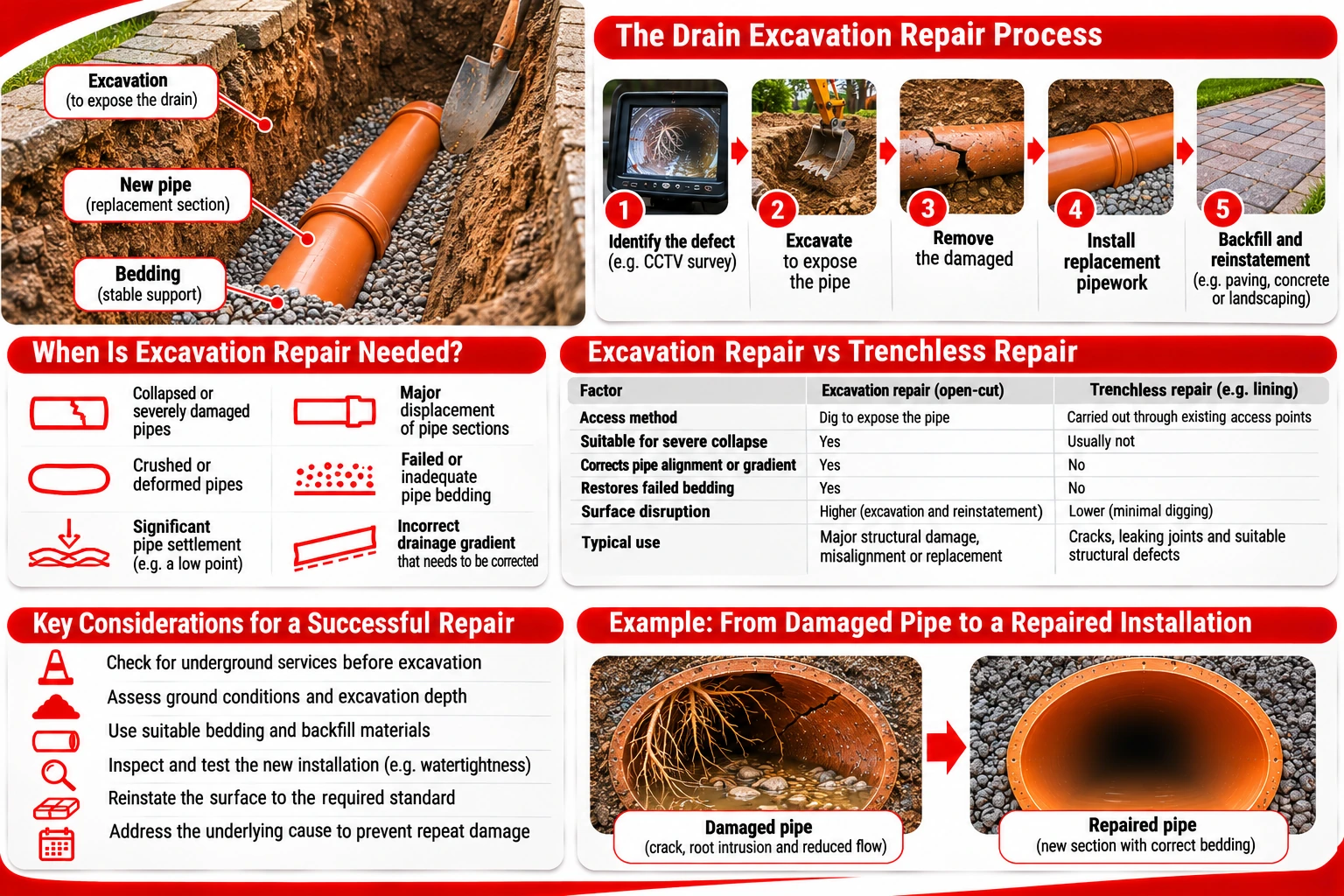
When Is Drain Excavation Repair Necessary?
Excavation is generally considered when a drainage defect cannot be resolved reliably through cleaning, localised internal repair or pipe lining. The decision depends on the severity of the damage, the pipe’s location, accessibility and whether the existing structure can support a suitable rehabilitation method.
A pipe does not need to be completely collapsed before excavation becomes necessary. Some defects involve the surrounding ground or pipe alignment, which cannot be corrected by installing a liner inside the existing pipe.
Typical situations where excavation may be required include:
-
Collapsed drainage pipes. Broken or displaced sections have significantly reduced or completely obstructed the internal opening.
-
Severely crushed pipes. External loading has compressed the pipe beyond a condition suitable for internal rehabilitation.
-
Major pipe displacement. Adjacent sections have moved sufficiently to prevent a reliable connection or maintain an acceptable flow path.
-
Significant pipe settlement. A section has developed an unacceptable low point that retains wastewater and sediment.
-
Extensive fractures. The pipe has lost structural integrity, with sections potentially moving or separating.
-
Failed pipe bedding. The surrounding support has deteriorated or was incorrectly installed, contributing to repeated structural problems.
-
Incorrect drainage gradients. A section requires repositioning to restore an appropriate fall.
-
Damaged junctions. A connection requires reconstruction because of severe displacement, breakage or unsuitable installation.
Excavation may also be necessary when an underground drain must be diverted to accommodate building works. In that situation, the work involves altering the drainage layout rather than simply repairing an existing defect.
Not every crack or displaced joint requires excavation. Certain localised defects can be repaired internally, provided the host pipe remains suitable and the selected method meets the required performance criteria.
For example, a small fracture in an otherwise stable pipe may be suitable for a localised liner. By contrast, a pipe that has collapsed and lost most of its internal clearance may not allow lining equipment to pass through or provide a suitable shape for rehabilitation.
The condition of the surrounding ground is another important factor. If soil is entering through a damaged pipe and leaving voids around it, replacing the pipe alone may not be sufficient. The excavation must also allow the ground support and bedding to be assessed and reinstated appropriately.
How Is an Excavated Drain Repair Carried Out?
An excavation repair normally involves locating the defect, planning safe access, exposing the pipe, completing the repair and reinstating the disturbed ground. The exact sequence depends on the excavation depth, ground conditions, pipe material and surrounding structures.
Before excavation begins, the affected section should be located as accurately as practicable. CCTV inspection can identify the approximate position of a defect, while a camera sonde and compatible locator may help establish its position from the surface.
However, CCTV distance readings and sonde locations are not substitutes for identifying other buried services. Existing utility records, appropriate detection equipment and safe excavation practices are required before ground is broken.
A typical drain excavation repair follows these stages:
-
Initial investigation. Establish the type and approximate location of the defect and determine whether excavation is necessary.
-
Site assessment. Identify underground services, nearby foundations, access restrictions and potential ground instability.
-
Excavation planning. Determine the excavation dimensions, required ground support and arrangements for managing wastewater.
-
Surface removal. Carefully remove paving, concrete, landscaping or other materials above the affected section.
-
Pipe exposure. Excavate around the drain while protecting adjacent pipework and maintaining excavation stability.
-
Removal of damaged material. Cut out or disconnect the defective section using methods appropriate to the pipe material.
-
Pipe installation. Fit replacement pipework with suitable joints, alignment, gradient and bedding.
-
Inspection and testing. Check the completed installation using the appropriate testing and inspection procedures.
-
Backfilling and reinstatement. Restore the surrounding support, compact backfill as specified and reinstate the surface.
The damaged pipe should be exposed sufficiently to assess the condition of the adjoining sections. If the visible damage extends beyond the original repair area, the excavation may need to be enlarged.
Replacement pipework must be compatible with the existing drainage system. Where different materials are connected, suitable proprietary couplings may be required to provide an effective joint.
The pipe should be installed on a prepared bed that provides uniform support. Localised hard points, unsupported joints and unsuitable backfill can create concentrated loads that contribute to future damage.
The excavation should not be backfilled until the relevant checks have been completed. Depending on the installation, these may include visual inspection, appropriate air or water testing and verification of the pipe’s alignment.
Excavation Repair vs Trenchless Drain Repair
Excavation and trenchless rehabilitation address different types of drainage problems. Neither method is universally preferable, and the most appropriate solution depends on the structural condition of the existing pipe.
Trenchless methods, such as cured-in-place pipe lining, can rehabilitate suitable damaged drains through existing access points. They often reduce the need to disturb driveways, gardens and other surfaces.
Excavation provides direct access to the pipe and surrounding ground. It can therefore address defects that internal rehabilitation cannot correct, including severe collapse, major misalignment and failed bedding.
| Factor | Excavation repair | Trenchless repair |
|---|---|---|
| Access method | Ground is opened to expose the pipe | Usually performed through existing or purpose-made access points |
| Severe pipe collapse | Allows damaged sections to be removed and replaced | Often unsuitable where equipment cannot pass or the pipe has lost its required geometry |
| Incorrect pipe gradient | Allows the pipe to be repositioned | Generally does not correct the original gradient |
| Damaged bedding | Can be removed and reconstructed | Does not directly restore external pipe support |
| Surface disruption | Requires excavation and reinstatement | Usually involves less surface disturbance |
| Pipe condition requirements | Damaged pipework can be removed | Suitability depends on the existing pipe and rehabilitation system |
| Repair extent | Can replace individual sections or longer runs | Can rehabilitate selected local defects or suitable pipe lengths |
| Main practical constraint | Excavation access, ground conditions and nearby structures | Internal access, pipe geometry and rehabilitation suitability |
A trenchless repair may be appropriate where the pipe remains sufficiently open and stable for the chosen system. For example, certain cracks or leaking joints can be rehabilitated without replacing the entire pipe.
Excavation is more appropriate where the physical position or shape of the pipe must change. Installing a liner inside a drain with a significant sag will generally preserve the existing low point rather than correct it.
The total cost also depends on site conditions. A short excavation in an accessible garden may be relatively straightforward, while a repair beneath reinforced concrete, a public highway or close to foundations can involve substantially more work.
Consequently, repair selection should be based on the defect and site constraints rather than assuming that either method is always cheaper or more durable.
Excavation Depth, Ground Conditions and Safety
Drain excavation involves significant risks because underground pipes are often located near foundations, buried utilities and unstable ground. The depth of the excavation is important, but it is not the only factor determining whether the work can be carried out safely.
Even relatively shallow excavations can collapse where the soil is unstable, saturated or affected by nearby loading. Suitable protective measures must be determined through an assessment of the actual conditions.
Important considerations include:
-
Ground stability. Soil type, moisture content, previous disturbance and nearby loading affect the risk of collapse.
-
Excavation support. Trench boxes, shoring or suitably designed battered sides may be necessary.
-
Underground services. Gas, electricity, water and telecommunications infrastructure must be identified and protected.
-
Nearby foundations. Excavation can remove support from adjacent structures if the work is not properly designed.
-
Groundwater. Water entering the excavation can destabilise the sides and interfere with pipe installation.
-
Wastewater management. Flow through the affected drain may need to be controlled or temporarily diverted.
-
Plant and equipment. Excavators and stored materials must be positioned to avoid unsafe loading near excavation edges.
-
Public access. Barriers and other controls may be needed to protect occupants, pedestrians and vehicles.
There is no universal excavation depth below which unsupported trench work is automatically safe. The need for support depends on the ground conditions, excavation geometry and other hazards.
In the UK, excavation work is subject to applicable health and safety legislation, including requirements under the Construction (Design and Management) Regulations 2015 where relevant. Contractors must plan the work and provide suitable controls for foreseeable risks.
Excavation near a building may require additional assessment to establish whether foundations could be affected. This is particularly important where the damaged drain runs beneath or immediately alongside a load-bearing structure.
If contaminated wastewater or sewage is present, workers must also consider biological hazards and appropriate hygiene precautions.
These requirements are a major reason why underground drain excavation should be undertaken by competent contractors with suitable equipment and experience.
What Affects the Cost and Duration of Drain Excavation Repair?
The cost of excavation repair depends on the amount of ground that must be opened, the complexity of the repair and the work required to restore the site afterwards.
The length of damaged pipe is only one part of the calculation. A short repair beneath a heavily trafficked road can be more complicated than replacing a longer section in an accessible garden.
The main cost factors include:
-
Excavation depth. Deeper repairs generally require more excavation, additional safety measures and greater quantities of backfill.
-
Surface material. Removing and reinstating concrete, asphalt, block paving or specialist finishes can increase costs.
-
Ground conditions. Rock, unstable soil and groundwater may require additional equipment or protective measures.
-
Access restrictions. Narrow passages, enclosed gardens and locations unsuitable for machinery can increase manual labour.
-
Pipe diameter and material. Larger or specialised pipework may require different fittings, equipment and installation methods.
-
Repair length. Replacing several metres of drainage pipe generally involves more materials and excavation than a short local repair.
-
Nearby services and structures. Additional precautions may be necessary where the excavation approaches foundations or other buried utilities.
-
Permits and traffic management. Work affecting public highways or other controlled areas may require approvals and additional site arrangements.
Surface reinstatement can represent a substantial proportion of the overall work. For example, restoring decorative paving or reinforced concrete may require more labour and materials than reinstating a landscaped area.
The duration is similarly variable. A straightforward, shallow repair with good access may be completed within a working day, but this should not be treated as a standard timeframe.
Deeper excavations, difficult ground conditions, extensive pipe replacement and complex reinstatement may extend the work over several days or longer.
Unexpected conditions can also affect the programme. Once the pipe is exposed, additional damage or unsuitable bedding may become visible, requiring changes to the original repair scope.
A reliable quotation should therefore distinguish between the pipe repair itself, excavation, waste removal, backfilling and surface reinstatement. It should also explain how unforeseen underground conditions will be handled.
Testing and Reinstatement After an Excavated Drain Repair
Completing the pipe connection is not the final stage of an excavation repair. The replacement section must be checked, properly supported and reinstated so that the drainage system can continue operating under the expected loads.
The appropriate inspection and testing arrangements depend on the pipework and project requirements. BS EN 1610 provides relevant requirements for the construction and testing of drains and sewers.
Checks may include:
-
Confirming that replacement pipes are correctly aligned and supported.
-
Inspecting joints and connections before they are covered.
-
Checking that the intended gradient has been maintained.
-
Carrying out suitable leakage testing where required.
-
Confirming that wastewater can pass through the repaired section.
-
Completing a CCTV inspection where appropriate to verify the internal condition and connections.
Backfilling should use materials and compaction methods suitable for the pipe and surrounding ground. Particular care is required around the pipe sides because inadequate support can allow flexible pipes to deform under external loading.
The bedding and initial backfill should be installed in accordance with the relevant specification and manufacturer requirements. Large stones or unsuitable material should not be placed where they could damage the pipe.
The final surface must also be reinstated appropriately. In a driveway, this means considering the expected vehicle loading and the construction of the original surface. In landscaped areas, reinstatement should account for settlement and the restoration of the ground profile.
Where a drain has failed because of ground movement, poor bedding or excessive loading, these causes should be addressed during the repair. Otherwise, replacing the damaged section without correcting the surrounding conditions may lead to further problems.
Drain excavation repair remains an important method for restoring underground drainage systems when structural damage cannot be addressed effectively from inside the pipe. Its principal advantage is direct access to both the defective pipework and its supporting ground, allowing damaged sections to be replaced and installation defects corrected. A successful repair depends on accurate diagnosis, safe excavation, suitable replacement materials, appropriate testing and careful reinstatement.