
What is a Drain Flow Test
A drain flow test is a practical assessment of how water moves through a drainage system. It involves introducing a controlled or observable quantity of water into a drain and checking whether it passes through the connected pipework and reaches the expected discharge point. The test can help identify restrictions, poor drainage performance, standing water and possible problems with pipe alignment.
Drain flow testing is commonly used when investigating slow drainage, recurring blockages, suspected misconnections or the performance of newly installed or repaired pipework. However, a flow test is not the same as a watertightness test. Water passing successfully through a drain does not prove that the pipe is free from leaks, and an abnormal flow result does not establish the exact location or cause of a defect without further investigation.
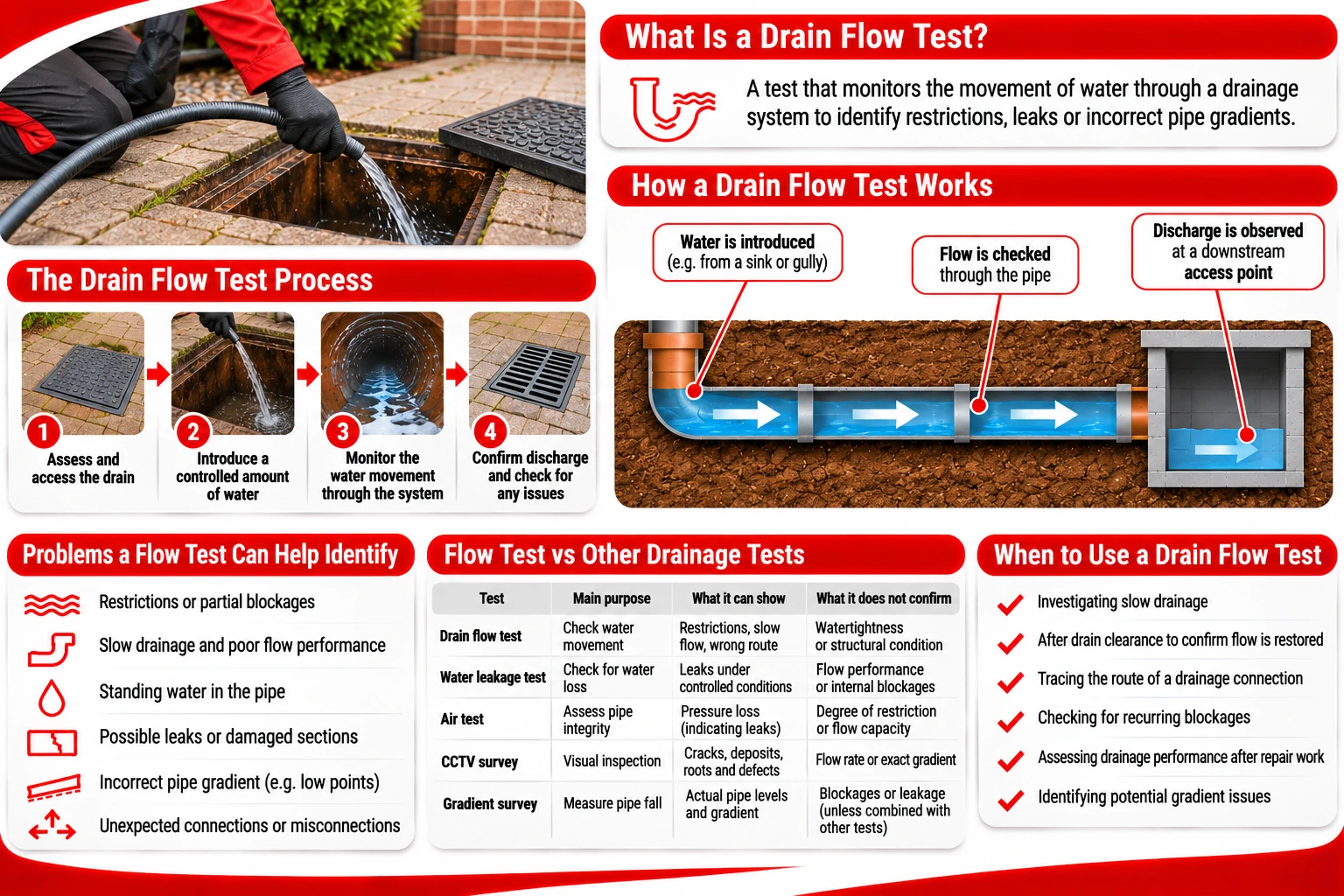
How Does a Drain Flow Test Work?
Most domestic underground drainage systems in the UK operate by gravity. Wastewater flows from appliances and sanitary fittings into branch pipes before entering underground drains and, ultimately, an appropriate sewer or other drainage destination.
The movement of water depends on several factors, including pipe gradient, internal diameter, surface roughness, the volume of discharge and the presence of restrictions. A drain flow test provides an indication of how these factors affect the system under the conditions being tested.
In a basic test, water is introduced at an upstream point while an engineer observes its movement at a downstream inspection chamber or other suitable access point. The engineer checks whether the water arrives, whether discharge appears satisfactory and whether any unusual backing-up occurs.
The procedure may also involve observing how quickly water levels fall after discharge stops. Persistent standing water or slow recovery can suggest a restriction, an unsuitable gradient or a low point in the pipe.
A typical flow assessment considers:
-
Water entry point. The fixture, gully or access point where water is introduced.
-
Expected flow route. The drainage branch and downstream connection through which the water should travel.
-
Discharge response. Whether water reaches the expected inspection point and flows away satisfactorily.
-
Water level changes. Whether the system backs up, surcharges or retains water after the test.
-
Flow consistency. Whether discharge is continuous or interrupted by apparent restrictions.
-
Unexpected discharge. Whether water appears at an unintended outlet, chamber or connection.
The quantity of water introduced should be appropriate for the pipework and the purpose of the test. A small discharge may pass through a partially obstructed pipe without revealing a problem that becomes apparent under greater loading.
Equally, introducing an excessive volume of water into a system already showing signs of blockage can cause wastewater to back up or overflow. The test should therefore be planned according to the drainage conditions.
A drain flow test does not always involve specialised measuring equipment. For routine domestic investigations, direct observation may be sufficient to establish whether water is reaching the intended downstream point.
More detailed assessments can involve measured flow rates, timed discharge observations or monitoring equipment. These methods provide additional information where the objective is to quantify drainage performance rather than simply confirm the direction and continuity of flow.
What Problems Can a Drain Flow Test Identify?
A flow test is most useful for identifying abnormal drainage behaviour. It can show that water is not travelling through the system as expected, but the result usually needs to be interpreted alongside the drainage layout and other observations.
For example, a slow-draining sink may be caused by an obstruction in the appliance trap, a branch waste pipe or the underground drain. Testing the system at different points can help narrow down the affected section.
Similarly, water accumulating in an inspection chamber may indicate a downstream restriction. However, the observation alone does not establish whether the cause is grease, roots, sediment or structural damage.
| Flow test observation | Possible explanation | Further investigation |
|---|---|---|
| Water drains slowly from one fixture | Local blockage or restriction in the waste pipe | Inspect the trap and branch pipe |
| Several fixtures discharge poorly | Restriction in a shared downstream section | Check accessible chambers and connected drains |
| Water backs up into an upstream chamber | Downstream obstruction or inadequate discharge capacity | Inspect the affected drain section |
| Water remains in a pipe after discharge | Localised sag, poor gradient or downstream restriction | CCTV inspection and, where necessary, level surveying |
| Water appears at an unexpected outlet | Possible misconnection or incorrectly understood drainage layout | Trace connections and confirm discharge destination |
| Water is visible escaping from an accessible defect | Possible pipe or joint leakage | Investigate the defect and carry out appropriate leakage testing |
| Flow improves after cleaning | Removed deposits were restricting discharge | Assess whether recurring accumulation has an underlying cause |
One important application is the investigation of recurring blockages. A drain may operate adequately during small discharges but struggle when several appliances are used together.
A flow test can help demonstrate this behaviour, although it cannot reproduce every possible operating condition. The result depends on the volume of water introduced and the state of the system at the time.
Flow testing can also assist with drainage connection investigations. Where several pipes enter an inspection chamber, introducing water from a known fixture may help identify which connection serves that fixture.
This can be useful in older properties where drainage records are incomplete. However, tracing the flow route does not automatically confirm that the final discharge destination is correct.
A suspected connection between foul and surface water drainage may require more systematic tracing, including dye testing and inspection of downstream infrastructure.
How Is a Drain Flow Test Carried Out?
The procedure depends on whether the objective is to investigate an existing drainage problem, verify a repair or establish how different parts of a system are connected.
Before introducing water, the engineer should identify suitable access points and consider the risk of backing up wastewater. Existing blockages, overflowing chambers or damaged pipework may make a conventional flow test inappropriate until the immediate problem has been addressed.
For a typical gravity drainage investigation, the process may involve the following stages:
-
Establish the drainage layout. Identify the relevant fixtures, branches, inspection chambers and expected direction of flow.
-
Inspect accessible points. Check for standing water, visible deposits, existing surcharge or other signs of restriction.
-
Select a test location. Choose an upstream point from which water can be introduced safely.
-
Introduce water. Discharge a suitable quantity while monitoring the system.
-
Observe downstream movement. Check whether water reaches the expected location and whether its passage appears restricted.
-
Monitor water levels. Note any backing-up, delayed discharge or water remaining after the flow stops.
-
Repeat where necessary. Test another branch or access point to help isolate the affected section.
-
Record the findings. Document the observations and identify whether further inspection or testing is required.
Where the system contains several branches, testing them separately can help identify which section is responsible for a problem.
For example, if water introduced from one fixture reaches a downstream chamber normally but discharge from another fixture is delayed, the restriction may lie within the second fixture’s branch. This is a diagnostic indication rather than conclusive proof.
Engineers may also use coloured water or a suitable drainage tracing dye when the purpose is to establish a connection. The dye makes the introduced water easier to distinguish from existing wastewater.
Dye tracing is particularly useful where multiple connections enter a chamber or where the route between two drainage points is uncertain. The dye and quantity used must be appropriate for the drainage system and receiving environment.
A flow test should not involve releasing contaminated water onto surrounding ground or into an inappropriate drainage system. Any testing method must account for the actual discharge arrangements.
Drain Flow Test vs Drainage Leakage and Air Testing
Drain flow testing is sometimes confused with other drainage tests because they all involve checking pipework performance. However, they assess different properties and cannot automatically replace one another.
A flow test primarily examines the movement of water through the system. It can reveal restrictions, unexpected flow routes and some visible discharge problems.
A leakage test assesses whether a drainage section is sufficiently watertight under specified test conditions. Depending on the procedure, this may involve water or air testing.
For example, a drain may discharge water freely while allowing wastewater to escape through a defective joint. The pipe has satisfactory apparent flow but may fail an appropriate watertightness assessment.
Conversely, a pipe may pass a leakage test while containing a significant obstruction that affects its operational performance. Watertightness does not guarantee adequate hydraulic capacity.
The main distinctions are:
-
Drain flow test. Assesses whether water travels through the intended route and discharges satisfactorily under the conditions tested.
-
Water leakage test. Uses a specified testing procedure to assess leakage from or into an isolated section of pipework.
-
Air test. Uses controlled air pressure and an appropriate procedure to assess the integrity of a drainage section.
-
CCTV drain survey. Provides visual information about internal pipe condition, connections and obstructions.
-
Gradient survey. Measures pipe levels to establish the actual fall and identify alignment problems.
These methods can complement one another. A flow test may indicate that a section is performing poorly, while CCTV identifies an obstruction and level measurements establish whether the gradient contributes to the problem.
In the UK, BS EN 1610 provides requirements for the construction and testing of drains and sewers. Relevant building regulations guidance, project specifications and applicable standards must also be considered when testing new drainage installations.
A basic observational flow test should not be described as certification that an installation meets all applicable drainage testing requirements.
Similarly, the absence of visible leakage during a short discharge test is not evidence that every joint is watertight. Small leaks may remain undetected without a suitable test.
What Affects Drain Flow Test Results?
The interpretation of a flow test depends on the conditions under which it is performed. Water volume, pipe geometry, existing deposits and downstream water levels can all influence the observed result.
A drainage system does not necessarily operate at a constant flow rate. Domestic wastewater discharge is intermittent, with short periods of higher flow when toilets, baths or appliances empty.
Surface water drainage is even more variable because flow depends on rainfall intensity, the area contributing runoff and the condition of downstream infrastructure.
Several factors can affect the reliability of a flow test:
-
Discharge volume. A small amount of water may not reveal a restriction that becomes significant during higher flows.
-
Pipe gradient. Insufficient fall can reduce the ability of water to transport solids, although gradient alone does not determine flow performance.
-
Internal deposits. Grease, sediment and debris can reduce the available cross-sectional area.
-
Pipe deformation. Severe distortion may restrict the movement of water and solids.
-
Downstream conditions. A surcharged sewer or flooded outlet can prevent normal discharge even when the upstream pipe is unobstructed.
-
Ventilation and trap conditions. Air movement and local plumbing arrangements can affect the behaviour of individual fixtures.
-
Test duration. A brief observation may not reveal problems that develop during sustained discharge.
The relationship between pipe gradient and flow is particularly important. Gravity drainage relies on an appropriate fall, but a visual flow test cannot accurately establish the gradient of a buried pipe.
For example, water may appear to discharge satisfactorily through a short section even if the gradient is less than intended. Conversely, slow movement may result from a downstream restriction rather than an incorrectly installed pipe.
Where gradient is a concern, the pipe levels should be measured using suitable surveying methods. CCTV observations can provide supporting evidence, especially when standing water is visible, but they do not replace level measurements.
Flow testing also has limitations when investigating leaks. If water escapes through a damaged underground joint, the loss may be too small to identify through ordinary discharge observation.
A more specific leakage test or targeted investigation may therefore be required where water loss, groundwater infiltration or soil erosion is suspected.
When Should a Drain Flow Test Be Used?
Drain flow testing is useful when the main question concerns whether water can move through a drainage system as intended. It can provide an initial assessment before more detailed investigation or help confirm that a known obstruction has been removed.
Common situations include:
-
Investigating slow drainage affecting one or more fixtures.
-
Checking whether a cleared drain now discharges satisfactorily.
-
Identifying the likely route of a drainage connection.
-
Investigating repeated wastewater backing-up.
-
Assessing suspected restrictions between inspection chambers.
-
Checking drainage performance after selected repair works.
-
Supporting investigations into standing water or suspected poor gradients.
After drain clearance, a controlled discharge can help verify that the immediate obstruction has been removed. However, restoring flow does not establish that the pipe is structurally sound or that the blockage will not return.
Following excavation or replacement of underground drainage, flow verification may form part of the completion checks. It should be carried out alongside any required inspection and formal testing rather than used as a substitute.
For recurring drainage problems, the most useful result is often the identification of the section requiring further attention. A flow test may indicate where water movement becomes restricted, allowing CCTV inspection or other investigation to be targeted more effectively.
The method is less suitable when the drainage system is already completely surcharged or when additional discharge could cause sewage to overflow. In these circumstances, the immediate restriction or downstream condition should be addressed before introducing further water.
A drain flow test is therefore a practical diagnostic tool rather than a comprehensive assessment of pipe condition. It helps establish whether water follows the expected route and discharges satisfactorily, while abnormal observations can guide more detailed investigation. For reliable conclusions, the results must be considered alongside the drainage layout, operating conditions and any supporting inspection or testing evidence.