
What is a Drainage Defect Classification
Drainage defect classification is the systematic process of identifying, recording and categorising faults within drains and sewers according to their characteristics, location and significance. It is most commonly associated with CCTV drain surveys, where an engineer examines the internal condition of a pipeline and records visible defects using recognised inspection terminology. The resulting classification helps distinguish structural damage from operational problems and provides a consistent basis for evaluating the condition of a drainage system.
In the UK, drainage defect recording is commonly based on BS EN 13508-2, which establishes a coding framework for visual inspection of drains and sewers outside buildings. Industry assessment methods can use these observations to produce condition grades, prioritise maintenance and identify sections requiring further investigation or repair. However, a defect code, a numerical condition grade and an engineering recommendation are not the same thing. Each represents a different stage in interpreting the inspection findings.
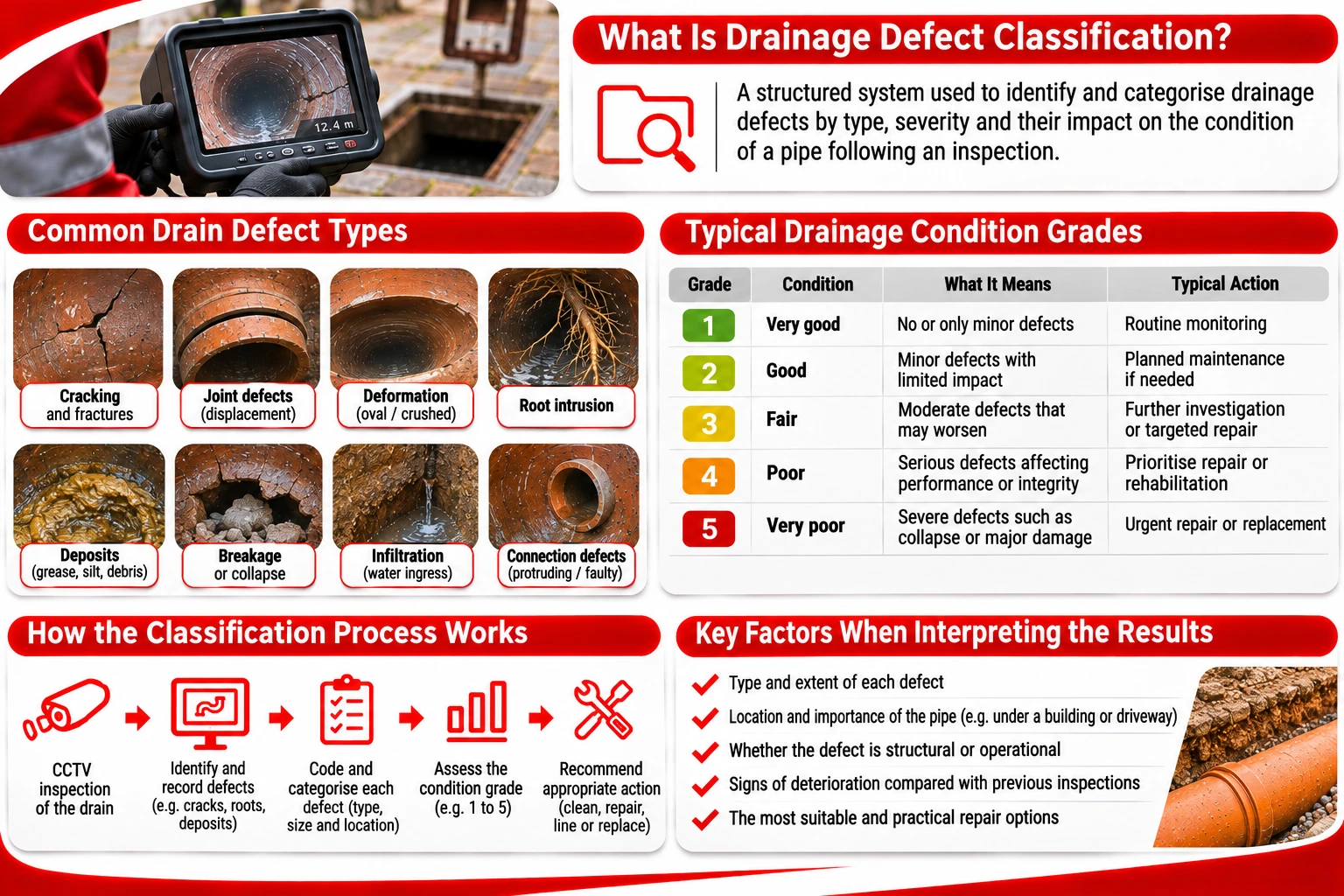
How Are Drainage Defects Classified During CCTV Inspections?
A drainage defect classification begins with a visual observation. The surveyor identifies an abnormal condition, records its position and describes it using the appropriate defect category and supporting information. This creates a structured record that can be reviewed and compared with subsequent inspections.
The inspection may identify cracks, fractures, displaced joints, deformation, root intrusion, sediment deposits or other conditions affecting the pipeline. Some observations relate to the physical structure of the pipe, while others describe materials or restrictions within it.
A useful distinction is between structural defects and service-related or operational defects. Structural defects concern the integrity and geometry of the pipe itself. Operational defects concern conditions that interfere with its ability to convey wastewater or surface water, although they may also be associated with structural damage.
The main categories include:
-
Structural cracking and fractures. Damage to the pipe wall, including longitudinal cracks, circumferential cracks and more extensive fractures.
-
Pipe deformation. Changes in the original cross-sectional shape, particularly in flexible pipe materials.
-
Joint defects. Displacement, separation or other abnormalities affecting connections between pipe sections.
-
Pipe breakage and collapse. Severe damage involving loss of pipe wall integrity or substantial obstruction of the internal opening.
-
Root intrusion. Roots extending into the pipeline through joints, cracks or other openings.
-
Deposits and obstructions. Sediment, grease, scale, debris and foreign materials restricting the drainage channel.
-
Infiltration. Water entering the drainage system through visible defects under suitable groundwater conditions.
-
Connection defects. Problems involving lateral connections, including protruding pipes and defective junctions.
These categories are not necessarily independent. A displaced joint may permit root intrusion, while a fractured pipe may allow surrounding soil to enter and accumulate along the invert. A complete inspection record should identify the relevant observations rather than describing the entire situation under one broad label.
The surveyor must also distinguish between a visible defect and an inferred cause. For example, a CCTV camera may show standing water along a pipe section, but the footage alone does not establish whether the cause is inadequate gradient, settlement or a downstream restriction. Similarly, soil entering through a damaged joint may suggest loss of surrounding material, but the extent of any external void cannot be determined from ordinary internal footage.
This distinction matters because classification should reflect what has actually been observed. Unsupported assumptions can lead to incorrect condition assessments and inappropriate repair recommendations.
Defect Coding, Severity and Condition Grades
Drainage defect classification operates at several levels. First, the defect is described using an appropriate inspection code. Its dimensions, extent and other characteristics are then recorded where the coding system requires them. Finally, the inspection data may be evaluated using an assessment methodology to establish the condition of the pipe or survey section.
BS EN 13508-2 provides a standardised approach to visual inspection coding. It allows observations to be documented consistently, including their location along the pipe and relevant descriptive attributes. The standard itself should not be confused with a universal five-grade repair decision system.
In UK practice, structural and service condition grades may be derived using industry assessment methodologies, such as those associated with the Manual of Sewer Condition Classification and related assessment guidance. The precise grading rules depend on the methodology and edition applied.
A commonly used five-grade interpretation runs from relatively minor recorded defects to very poor condition, but the grade is not a direct measurement of remaining pipe life.
| Condition grade | General interpretation | Typical assessment implication |
|---|---|---|
| Grade 1 | Minor or limited recorded defects | Usually low immediate concern |
| Grade 2 | Defects indicating some deterioration | Review condition and maintenance needs |
| Grade 3 | More significant deterioration | Consider targeted investigation or intervention |
| Grade 4 | Serious defects or poor condition | Prioritise engineering assessment and appropriate action |
| Grade 5 | Very severe defects or very poor condition | Urgent review and potentially prompt intervention |
This table is a simplified explanation of condition grading, not a substitute for the scoring rules of a particular assessment system. The same defect description can have different significance depending on its dimensions, extent, pipe material and the assessment methodology used.
Structural and service condition should also be considered separately. A pipe with extensive grease deposits may have poor hydraulic performance despite having relatively sound walls and joints. Conversely, a pipe with significant cracking may continue to carry water without obvious restriction, even though its structural condition is concerning.
This distinction is particularly important when interpreting CCTV survey reports. A low structural grade does not guarantee that the drain is free from blockages, and a poor service grade does not automatically mean the pipe requires structural replacement.
Some assessment systems calculate scores from individual defects and then derive an overall grade for a pipe length. These calculations should be carried out using the applicable coding and grading rules rather than assigning an arbitrary score based on appearance.
What Information Should a Drainage Defect Record Contain?
A defect classification is useful only when the observation can be located, interpreted and checked against the original inspection evidence. Simply stating that a drain is damaged provides insufficient information for planning repairs or comparing its condition over time.
A structured CCTV record normally identifies the inspected pipeline, its direction of inspection and the positions of recorded observations. It should also contain enough information to distinguish individual defects and establish the context in which they were found.
Important inspection information includes:
-
Pipe identification. The upstream and downstream chambers or other reference points defining the surveyed section.
-
Pipe dimensions and material. The nominal diameter or other relevant dimensions, together with the identified pipe material where it can be established.
-
Inspection direction. Whether the camera travelled upstream or downstream from the starting point.
-
Defect location. The recorded distance from the survey origin, with other positional information where applicable.
-
Defect type. The appropriate inspection code and description.
-
Defect characteristics. Relevant measurements, circumferential position, extent or other attributes required by the coding system.
-
Visual evidence. Images or video footage supporting the recorded observation.
-
Inspection limitations. Any obstruction, poor visibility or incomplete section affecting confidence in the findings.
Circumferential position is particularly useful for distinguishing defects on different parts of the pipe wall. CCTV inspection conventions commonly use a clock-face reference, with 12 o’clock representing the crown and 6 o’clock representing the invert. This allows a defect to be described more precisely than simply stating that it appears on one side of the pipe.
Longitudinal location is normally recorded using the inspection equipment’s distance measurement system. However, cable movement, wheel slip, calibration and other factors can affect the accuracy of the measurement. Where excavation is planned, the location may need to be confirmed using suitable locating or surveying equipment.
The record should also identify the extent of the inspection. If a camera cannot pass a major obstruction, the uninspected section must not be treated as defect-free. A report that omits this limitation may give an inaccurate impression of the pipeline’s overall condition.
Pipe material is another relevant consideration. A crack in a rigid vitrified clay pipe and deformation in a flexible plastic pipe represent different structural behaviours, even when both affect drainage performance. Classification should therefore preserve the characteristics of the observed defect rather than treating all visible abnormalities as equivalent.
How Does Defect Classification Influence Repair Decisions?
Condition grades help identify drainage sections requiring attention, but they do not independently determine the most appropriate repair. Engineering decisions must consider the defect, its location, the pipe’s function and the consequences of failure.
For example, a significant fracture beneath a building may require a different response from a similar defect in an accessible garden. The consequences of wastewater escape, ground movement and disruption to surrounding structures may be greater, even if the recorded defect type is the same.
A useful assessment considers three separate questions: what is wrong with the pipe, how serious is the observed condition, and what action is justified by the associated risks.
The following factors influence the decision:
-
Structural integrity. Whether the pipe can continue resisting the loads imposed by the surrounding ground and surface activity.
-
Hydraulic performance. Whether wastewater can pass through the section without unacceptable restrictions or repeated blockages.
-
Evidence of progression. Whether previous surveys show that defects are increasing in size or severity.
-
Leakage and infiltration. Whether defects are associated with wastewater escape or groundwater entering the system.
-
Location and accessibility. Whether the affected section lies beneath a building, highway or other sensitive area.
-
Consequences of failure. The potential for flooding, property damage, environmental contamination or service interruption.
-
Repair feasibility. Whether the pipe remains suitable for localised repair, lining or replacement.
A classification may support routine monitoring where defects are minor and stable. More serious structural findings can justify further investigation, targeted rehabilitation or excavation, depending on the condition of the surrounding pipework.
However, high condition grades should not automatically be translated into a particular repair technique. For example, a severely deformed or collapsed section may be unsuitable for conventional lining because the pipe has lost the geometry or access needed for the installation. A localised fracture in an otherwise stable pipe may be suitable for a less disruptive repair.
Operational defects also require careful interpretation. Sediment accumulation may be removed through cleaning, but repeated deposits in the same location can indicate a persistent hydraulic or structural problem. In that situation, the classification provides evidence for further investigation rather than simply recommending repeated clearance.
A sound repair recommendation should explain the relationship between the recorded defects and the proposed work. This is more useful than presenting a numerical grade without describing what it means for the particular drainage system.
Limitations of Drainage Defect Classification and Survey Quality
Drainage defect classification depends on the quality of the inspection evidence. CCTV surveys provide detailed visual information, but their reliability can be affected by equipment, lighting, pipe cleanliness, water levels and the experience of the person interpreting the footage.
A heavily silted pipe may conceal cracks or defective joints beneath deposits. Standing water can obscure the invert, while grease and other coatings may prevent the camera from showing the underlying pipe surface. Where these conditions significantly restrict visibility, cleaning and a repeat inspection may be necessary before a reliable condition assessment can be completed.
The camera system also influences what can be recorded. A small push-rod camera may be suitable for inspecting domestic drains but may not provide the same measurement capabilities as a specialist crawler fitted with dimensional profiling equipment. Ordinary CCTV footage can reveal apparent deformation, but accurate percentage measurements require suitable calibrated equipment.
Other limitations include:
-
Hidden external defects. CCTV cannot directly assess the condition of pipe bedding or surrounding ground.
-
Intermittent infiltration. Water entering through a defect may only be visible under particular groundwater conditions.
-
Uncertain defect dimensions. Camera perspective and lens characteristics can affect visual estimates.
-
Incomplete access. Bends, obstructions and damaged sections may prevent inspection of the full pipe length.
-
Differences in interpretation. Surveyors may classify ambiguous observations differently without consistent training and quality control.
-
Changes in coding methodology. Reports produced under different standards or assessment editions may not be directly comparable.
These limitations do not make defect classification unreliable. They establish the conditions under which the results should be interpreted and identify when additional evidence is necessary.
Quality control is particularly important for surveys used in property transactions, construction projects or major drainage rehabilitation schemes. Inspection records should be internally consistent, supported by suitable footage and reviewed where the findings will influence significant expenditure or engineering decisions.
Where repeat surveys are used to monitor deterioration, consistent inspection direction, defect recording and assessment methodology improve comparability. Otherwise, an apparent change in condition grade may reflect differences in survey quality or scoring rules rather than actual deterioration.
A further distinction is needed between a condition assessment and a remaining-life prediction. A CCTV survey can document visible defects and support an assessment of present condition, but it cannot establish the exact date when a pipe will fail. Ground conditions, loading, maintenance and future deterioration all influence service life.
Drainage defect classification provides a structured way to turn CCTV observations into usable engineering information. By separating defect identification, condition grading and repair decisions, it helps drainage professionals prioritise problems without treating every recorded fault as equally serious. The most reliable assessments combine consistent coding, clear inspection evidence and consideration of the actual risks associated with the affected pipeline.