What is a Encrusted Pipe
An encrusted pipe is a drainage or sewer pipe with a substantial build-up of deposits attached to its internal walls. These deposits may consist of mineral scale, hardened grease, corrosion products or other substances carried by wastewater. As the material accumulates, it reduces the effective internal diameter of the pipe, increases resistance to flow and creates surfaces where additional debris can become trapped. Severe encrustation can significantly restrict drainage even when the original pipe remains structurally intact.
Pipe encrustation usually develops gradually rather than appearing as a sudden obstruction. Deposits can accumulate over months or years, depending on wastewater composition, pipe material, temperature and flow conditions. The problem is particularly important in gravity drainage systems, where a reduction in the available channel can contribute to slow discharge, standing wastewater and repeated blockages. Unlike loose debris that can often be flushed away, firmly attached encrustation may require specialist mechanical cleaning or carefully controlled descaling.
What Causes Encrustation Inside Drainage Pipes?
Encrustation occurs when substances carried by wastewater adhere to the internal pipe surface and gradually form persistent deposits. The composition varies considerably between domestic drains, commercial drainage systems and industrial wastewater networks. Some deposits form through chemical precipitation, while others develop as grease, solids and corrosion products accumulate and harden.
Mineral scale is one of the main forms of encrustation. Water contains dissolved minerals, including calcium and magnesium compounds, which can form deposits under suitable chemical and temperature conditions. Calcium carbonate is a familiar example, particularly in hard-water areas. However, the presence of hard water alone does not mean that every drain will develop substantial scale. Wastewater chemistry, temperature changes, evaporation and local flow conditions influence whether mineral deposits form and remain attached.
Grease-related encrustation develops through a different mechanism. Fats, oils and grease discharged from kitchens can cool, solidify or combine with other materials within the drainage system. Over time, deposits may become compacted and difficult to remove, particularly where wastewater moves slowly or the pipe has an irregular internal surface.
In sewer systems, fats can also react with calcium and other substances to form hard, soap-like deposits. These accumulations may contain food waste, wipes, sediment and other material, creating a much more resistant obstruction than ordinary soft grease.
The principal types of pipe encrustation include:
-
Mineral scale. Deposits containing calcium carbonate or other mineral compounds that form on the internal pipe surface.
-
Hardened grease. Accumulations of fats, oils and grease that adhere to the pipe wall and incorporate other waste.
-
Corrosion products. Rust and other material associated with the deterioration of metallic pipe surfaces.
-
Chemical precipitates. Deposits formed when dissolved substances react or become less soluble under particular wastewater conditions.
-
Biological and mixed deposits. Material containing microorganisms, organic solids and mineral particles that may develop into persistent layers.
-
Industrial process deposits. Scale or hardened residues associated with particular manufacturing, food processing or commercial activities.
These deposits do not always occur separately. A pipe may contain a mixture of mineral scale, grease, sediment and corrosion products, making the resulting encrustation harder to classify and remove.
The internal condition of the pipe influences how readily deposits accumulate. A smooth, correctly installed pipe generally provides fewer irregularities where solids can lodge than a pipe with rough surfaces, defective joints or existing deposits. However, even a smooth pipe can become encrusted if the wastewater composition and operating conditions favour deposition.
Low-flow conditions can contribute to the problem by allowing suspended material to settle and remain in contact with the pipe wall. Repeated partial blockages may further reduce flow velocity, encouraging additional accumulation. This can create a progressive cycle in which the deposit itself makes future deposition more likely.
How Does Encrustation Affect Pipe Diameter and Drainage Performance?
The main hydraulic effect of encrustation is a reduction in the pipe’s effective internal opening. As deposits become thicker, less space remains available for wastewater to pass through. The roughened internal surface can also increase flow resistance, meaning the effect is not limited to the loss of cross-sectional area.
For a circular pipe, the available cross-sectional area depends on the square of its internal diameter. Consequently, a relatively modest reduction in diameter can produce a substantial reduction in the space available for flow.
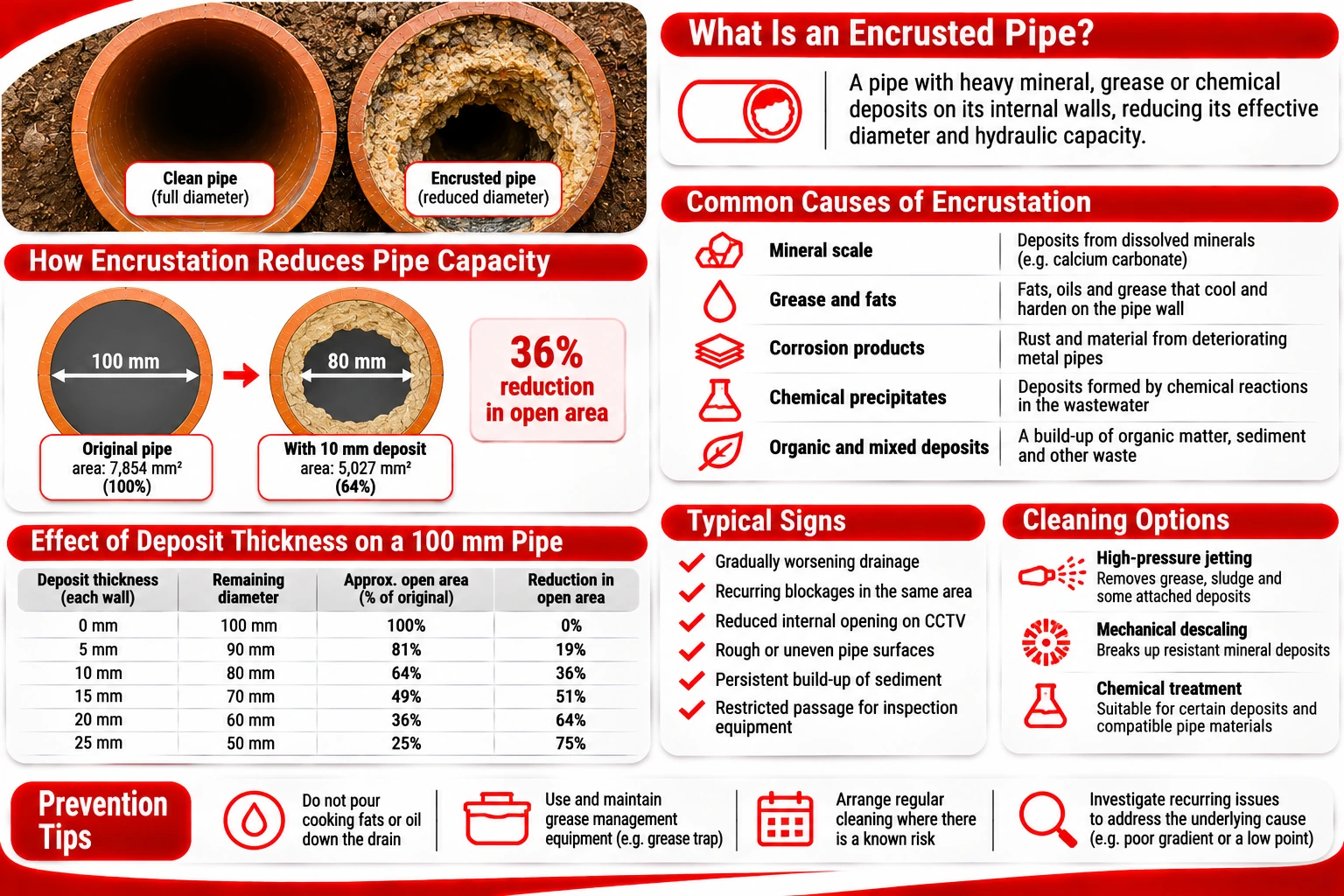
Consider a pipe with an original internal diameter of 100 mm. If a uniform deposit develops to a thickness of 10 mm around the entire circumference, the remaining internal diameter becomes 80 mm. The open cross-sectional area is then approximately 64% of the original, representing a 36% reduction.
This is a geometric comparison rather than a direct calculation of drainage capacity. Actual wastewater flow also depends on pipe gradient, roughness, water depth, discharge rate and other hydraulic conditions.
The following table illustrates how uniform deposits affect the available cross-sectional area of a 100 mm internal diameter pipe.
| Deposit thickness on each wall | Remaining internal diameter | Approximate open area | Reduction in open area |
|---|---|---|---|
| 0 mm | 100 mm | 100% | 0% |
| 5 mm | 90 mm | 81% | 19% |
| 10 mm | 80 mm | 64% | 36% |
| 15 mm | 70 mm | 49% | 51% |
| 20 mm | 60 mm | 36% | 64% |
| 25 mm | 50 mm | 25% | 75% |
These figures assume that deposits form evenly around the full circumference. Real encrustation is frequently irregular, with thicker material along the invert, around joints or on particular sections of the pipe wall. The resulting restriction may therefore be localised rather than uniform.
A thick deposit along the bottom of a gravity drain can be particularly disruptive because it occupies part of the channel normally used by smaller wastewater flows. Solid material may accumulate behind the deposit, even where enough space remains above it for water to pass.
In other cases, deposits form around the entire circumference and gradually narrow the opening. This can increase the likelihood that paper, food waste or other solids become lodged in the pipe.
The hydraulic consequences become more noticeable when several restrictions occur along the same drainage run. A pipe may continue to drain under light use but struggle when a washing machine discharges, a toilet is flushed or multiple appliances operate together. During these higher-flow events, the restricted section may contribute to wastewater backing up upstream.
Encrustation can also make drainage cleaning more difficult. Flexible cleaning tools may pass through the remaining opening without removing the attached material, creating the impression that the pipe has been cleared even though its effective diameter remains substantially reduced.
Where Does Pipe Encrustation Develop and How Is It Identified?
Encrustation can occur in different parts of a drainage system, but its location often reflects the type of wastewater and the conditions within the pipe. Domestic kitchen drains may accumulate grease-rich deposits, while other drainage networks may experience mineral or corrosion-related build-up.
Changes in temperature, flow direction and pipe geometry can influence where deposits become established. Bends, junctions, changes in gradient and rough internal surfaces may provide locations where material collects and gradually becomes more resistant to removal.
Commercial kitchens are particularly relevant because wastewater can contain substantial quantities of fats, oils and grease. Grease management equipment can reduce the amount entering the drainage network, but its effectiveness depends on appropriate selection, installation and maintenance.
Industrial wastewater systems may experience different forms of encrustation associated with the substances handled on site. In these situations, understanding the chemical composition of the deposit may be necessary before choosing a cleaning method.
The symptoms of an encrusted pipe are not always distinctive. Slow drainage, recurring blockages and wastewater backing up can also result from root intrusion, displaced joints, pipe deformation or other restrictions. The presence of these symptoms does not establish that mineral or grease deposits are responsible.
Typical indicators include:
-
Gradually worsening drainage. Wastewater discharge becomes slower as the available pipe opening decreases.
-
Repeated blockages in the same section. Debris becomes trapped against persistent deposits after previous cleaning.
-
Reduced internal opening on CCTV. Visible layers of attached material occupy part of the pipe circumference.
-
Rough or irregular pipe surfaces. Deposits create protrusions that interfere with the passage of solids.
-
Persistent sediment accumulation. Material collects upstream of an encrusted section or around existing deposits.
-
Restricted access for inspection equipment. A heavily narrowed pipe may prevent a camera or cleaning tool from travelling through the affected section.
CCTV drain inspection is commonly used to identify encrustation and assess its distribution. A camera can reveal the visible thickness, texture and extent of deposits, together with the condition of accessible sections of the pipe wall.
However, CCTV footage does not always establish the chemical composition of the material. White or pale deposits may suggest mineral scale, while darker material may contain grease or organic waste, but appearance alone is not definitive. Where the deposit’s composition affects the choice of treatment, sampling or other suitable investigation may be required.
Heavy encrustation can also conceal the underlying pipe condition. Cracks, corrosion, defective joints and other structural abnormalities may remain hidden beneath attached material. A post-cleaning inspection can therefore provide a more reliable assessment of the pipe than footage obtained before deposits are removed.
It is important to distinguish encrustation from loose sediment. Sediment may settle along the invert and move when disturbed, whereas encrustation is generally attached to the internal surface and resists ordinary flushing. Some pipes contain both conditions, and different cleaning techniques may be required to address them.
How Are Encrusted Drainage Pipes Cleaned?
The most suitable cleaning method depends on the deposit’s composition, thickness, hardness and location, together with the material and condition of the pipe. A technique that is effective against soft grease may have little effect on hard mineral scale. Conversely, aggressive mechanical cleaning can damage a weakened pipe if the equipment is not appropriate.
High-pressure water jetting is commonly used to remove grease, sludge and certain attached deposits from drainage systems. Pressurised water is delivered through a nozzle selected for the pipe and the type of material being removed. The jetting action helps dislodge deposits and transport loosened waste towards an accessible collection or removal point.
Jetting performance depends on the pressure and flow available at the nozzle, nozzle configuration, pipe diameter and resistance of the deposit. Increasing pressure is not automatically the best solution, particularly where the pipe is old, damaged or made from a material vulnerable to aggressive cleaning.
Hard mineral deposits may require specialist mechanical descaling. This can involve rotating tools or other equipment designed to break up attached material and restore the internal opening. The tools must be selected and operated with regard to the pipe’s material, diameter and structural condition.
Chemical descaling may be appropriate for certain mineral deposits in suitable systems, but it requires careful assessment. The chemical must be compatible with the pipe material, seals and connected equipment, and the resulting wastewater must be managed appropriately. Chemical treatment is not a universal solution for all forms of encrustation.
The main cleaning approaches can be distinguished as follows:
-
High-pressure water jetting. Suitable for many grease deposits, sludge accumulations and some forms of attached material, depending on their hardness.
-
Mechanical descaling. Used where resistant deposits require controlled physical removal from the internal pipe surface.
-
Targeted chemical treatment. Considered for compatible deposits and pipe materials where a suitable, controlled treatment process is available.
-
Combined cleaning methods. May be necessary where the pipe contains several different types of deposit.
-
Pipe replacement. Considered where encrustation is accompanied by severe deterioration or where safe, effective cleaning is not feasible.
Before selecting a method, the engineer should establish whether the pipe is sufficiently sound to withstand cleaning. Heavy deposits can sometimes conceal weakened sections, particularly in older metallic pipework affected by corrosion. Removing the deposits may expose existing defects or reveal that the remaining pipe wall is thinner than expected.
The cleaning process should also account for the material removed. Large fragments of hardened scale or grease can create a secondary blockage farther downstream if they are simply pushed through the system. Suitable collection and removal arrangements may therefore be needed.
Following cleaning, a CCTV inspection can help confirm whether the deposits have been removed and whether the pipe opening has been restored. It can also reveal structural defects that were previously obscured.
A successful cleaning operation should not be judged solely by whether water begins flowing again. A pipe may regain sufficient capacity for normal discharge while retaining substantial deposits along its walls. Where the objective is to restore the internal profile, the remaining material and its effect on the pipe should be assessed.
How Can Encrustation Be Prevented or Reduced?
Preventing encrustation requires addressing the substances entering the drainage system and the conditions that allow them to accumulate. Cleaning a pipe without considering the underlying cause may provide only temporary improvement, particularly where grease or mineral-rich wastewater continues to enter the same section.
For domestic drainage systems, controlling the disposal of fats, oils and grease is one of the most practical measures. Cooking oil and liquid fat should not be poured into sinks, even when followed by hot water or detergent. Hot water may temporarily move grease farther along the pipe, but it does not guarantee that the material will remain dissolved or pass safely through the drainage network.
Commercial premises may require more structured controls. Food businesses can reduce grease discharge through suitable kitchen practices, grease separation equipment and planned maintenance. The appropriate arrangements depend on the activities undertaken and the characteristics of the drainage system.
Where mineral scale is the principal problem, prevention may involve examining the water or wastewater chemistry and identifying why precipitation occurs. Industrial systems may require process-specific controls, while domestic drains are more likely to benefit from identifying particular appliances or sections where deposits repeatedly develop.
Useful preventative measures include:
-
Avoid disposing of cooking fats, oils and grease through sinks and drains.
-
Remove food waste from utensils and dishes before washing.
-
Maintain grease management equipment where installed.
-
Investigate recurring slow drainage rather than repeatedly relying on temporary clearance.
-
Arrange suitable cleaning where previous inspections have identified persistent deposits.
-
Check whether repeated encrustation is associated with poor pipe gradients or localised standing wastewater.
-
Review wastewater characteristics where mineral or chemical deposits repeatedly affect commercial or industrial systems.
Routine cleaning intervals should reflect the actual risk of accumulation rather than an identical schedule for every property. A commercial kitchen with substantial grease discharge may require more frequent attention than a domestic drainage system with relatively low grease loading.
Repeated encrustation at the same location may also justify checking the pipe’s geometry. A low point, displaced joint or rough internal surface can encourage material to remain in the pipe. In such cases, cleaning may restore flow temporarily without removing the condition that promotes further deposits.
The distinction between encrustation and structural damage remains important when planning long-term maintenance. A structurally sound pipe with attached deposits may be suitable for specialist cleaning, whereas a heavily corroded or fractured pipe may require rehabilitation or replacement. The correct approach depends on the condition revealed by inspection, not simply the amount of material removed.
An encrusted pipe is therefore more than a drain containing ordinary debris. Its internal surface has become coated with persistent deposits that reduce the available opening, increase flow resistance and create conditions for further accumulation. Effective treatment involves identifying the material, selecting a cleaning method compatible with the pipe and confirming the condition of the underlying structure. Where the causes of deposition are also addressed, the risk of repeated restrictions and associated drainage problems can be reduced.