What is a Ductile Iron Pipe
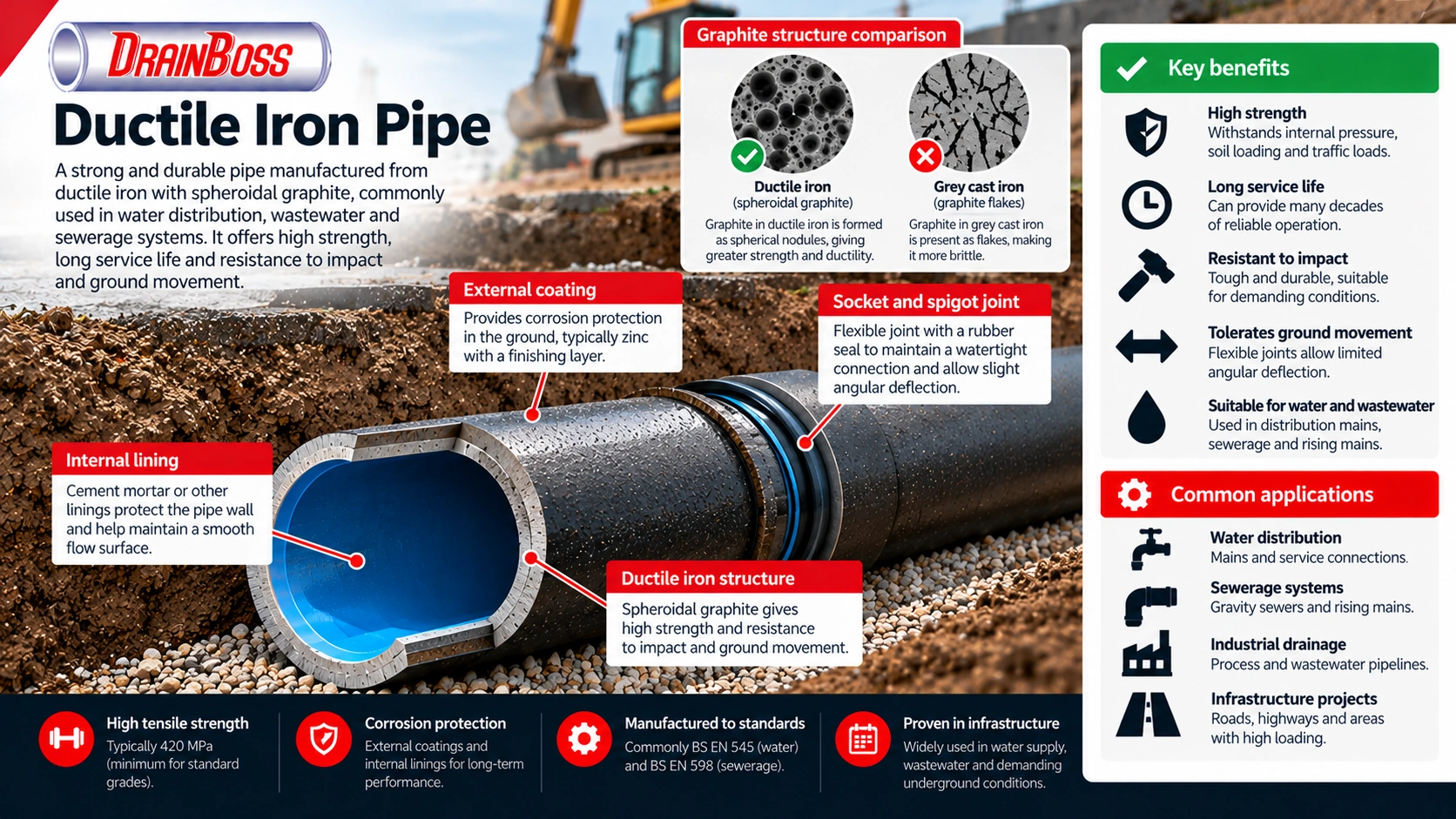
Ductile iron pipe is a high-strength metal pipe manufactured from cast iron in which the graphite is present as small, rounded nodules rather than flakes. This spheroidal graphite structure gives the material greater ductility, toughness and resistance to impact than traditional grey cast iron. Ductile iron pipes are widely used in water distribution, wastewater infrastructure, sewer rising mains and other underground pipeline systems where mechanical strength and long service life are important.
The material combines the compressive strength associated with cast iron with improved tensile properties and the ability to accommodate limited deformation without brittle fracture. This makes ductile iron particularly suitable for buried pipelines exposed to soil loading, traffic loading, internal pressure and certain ground movements. Its mechanical properties also make it useful where pipes must withstand handling and installation stresses.
Ductile iron is not inherently immune to corrosion. Modern pipes are commonly supplied with protective external coatings and internal linings selected for the intended operating environment. In the United Kingdom, ductile iron pipework used in water and drainage infrastructure is manufactured and specified according to relevant standards, including BS EN 545 for water pipelines and BS EN 598 for sewerage applications.
Although ductile iron pipes can remain operational for many decades, their actual service life depends on installation quality, soil conditions, water chemistry, protective coatings, operating pressure and maintenance. Their suitability should therefore be assessed as part of the complete pipeline system rather than solely on the strength of the base metal.
How Ductile Iron Pipes Are Manufactured
Ductile iron is produced by modifying the structure of cast iron during manufacture. In conventional grey cast iron, graphite forms as flakes within the metal matrix. These flakes create stress concentrations that contribute to relatively brittle behaviour, particularly under tensile loading or impact.
Ductile iron is manufactured by treating molten iron with a nodularising agent, commonly magnesium or a magnesium-containing alloy. Under suitable processing conditions, this treatment causes the graphite to form approximately spherical nodules during solidification. The resulting microstructure reduces the stress concentration associated with graphite flakes and improves the material’s mechanical performance.
The metal matrix surrounding the graphite nodules may contain ferrite, pearlite or a combination of both. The proportions influence properties such as strength, hardness and ductility. Manufacturers control the chemical composition, treatment process, cooling conditions and any subsequent heat treatment to achieve the required material characteristics.
Many ductile iron pipes are manufactured using centrifugal casting. Molten iron is introduced into a rotating mould, where centrifugal force distributes the metal around the inner surface. As the iron solidifies, it forms a cylindrical pipe wall. The process is well suited to producing pipes with controlled dimensions and consistent material distribution.
After casting, the pipe undergoes additional manufacturing stages. These may include heat treatment, dimensional inspection, surface preparation, lining, coating and testing. The precise sequence depends on the manufacturing process and the applicable product specification.
Typical manufacturing and quality-control operations include:
-
Nodularisation of molten iron to produce the required spheroidal graphite structure.
-
Centrifugal casting to form the pipe barrel.
-
Heat treatment where required to obtain the specified mechanical properties.
-
Inspection of dimensions, wall thickness and surface condition.
-
Application of internal linings suitable for the intended fluid.
-
Application of external coatings to provide corrosion protection.
-
Pressure or leak-tightness testing in accordance with the relevant product standard.
-
Final inspection of pipe ends, sockets and protective layers.
The manufacturing process must produce more than a strong pipe barrel. The dimensions of the socket, spigot and sealing surfaces are also important because joint performance depends on their accuracy. A pipe with suitable material properties can still experience leakage if its joint geometry or sealing components are defective.
Protective coatings and linings are normally applied under controlled factory conditions. This helps achieve consistent coverage and reduces the likelihood of defects caused by unsuitable site conditions. However, coatings can still be damaged during transport, handling or installation, so inspection and appropriate repair procedures remain necessary.
Mechanical Properties and Performance Under Load
The mechanical properties of ductile iron distinguish it from traditional grey cast iron. Its spheroidal graphite structure allows the material to withstand higher tensile stresses and greater deformation before fracture. This is particularly important in buried pipelines, where loading conditions are not always uniform.
Ductile iron pipes may experience internal pressure, external soil pressure, traffic loading, bending forces and localised stresses at joints. The ability to withstand these loads depends on the pipe’s material properties, diameter, wall thickness, installation conditions and joint design.
The tensile strength of ductile iron used in pipe manufacture is commonly specified at a minimum of 420 MPa under relevant product standards. The actual mechanical requirements, including elongation, depend on the applicable standard and product characteristics.
Ductile iron also has a relatively high elastic modulus, commonly around 170 GPa. This contributes to its stiffness and resistance to deformation under load. However, stiffness alone does not determine whether a buried pipe installation is suitable, as bedding, backfill and surrounding ground conditions also influence structural performance.
The following table summarises important characteristics of ductile iron pipework.
| Property | Typical characteristic | Practical significance |
|---|---|---|
| Graphite structure | Spheroidal graphite nodules | Reduces stress concentrations compared with grey cast iron |
| Minimum tensile strength | Commonly 420 MPa for standard pipe grades | Provides resistance to tensile loading |
| Elastic modulus | Approximately 170 GPa | Contributes to pipe stiffness |
| Density | Approximately 7,100 kg/m³ | Results in relatively heavy pipe sections |
| Ductility | Greater than traditional grey cast iron | Improves resistance to brittle fracture |
| Impact resistance | Improved compared with grey cast iron | Helps withstand handling and certain external impacts |
| Corrosion resistance | Depends strongly on protective systems and environment | Requires suitable coatings and linings |
| Joint flexibility | Available through suitable socket and gasket designs | Allows limited angular deflection and movement |
These values describe general material characteristics rather than the performance of every manufactured pipe. Product specifications, wall thickness classes and protective systems must be checked for the intended application.
One important advantage of ductile iron is its ability to resist external loading. Pipes installed beneath roads may experience repeated traffic loads in addition to the permanent weight of soil above them. Correctly specified ductile iron pipework can accommodate these conditions, provided the installation is designed and constructed appropriately.
The material’s ductility also provides some tolerance to bending and deformation. However, this should not be interpreted as unlimited resistance to ground movement. Significant settlement, landslides or differential movement can damage ductile iron pipes, particularly where joints, restraints or surrounding structures impose additional stresses.
Joint flexibility is often more important than deformation of the pipe barrel when accommodating minor ground movement. Suitable flexible joints can permit limited angular deflection while maintaining a seal. The permitted movement depends on the joint design, pipe diameter and manufacturer’s specifications.
Protective Linings and Corrosion Control
Corrosion protection is essential to the long-term performance of ductile iron pipework. Although the material offers excellent mechanical properties, iron can corrode when exposed to moisture, oxygen and other environmental conditions. The rate and form of corrosion depend on factors such as soil chemistry, groundwater, electrical conditions and the substances transported through the pipe.
External corrosion is a particular consideration for buried pipelines. Aggressive soils, certain groundwater conditions and stray electrical currents can increase corrosion risks. Protective systems are therefore selected according to the anticipated exposure and the applicable technical requirements.
Zinc-based external coatings are widely used on ductile iron pipes. They may be combined with finishing layers that provide additional protection. Other coating systems, including polyurethane, epoxy and polyethylene-based arrangements, may be specified for particular applications.
The appropriate coating depends on the pipe’s operating environment. A standard protective system suitable for one installation may not provide adequate protection in highly aggressive soil or under unusual electrical conditions.
Internal linings serve a different purpose. They protect the pipe wall from the transported fluid and can help maintain suitable hydraulic performance by providing a relatively smooth internal surface.
Cement mortar lining is commonly used in ductile iron water pipes. Other lining materials may be selected where the transported liquid has chemical characteristics that make conventional cement mortar unsuitable.
For sewerage applications, lining selection requires particular attention. Wastewater may contain substances that affect the durability of certain materials, and sewer environments can expose pipe surfaces to corrosive gases and biological processes.
Hydrogen sulphide is especially relevant in some wastewater systems. Under suitable conditions, hydrogen sulphide can be converted into sulphuric acid on exposed surfaces, creating an aggressive environment. Protective lining selection must account for the expected exposure rather than assuming that all wastewater has similar characteristics.
Damage to coatings and linings can occur during installation or subsequent maintenance. Scratches, impact damage and defective coating repairs may expose the underlying metal to conditions that accelerate corrosion.
For this reason, pipe inspection before installation is important. Any damage should be assessed and repaired using methods approved for the particular coating or lining system. In some cases, extensive damage may require rejection or replacement of the affected component.
Corrosion control is most effective when material selection, protective coatings, joint design and installation conditions are considered together. A high-quality coating cannot compensate for every problem caused by unsuitable bedding, severe mechanical damage or an incorrectly specified pipeline.
Ductile Iron Pipes in Water Supply and Sewerage Systems
Ductile iron pipes are used in several types of infrastructure, but the technical requirements vary according to the transported fluid and operating conditions. A pipe intended for potable water distribution is not automatically suitable for industrial wastewater or chemically aggressive drainage.
In water supply networks, ductile iron is commonly used for distribution mains, transmission pipelines and connections to larger infrastructure. Its mechanical strength makes it suitable for many buried installations where internal pressure and external loading must be considered.
Ductile iron pipework is also used in wastewater systems, particularly where sewage must be transported under pressure. A sewer rising main carries wastewater from a pumping station towards a higher discharge point or another section of the sewer network. Unlike a conventional gravity sewer, a rising main operates under positive pressure during pumping.
This application can benefit from the strength and pressure capabilities of ductile iron. However, the pipe must be specified for the expected operating pressures, pressure surges and wastewater characteristics.
Pumping systems can generate transient pressure changes when pumps start, stop or operate under abnormal conditions. These pressure surges, often described as water hammer, may create short-duration pressures higher or lower than normal operating values. Pipework, joints, valves and restraints must be designed for the relevant transient conditions.
Gravity sewerage is another possible application. Ductile iron pipes may be selected where structural loading, installation constraints or other project requirements favour a metallic pipe system. However, gravity sewers are also commonly constructed from concrete, vitrified clay, PVC-U, polypropylene and other materials.
In drainage infrastructure, ductile iron may be appropriate for:
-
Sewer rising mains operating under pressure.
-
Sections of wastewater pipelines exposed to significant external loading.
-
Buried drainage routes where high mechanical strength is required.
-
Pipework associated with pumping stations and wastewater treatment facilities.
-
Selected gravity sewer installations with demanding structural requirements.
-
Pipeline sections requiring suitable restrained or flexible joint arrangements.
-
Infrastructure where the specified pipe system must withstand particular installation or operating conditions.
The choice of material should reflect the actual requirements of the project. Ductile iron is not necessarily the most economical or technically appropriate solution for a small domestic drain, where plastic pipework may provide adequate performance with lower weight and simpler handling.
Similarly, highly aggressive industrial effluent may require specialist lining systems or alternative pipe materials. The base strength of ductile iron does not guarantee chemical compatibility with every liquid.
In the UK, BS EN 545 covers ductile iron pipes, fittings, accessories and joints for water pipelines. BS EN 598 addresses corresponding products for sewerage applications. These standards provide requirements relevant to product characteristics, performance and testing, although the complete pipeline design must also consider installation and operational conditions.
Pipe Joints, Installation and Ground Movement
The performance of a ductile iron pipeline depends heavily on its joints. Pipes are commonly supplied with socket and spigot ends that allow individual sections to be connected using elastomeric sealing rings. Other arrangements, including flanged and restrained joints, are used where appropriate.
Push-in flexible joints are widely used in buried pipelines. The spigot end of one pipe is inserted into the socket of the next, with a gasket providing the seal. The joint may allow limited angular deflection, helping the pipeline accommodate minor changes in alignment and certain ground movements.
The permitted angular deflection is not the same for every pipe diameter or joint system. Installation must follow the manufacturer’s specifications, and the joint should not be forced beyond its allowable limits.
Restrained joints are used where axial forces must be resisted without relying solely on external thrust restraint arrangements. These forces can occur at bends, tees, reducers and other locations where internal pressure produces an unbalanced load.
Flanged connections are often used around valves, pumping equipment and accessible plant installations. They provide a bolted connection, but correct gasket selection, bolt tightening and alignment are essential to maintaining a reliable seal.
Buried installation begins with suitable trench preparation. The pipe must be supported by appropriate bedding, and the surrounding material must be placed and compacted according to the design. Poor support can create concentrated loads and increase the risk of movement or damage.
Pipe weight is an important practical consideration. Ductile iron is considerably heavier than many thermoplastic pipe materials, so lifting equipment and suitable handling procedures are often necessary. Pipes should be supported and moved in ways that avoid damaging their protective coatings or joint surfaces.
Ground movement requires particular attention. Although ductile iron has greater ductility than grey cast iron, the pipeline’s ability to tolerate movement depends on its joints, supports and restraint arrangements.
Differential settlement can introduce bending and shear forces into a pipeline. Flexible joints may accommodate limited movement, but substantial displacement can exceed their capabilities. Where significant ground movement is anticipated, the design may require special joints, alternative alignments or additional engineering measures.
The installation should also account for the interaction between the pipe and surrounding structures. Connections to rigid chambers, buildings or pumping stations can experience concentrated stresses if the adjacent ground settles differently. Suitable transition arrangements may be necessary to reduce these effects.
After installation, the pipeline should undergo the inspections and tests required by the applicable specification. Pressure testing, joint inspection and verification of the installed alignment may be necessary before the pipe is placed into service.
Service Life, Inspection and Maintenance
Ductile iron pipelines are commonly designed for long-term infrastructure use, and well-protected installations can remain operational for many decades. A service life of 100 years is sometimes cited for modern ductile iron systems under suitable conditions, but it should not be treated as a guaranteed lifespan for every installation.
Actual durability depends on the operating environment, coating condition, installation quality, pressure history and maintenance. Two pipes manufactured to the same standard may experience very different deterioration rates if one is installed in relatively benign soil and the other in a highly aggressive environment.
Routine inspection requirements depend on whether the pipe carries water, wastewater or another substance. Buried pipelines cannot always be inspected directly without excavation, so operators often rely on performance records, leakage monitoring and targeted investigations.
For pressurised water systems, unexpected changes in pressure or flow can indicate leakage or other operational problems. In wastewater rising mains, recurring failures, abnormal pumping conditions or unexplained losses may require investigation.
Gravity drainage systems may be inspected using CCTV equipment where access and pipe conditions permit. However, conventional CCTV inspection methods are not always suitable for pressurised pipelines operating under normal service conditions.
Maintenance activities can include inspecting accessible joints and fittings, assessing corrosion protection, repairing damaged components and investigating suspected leakage. Cleaning requirements depend on the transported liquid and the nature of any deposits.
In wastewater applications, sediment, grease and other material may accumulate where operating conditions allow deposition. Cleaning methods must be selected according to the pipe condition, lining material and system design. Excessive mechanical force or inappropriate cleaning equipment can damage protective linings.
Age alone is not sufficient to determine whether a ductile iron pipe requires replacement. An older pipeline with effective corrosion protection and a favourable operating history may remain serviceable, while a newer installation exposed to aggressive conditions or repeated mechanical stress may deteriorate more quickly.
Condition assessment should consider the type and extent of defects, their likely causes and the consequences of failure. Where deterioration is localised, targeted repair or replacement may be possible. More extensive corrosion, repeated leakage or significant structural damage may justify renewal of a longer section.
Ductile Iron Compared with Other Drainage Pipe Materials
Ductile iron competes with several other materials used in drainage and underground pipeline construction. Each material offers a different balance of strength, weight, corrosion resistance, flexibility and installation requirements.
PVC-U and other thermoplastics are widely used in gravity drainage because they are lightweight, corrosion-resistant and relatively straightforward to install. Their suitability depends on pipe stiffness, loading conditions, temperature and chemical exposure.
Concrete pipes provide high structural capacity and are commonly used in gravity sewerage and surface water drainage. Their performance depends on the pipe specification, bedding arrangement and environmental exposure. Certain wastewater conditions may require additional corrosion protection.
Vitrified clay offers strong resistance to many chemical environments and is widely used in gravity sewerage. However, its behaviour under impact and ground movement differs from ductile iron, and joint selection remains important.
Steel pipes can provide high strength and are used in certain pressure pipeline applications. They generally require appropriate corrosion protection, and welded or other engineered joints may be specified according to the installation.
Ductile iron is particularly valuable where a combination of mechanical strength, pressure capability and robust buried performance is required. Its main disadvantages include relatively high weight, the need for suitable corrosion protection and installation requirements that can be more demanding than those associated with lightweight plastic pipes.
Material selection should therefore begin with the hydraulic and structural requirements of the pipeline. Pressure rating, diameter, installation depth, soil conditions, transported fluid and anticipated maintenance must all be considered before comparing costs.
The most suitable material is not necessarily the one with the highest tensile strength or the longest theoretical service life. A properly specified pipeline must provide reliable performance under the actual conditions of use, with joints, coatings, bedding and maintenance arrangements appropriate to the installation.
Ductile iron remains an important material for water and wastewater infrastructure because it combines high mechanical strength with improved ductility compared with traditional cast iron. When correctly specified, protected and installed, it can provide durable service in demanding underground environments where structural reliability and pressure performance are essential.