
What is a End Cap
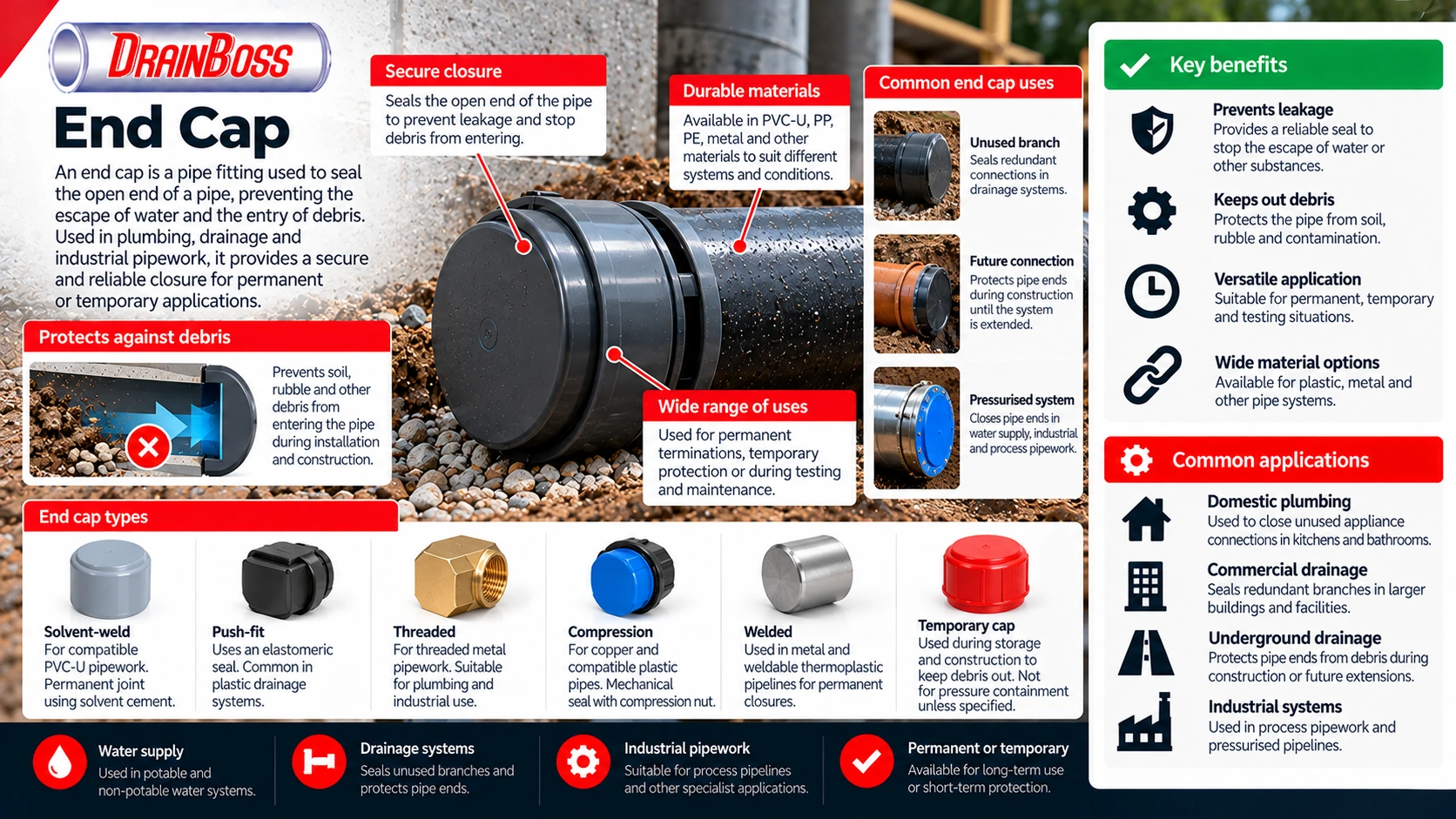
An end cap is a pipe fitting designed to close the open end of a pipe, preventing the escape of water, wastewater or other substances and protecting the pipe from external contamination. End caps are used in plumbing, drainage, water distribution and industrial pipework, both as permanent closures and as temporary components during construction, maintenance or testing. Their design varies according to the pipe material, diameter, operating pressure and the method used to secure the fitting.
In drainage systems, an end cap may close an unused branch, isolate a redundant connection or protect pipework that will be extended during a later construction phase. In pressurised systems, it must also withstand the forces generated by internal pressure. A fitting suitable for closing an unpressurised waste pipe is not necessarily appropriate for a water supply main or pumped wastewater pipeline.
Although an end cap is a relatively simple component, its performance depends on correct installation and compatibility with the pipe. An incorrectly fitted cap can allow leakage, become displaced during testing or create a concealed drainage problem if it is installed in the wrong location. The distinction between a permanent closure, a removable access fitting and a temporary testing plug is therefore important.
What Is an End Cap Used for in Plumbing and Drainage?
The primary function of an end cap is to terminate a section of pipework without leaving an open connection. This is necessary when a pipeline reaches its intended endpoint, when an existing branch is no longer required or when an unfinished installation needs protection until work resumes.
In domestic plumbing, end caps are frequently used when alterations are made to kitchens, bathrooms and utility rooms. Removing a sink, washing machine or other appliance may leave an unused pipe connection. The open end must be sealed appropriately to prevent leakage, odours or contamination, depending on the type of system.
In drainage installations, end caps are commonly fitted to unused branches of soil and waste systems. An unused branch connected to a foul drainage network can provide a route for sewer gases to enter a building if it is left open. A properly installed closure prevents this direct communication between the drainage system and the surrounding environment.
End caps are also useful during staged construction. For example, an underground drainage pipe may be installed before a planned extension or outbuilding is constructed. Closing the pipe protects the unfinished connection from soil, stones, concrete washout and other construction debris.
This protection is particularly important because material entering an open drainage pipe can travel further into the system. Once the pipe has been buried or covered by flooring, removing hardened deposits or compacted debris may require more extensive work.
Typical applications include:
-
Sealing unused soil and waste pipe branches after alterations to sanitary installations.
-
Closing underground drainage connections reserved for future development.
-
Protecting newly installed pipes against soil, rubble and construction debris.
-
Terminating sections of water supply pipework that are no longer required.
-
Isolating pipe sections during planned modifications, where the closure is suitable for the operating conditions.
-
Closing pipe ends during storage and transportation to prevent contamination.
-
Providing a permanent termination on suitable industrial and process pipelines.
A capped pipe should not automatically be considered abandoned or disconnected. It may remain connected to an active drainage or water supply system, and this affects how the closure must be designed and maintained.
Where a redundant branch remains connected to a foul drain, the cap must form a suitable seal against the conditions that may occur within the pipe. Where a water supply branch is permanently taken out of service, simply capping the distant end may leave a stagnant section of pipework. In potable water installations, redundant dead legs should generally be removed or minimised as part of appropriate water hygiene management.
End Cap Types and Connection Methods
End caps are manufactured in several forms, each intended for particular pipe materials and installation conditions. The main differences concern how the fitting attaches to the pipe, whether it can be removed and the degree of sealing performance it provides.
A solvent-weld end cap forms a permanent connection with compatible plastic pipework. It is commonly used with suitable PVC-U systems, where an approved solvent cement chemically bonds the mating surfaces. Correct preparation and curing are essential because the joint cannot normally be dismantled without cutting the pipe.
Push-fit end caps use a mechanical connection incorporating an elastomeric sealing ring. They are available for selected plastic drainage systems and allow installation without solvent cement. Depending on the product design, some can be removed and reused, although the manufacturer’s instructions determine whether this is permitted.
Compression end caps use a mechanical arrangement to seal around the pipe. These are common in certain water supply and plumbing systems, including applications involving copper and compatible plastic pipework. The fitting must match the pipe dimensions and any required support inserts must be installed.
Threaded end caps are used on compatible threaded pipework and fittings. They may be manufactured from brass, stainless steel, malleable iron or other suitable materials. Thread form, sealing method and pressure rating must be compatible with the system.
Welded end caps are used in metallic and certain thermoplastic pressure pipelines. A correctly specified welded closure can provide a permanent, pressure-resistant termination, but the jointing process requires appropriate equipment and procedures.
The following table compares common end cap arrangements.
| End cap type | Typical pipe system | Connection method | Main consideration |
|---|---|---|---|
| Solvent-weld cap | Compatible PVC-U pipework | Solvent cement | Permanent joint requiring correct preparation and curing |
| Push-fit cap | Selected plastic drainage systems | Elastomeric sealing ring | Seal condition and correct insertion depth |
| Compression stop end | Copper and compatible plastic plumbing pipes | Compression nut and sealing components | Pipe compatibility, tightening and support inserts |
| Threaded cap | Threaded metal pipework | Screw thread with suitable sealing arrangement | Thread compatibility and pressure rating |
| Welded cap | Steel and weldable thermoplastic pipelines | Approved welding process | Joint integrity and applicable welding requirements |
| Mechanical end cap | Selected water and industrial pipelines | Bolted or restrained mechanical connection | Pressure resistance and axial restraint |
| Temporary protective cap | Pipes awaiting installation | Friction fit or other temporary attachment | Protection from debris rather than pressure containment |
The final category is particularly important. A lightweight plastic cap supplied to protect a pipe during storage may look similar to a functional closure, but it should not be used to contain water pressure or seal an active drainage system unless specifically designed for that purpose.
Pipe plugs are sometimes confused with end caps. An end cap generally fits over or onto the end of a pipe, whereas a plug commonly fits inside a pipe opening or closes an internally threaded fitting. However, product terminology varies, and manufacturers may use the terms differently.
The actual connection design is more important than the product name. A removable internal test plug, for example, should not be treated as a permanent end cap simply because it seals the pipe opening.
Selecting an End Cap by Pipe Diameter and Material
An end cap must match the dimensional system of the pipe to which it is attached. Nominal pipe sizes do not always correspond directly to measured outside diameters, and two pipes described using the same nominal size may require different fittings.
For example, domestic plastic waste pipework in the UK commonly uses nominal sizes of 32 mm, 40 mm and 50 mm. Soil pipework commonly uses a nominal size of 110 mm, while underground drainage systems frequently use 110 mm and larger nominal diameters. However, different product systems may use different dimensional conventions, particularly where imperial and metric products are involved.
A nominal 110 mm drainage pipe and a nominal 110 mm soil pipe may appear similar, but fitting compatibility should still be confirmed. Differences in socket geometry, joint design, wall construction or manufacturer specifications can affect whether a particular end cap is suitable.
The same principle applies to pressure pipework. A fitting selected for a 25 mm polyethylene water supply pipe must be compatible with the relevant pipe outside diameter, material specification and pressure classification.
Material compatibility also matters because pipe systems respond differently to temperature, chemical exposure and mechanical loading.
PVC-U is widely used in drainage because it is corrosion-resistant and suitable for many ordinary wastewater applications. Polypropylene is used in various waste and soil systems, including products designed for elevated discharge temperatures. Polyethylene is common in water supply and specialist pressure systems, while metallic pipes may require threaded, welded, flanged or mechanical closures.
For an end cap to perform reliably, the following characteristics should be checked:
-
Pipe outside diameter and the dimensional standard used by the manufacturer.
-
Pipe material and compatibility with the fitting.
-
Intended application, such as gravity drainage, potable water or pumped wastewater.
-
Maximum operating pressure and any anticipated pressure surges.
-
Operating temperature and the temperature limits of seals or jointing materials.
-
Resistance to the substances transported through the pipeline.
-
Whether the closure must be permanent or removable.
-
Exposure to sunlight, ground conditions, mechanical loads or other environmental influences.
Where a cap is installed underground, its resistance to external loading and joint displacement must also be considered. The surrounding bedding and backfill should support the pipe adequately, and the closure should not be exposed to concentrated loads that exceed its intended design.
Chemical compatibility can be important in commercial kitchens, laboratories and industrial drainage systems. Certain cleaning agents, solvents or process liquids may affect elastomeric seals or plastic materials. A fitting suitable for ordinary domestic wastewater should not automatically be assumed suitable for aggressive industrial discharge.
Pressure Resistance and the Forces Acting on a Closed Pipe
In an unpressurised gravity drainage system, an end cap normally functions as a closure against leakage, odours and contamination. However, a drainage pipe can experience internal pressure under abnormal conditions, including downstream blockages, surcharge or testing.
Pressurised water systems create a more demanding situation. Internal pressure acts across the closed area at the end of the pipe, producing an axial force that attempts to push the end cap away from the pipeline.
This force can be estimated using the relationship:
Where:
-
\(F\) is the axial force in newtons.
-
\(P\) is the internal gauge pressure in pascals.
-
\(A\) is the internal cross-sectional area of the pipe in square metres.
Consider a pipe with an internal diameter of 100 mm operating at a gauge pressure of 5 bar. Since 5 bar is equivalent to 500,000 pascals, the internal cross-sectional area is approximately 0.00785 m².
The resulting force is approximately:
This is equivalent to approximately 3.9 kN of axial force acting on the closure. The calculation illustrates why a pressure-rated cap must also have a connection or restraint arrangement capable of resisting the force generated by the system.
The example is based on a simplified static pressure calculation. Actual pipeline design may need to account for pressure surges, testing pressures, joint restraint, material properties and other loading conditions.
For larger pipe diameters, the force increases substantially because the closed area increases with the square of the internal diameter. Doubling the diameter produces four times the pressure-loaded area at the same internal pressure.
A cap may have sufficient material strength to withstand internal pressure but still become displaced if the connection is not adequately restrained. This distinction is particularly important in pressure pipelines with mechanical or push-fit joints.
In buried water mains and sewer rising mains, end closures may require engineered restraint, depending on the joint system and installation. This can involve restrained fittings, appropriate anchorage or other arrangements designed for the anticipated loads.
Pressure testing introduces another consideration. A pipeline may be tested at a pressure higher than its normal operating pressure, subject to the applicable test procedure. Temporary closures used during testing must therefore be rated and secured for the test conditions rather than selected only for ordinary operation.
Temporary End Caps, Test Plugs and Permanent Closures
Temporary and permanent closures serve different purposes, even when they appear similar.
During construction, a temporary end cap may be installed simply to prevent debris entering an unfinished pipe. This type of protection can be essential on busy building sites, where open drainage connections may otherwise collect mortar, plaster, stones or packaging material.
A temporary protective cap is not necessarily watertight or pressure-resistant. Its function may be limited to keeping the pipe opening clean until the next stage of installation.
Testing closures have a different role. Drainage systems may be subjected to air or water tests as part of installation verification. The closures used must be suitable for the test method and must be installed in accordance with the relevant procedures.
Inflatable test plugs are sometimes used to isolate sections of drainage pipework. They seal against the internal wall of the pipe and can be useful where a temporary closure is required. However, their safe use depends on the plug specification, correct inflation, pipe condition and the pressure differential across the plug.
A plug can be expelled with considerable force if it is incorrectly installed or subjected to excessive pressure. For this reason, test plugs require appropriate restraint and exclusion arrangements, particularly where pressurised testing or retained water is involved.
A permanent end cap is intended to remain in place during the normal service life of the installation. It should be selected according to the pipe system and the conditions expected at that location.
The distinction is especially relevant when an unused drainage branch is buried or enclosed within a building. A temporary friction-fit cap may prevent debris entering during construction, but it should not be left as the permanent closure unless the product is specifically approved for that application.
Permanent closures also need to account for possible future work. Where a pipe is intended for later extension, the termination should be positioned so that it can be located and accessed without unnecessary demolition or excavation.
In some circumstances, a removable fitting may be appropriate. However, a capped pipe end should not be used as a substitute for a properly designed rodding eye or inspection access point unless the arrangement is specifically suitable for that purpose.
Installation Defects and Leakage at End Caps
Most end cap failures arise from an unsuitable fitting, poor joint preparation, incorrect installation or operating conditions beyond the component’s design limits. The cap itself may remain intact while leakage occurs at the connection between the fitting and the pipe.
With push-fit fittings, damaged or displaced elastomeric seals can prevent a watertight connection. Dirt, grit or sharp pipe edges may interfere with the seal during installation. Incorrect insertion depth can also leave the joint vulnerable to movement or leakage.
Solvent-weld fittings require clean, compatible surfaces and correct application of the specified solvent cement. Poor preparation, insufficient cement coverage or movement before the joint has developed adequate strength can compromise the connection.
Compression fittings can leak if the pipe is incorrectly prepared, the sealing components are damaged or the fitting is assembled improperly. Excessive tightening can also cause problems, depending on the fitting design and material.
For threaded caps, leakage may result from incompatible threads, damaged threads or an unsuitable sealing method. The use of thread-sealing materials should follow the fitting manufacturer’s instructions and the requirements of the particular installation.
Mechanical movement can affect end caps in both above-ground and underground systems. Thermal expansion, vibration, ground settlement and accidental impact may place stress on the connection. A closure installed on unsupported pipework may be subjected to forces that were not anticipated during fitting selection.
A particularly important installation error is leaving an open branch within a concealed drainage system. If the branch is connected to foul drainage, it may allow sewer gases to escape into a void or occupied space. If the system becomes surcharged, wastewater may also escape through the opening.
Another problem occurs when an end cap is fitted to a drainage branch that should remain open for ventilation or access. Closing the wrong pipe can alter the intended function of the drainage system, potentially affecting pressure balance or preventing maintenance.
Before capping an unidentified pipe, its purpose should therefore be established. The pipe may be part of a venting arrangement, an overflow, a discharge route or an active connection that is not immediately obvious.
Where a capped pipe is buried, its location should be recorded accurately. This is especially useful for planned future extensions, since the termination may otherwise be difficult to locate once the surrounding area has been landscaped or paved.
End Caps and Redundant Drainage Connections
Closing an unused drainage connection is not always the same as properly decommissioning it. The appropriate treatment depends on where the branch connects, whether the remaining pipework is accessible and whether it will be used again.
A short redundant branch may be capped where this is compatible with the drainage design. However, leaving a long, unused section connected to an active system may create an unnecessary space in which wastewater, sediment or other material can accumulate.
For example, a former appliance waste connection may remain connected to a kitchen drainage run after refurbishment. If the branch is no longer needed, removing the redundant section back to an appropriate junction may be preferable to retaining a lengthy dead-end pipe.
Underground drainage requires additional consideration. An unused connection leading towards a former outbuilding or demolished structure may still communicate with the main drainage system. If it is left open, it can allow soil, groundwater, roots or debris to enter, depending on the surrounding conditions.
Capping the exposed end may prevent immediate ingress, but the remaining branch should also be assessed for structural condition and suitability. A damaged redundant pipe may still create problems if it remains connected to an operational drain.
Where an entire drainage run is abandoned, decommissioning may involve more than installing an end cap. The work may require disconnection at an appropriate location, sealing of openings, removal of selected pipe sections or other measures determined by the site conditions and applicable requirements.
A drainage survey can be useful when the route or connection of a redundant pipe is uncertain. CCTV inspection may establish whether the pipe remains connected, identify junction locations and reveal defects that affect the proposed closure.
End caps are also relevant when future drainage extensions are planned. A properly located and documented capped connection can reduce the need to disturb an existing drainage run when new pipework is added. The connection must nevertheless be sized and positioned for the proposed future use, rather than selected solely because a convenient branch is available.
For permanent installations, the end cap should be treated as part of the pipe system rather than a disposable accessory. Its material, joint integrity, pressure resistance and accessibility all influence whether the termination remains reliable after the surrounding construction work has been completed.