
What is a Floatable Debris
Floatable debris refers to solid materials that remain on or near the surface of water and are transported through drainage systems, sewers, rivers and stormwater channels. Common examples include leaves, plastic packaging, bottles, food containers, polystyrene, vegetation and other lightweight waste. These materials can enter drainage networks through road gullies, surface water inlets, open channels and improperly managed waste disposal points, creating operational and environmental problems.
In drainage engineering, floatable debris is distinguished from sediment and other materials that primarily travel along the bottom of a pipe or channel. Its behaviour depends on buoyancy, water velocity, turbulence and the shape of individual objects. Some materials remain at the surface throughout transport, while others become temporarily submerged, trapped against structures or incorporated into larger accumulations of waste.
Floatable debris is particularly important in stormwater management because rainfall can rapidly mobilise litter and vegetation from roads, car parks, roofs and landscaped areas. During intense rainfall, the resulting flow may transport substantial quantities of material towards drainage inlets, culverts and receiving watercourses. Even relatively small objects can contribute to blockages when they accumulate against gratings, screens or other restrictions.
The consequences extend beyond reduced drainage capacity. Floatable debris can damage pumping equipment, interfere with water treatment processes, obstruct hydraulic structures and carry pollutants into rivers and coastal waters. Effective management therefore involves controlling debris at its source, understanding how it moves through drainage networks and providing suitable collection arrangements where necessary.
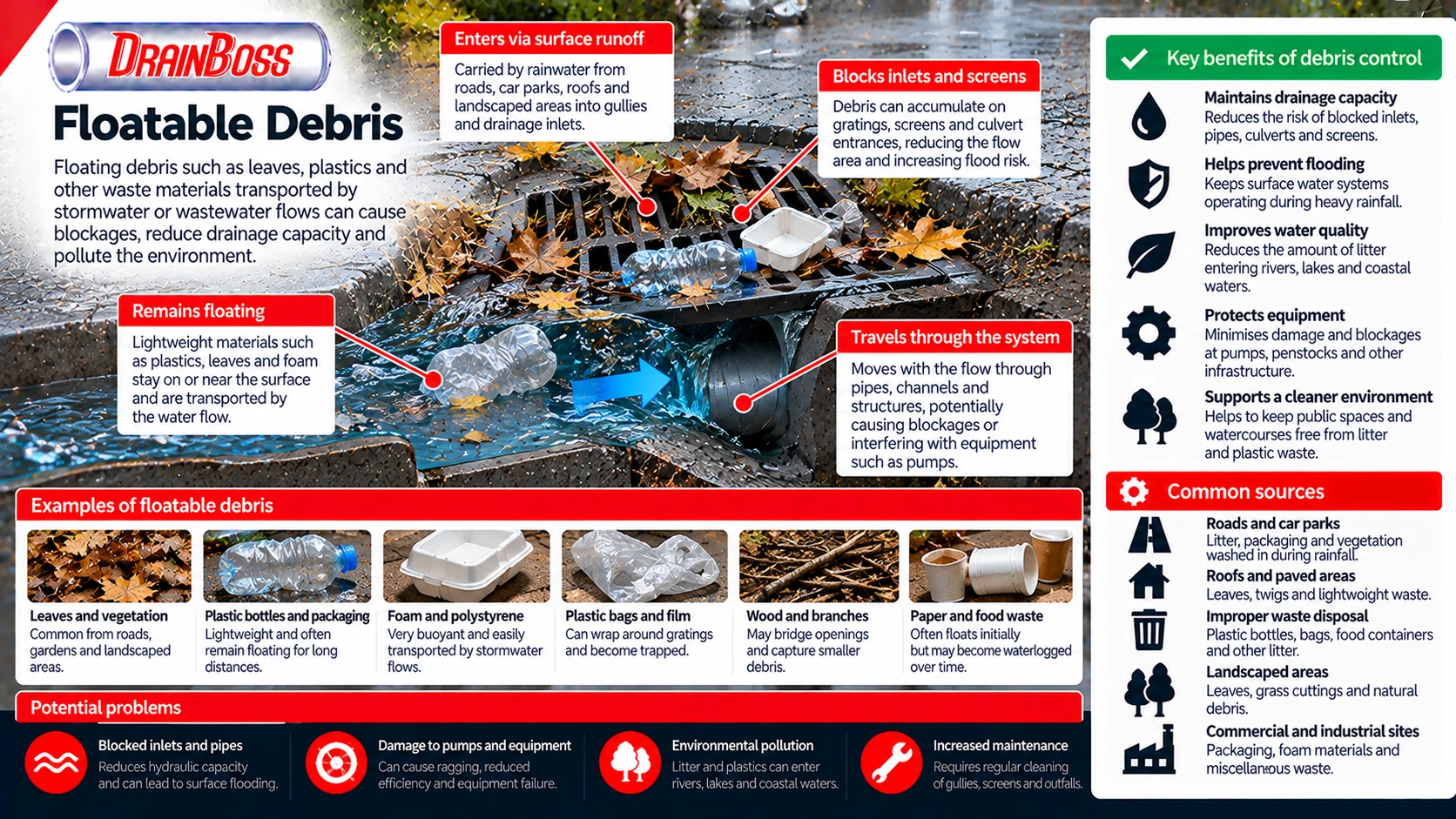
Types of Floatable Debris and Their Behaviour in Water
Floatable debris includes a wide range of natural and manufactured materials. Their ability to remain afloat depends on density, trapped air, water absorption and the conditions within the drainage system. A material that initially floats may eventually sink after becoming saturated, while a partially submerged object may continue travelling near the surface for considerable distances.
Natural debris is common in drainage systems serving areas with trees, gardens and open vegetation. Leaves, twigs, bark, grass cuttings and other plant material can be washed into gullies and channels during rainfall. Seasonal leaf fall can increase the amount of organic material entering surface water systems, particularly where roadside trees overhang paved areas.
Manufactured debris includes plastic bottles, packaging films, takeaway containers, foam products and other discarded items. Many plastic materials have densities lower than water, but the behaviour of a finished object also depends on its shape and whether it contains trapped air. A sealed plastic bottle may float even when the polymer used to manufacture it is denser than water.
The main categories of floatable debris include:
-
Natural vegetation, including leaves, twigs, branches, grass and floating plant material.
-
Plastic packaging, including bottles, bags, wrappers and food containers.
-
Expanded polystyrene and other lightweight foam materials.
-
Paper and cardboard that may initially float before absorbing water.
-
Timber fragments and other buoyant construction waste.
-
Sanitary waste, wet wipes and miscellaneous litter that can become trapped near the water surface.
-
Floating grease, fats and other buoyant accumulations that may carry or bind solid debris.
These categories do not behave identically. A rigid plastic bottle may move relatively freely through an open channel, while a flexible plastic bag can wrap around a grating or become entangled with vegetation. Long branches may bridge an opening, creating a framework that captures smaller material.
Wet wipes require particular care in classification. Some may float temporarily, but they are not consistently buoyant and often become submerged or entangled within wastewater systems. Their importance lies partly in their ability to form persistent accumulations with fats, fibres and other waste.
Grease and fats also behave differently from ordinary solid litter. They may float as separate phases, adhere to pipe surfaces or combine with other materials. In foul drainage systems, these substances can contribute to deposits and blockages, but they should not automatically be treated as equivalent to floating plastic or vegetation.
The distinction between different debris types matters when selecting removal equipment. A screen that captures large bottles and branches may allow smaller packaging fragments to pass, while a fine screen may retain more material but require more frequent cleaning.
How Floatable Debris Enters and Moves Through Drainage Systems
Surface water drainage systems are particularly exposed to floatable debris because they collect runoff from areas where litter and vegetation accumulate. Rainfall washes material towards road gullies, channel drains, surface water inlets and open drainage ditches. The amount transported depends on rainfall intensity, local topography, surface conditions and the availability of loose material.
The first significant rainfall after a dry period can mobilise debris that has accumulated on roads and other impermeable surfaces. This process is sometimes associated with the first flush of stormwater runoff, although the timing and magnitude of pollutant and debris transport vary between catchments.
Road gullies may capture some coarse material within their chambers, depending on their construction. However, they are not designed to retain every floating object, and some debris may pass into the connected drainage network. Where inlet gratings become obstructed, water may bypass the gully and continue flowing across the surface.
Once debris enters a pipe, its movement depends on the hydraulic conditions. In a partially full gravity drain, buoyant material may travel near the water surface. Under more turbulent conditions, objects can become submerged, rotate or collide with pipe walls and fittings.
Pipe bends, junctions and changes in diameter can influence debris movement, but they do not automatically cause accumulation. The likelihood of obstruction depends on the available opening, flow conditions, debris dimensions and the presence of existing restrictions.
In open channels, floating material tends to move with the surface flow. Local circulation, vegetation, bridge piers and channel geometry may concentrate debris in particular areas. During floods, rising water levels can mobilise material from riverbanks and floodplains that would not normally enter the watercourse.
The following table compares common transport conditions and their implications.
| Drainage environment | Typical floatable debris | Main transport characteristics | Potential problem |
|---|---|---|---|
| Road gullies | Leaves, packaging, litter | Runoff carries material towards inlet openings | Grating obstruction and reduced inlet capacity |
| Surface water pipes | Plastic fragments, leaves, lightweight waste | Transport depends on flow depth and turbulence | Accumulation at restrictions or outlet structures |
| Open drainage ditches | Vegetation, bottles, branches | Material moves with surface flow and local currents | Debris jams and restricted channel flow |
| Culverts | Branches, packaging, mixed litter | Floating objects may concentrate at the entrance | Partial or complete inlet obstruction |
| Stormwater storage basins | Bottles, packaging, vegetation | Lower velocities may allow material to accumulate | Floating litter and obstruction of outlet controls |
| Foul sewers | Sanitary waste, wipes, grease-associated material | Movement varies with wastewater flow and buoyancy | Entanglement, blockages and equipment problems |
| Pumping stations | Wipes, plastic waste, fibrous material | Debris is carried towards wet wells and pumps | Ragging, screen blockage and pump interference |
The table illustrates why debris management cannot rely on one removal method throughout a drainage network. The appropriate approach depends on where material enters, how it moves and which downstream structures are vulnerable.
Why Floating Debris Causes Blockages and Flooding
Floatable debris becomes a hydraulic problem when it accumulates at a location where water must pass through a limited opening. Typical locations include road gullies, culvert entrances, trash screens, outlet control structures and drainage channels containing vegetation or other obstructions.
An individual leaf or plastic bottle may have little effect on a large drainage opening. However, several objects can become trapped together and form a barrier that captures additional material. This process can progressively reduce the effective flow area.
At a culvert entrance, branches may become lodged across the opening. Leaves, plastic bags and smaller debris can then collect against the branches, creating a more substantial obstruction. Water may rise upstream as the available flow area decreases.
The resulting increase in upstream water level depends on the flow rate, opening geometry and extent of the obstruction. If water cannot pass through the structure quickly enough, it may overtop the surrounding ground or follow an alternative surface route.
Road gullies experience a related problem. Leaves and flexible packaging can cover portions of the grating, reducing the area available for water to enter. During heavy rainfall, this can contribute to surface ponding even when the connected underground pipe remains unobstructed.
Debris accumulation can also affect engineered stormwater storage systems. An outlet control designed to release water at a specified rate may become obstructed by floating material. This can increase the water level within the storage feature and alter its intended operation.
In pumping stations, debris may interfere with mechanical equipment. Fibrous materials and flexible waste can wrap around impellers or other components, while larger objects may obstruct pump inlets. The consequences can include reduced pumping efficiency, increased maintenance requirements and operational failure.
The hydraulic effect of debris is not determined solely by its total mass. A lightweight plastic sheet may cover a large opening, while a heavier compact object may pass through without creating a restriction. Shape, flexibility and the ability to become entangled are often more important than weight.
Debris accumulation may also increase local turbulence and cause water to be redirected towards vulnerable banks or structures. At bridges and culverts, large debris jams can alter flow patterns and contribute to local erosion. The significance depends on the size of the obstruction and the surrounding hydraulic conditions.
Floatable Debris Capture and Removal Methods
Drainage systems use several methods to intercept or remove floating material before it reaches vulnerable infrastructure or receiving waters. The appropriate solution depends on the expected debris load, available space, hydraulic capacity and maintenance arrangements.
Trash screens are commonly installed at selected culvert entrances, pumping stations and other locations where large debris could obstruct downstream equipment. They provide a physical barrier that retains objects larger than the screen openings.
Screen design involves a balance between debris capture and hydraulic performance. Smaller openings retain more material but may become blocked more quickly. Larger openings reduce the likelihood of rapid obstruction but allow smaller objects to pass.
A screen must be designed for both clean and partially obstructed conditions. Its installation can introduce an additional restriction into the drainage system, particularly if the retained material is not removed regularly.
Some systems use mechanical screening equipment to remove debris automatically. These arrangements may be appropriate where flows are substantial or manual cleaning would be difficult. Mechanical systems still require inspection, maintenance and a suitable method for collecting and disposing of the removed material.
Floating booms provide another approach in open water. They can intercept selected floating objects and direct them towards a collection point. Their performance depends on water velocity, depth, debris characteristics and the ability to withstand the forces imposed by the flow.
Booms are generally more suitable for certain low-energy or controlled environments than for unrestricted high-velocity flood flows. They should not be installed without assessing the potential for accumulated debris to obstruct water movement or damage nearby structures.
Stormwater treatment devices may also incorporate components designed to retain floatable material. Some proprietary systems use internal baffles, separation chambers or other arrangements to prevent floating debris from reaching the outlet.
These devices should be evaluated according to their declared treatment and hydraulic performance. A system that retains coarse floating litter may not provide equivalent removal of fine suspended sediment or dissolved pollutants.
Common debris management methods include:
-
Regular street cleaning to reduce the amount of loose litter and vegetation available for transport.
-
Gully cleaning to remove accumulated material from suitable inlet chambers.
-
Trash screens at selected culverts and drainage structures.
-
Gross pollutant traps designed to retain coarse litter and other specified materials.
-
Floating booms or collection barriers in appropriate open-water locations.
-
Mechanical screening at selected pumping and wastewater treatment facilities.
-
Routine removal of accumulated debris from stormwater basins, channels and outlet structures.
The best location for debris capture is not necessarily the point closest to the receiving watercourse. Removing material earlier in the drainage network may prevent it from causing several problems downstream.
However, upstream interception is only effective when the collection point remains accessible and receives appropriate maintenance. A poorly maintained screen can create a greater local flooding risk than an unobstructed drainage opening.
Floatable Debris in Stormwater Treatment and Water Pollution
Floatable debris is both an operational drainage concern and a source of environmental pollution. Plastic packaging, foam products and other manufactured materials can travel through surface water networks and enter rivers, lakes, estuaries and coastal waters.
Unlike many natural materials, common plastics may persist in the environment for long periods. Larger items can fragment into smaller pieces through physical wear, sunlight exposure and other processes. The resulting particles may become more difficult to collect once they are dispersed.
Floating litter can also affect wildlife. Animals may become entangled in plastic waste or ingest fragments mistaken for food. The consequences vary according to the species, material and exposure conditions.
Organic debris behaves differently. Leaves, grass and other vegetation can decompose naturally, but substantial accumulations may still affect water quality and drainage performance. Decomposition consumes oxygen, and excessive organic loading can contribute to local water quality problems under suitable conditions.
Floatable debris can also transport other pollutants. Packaging and other waste may carry residues, while floating vegetation can trap smaller litter and contaminated sediment. However, the presence of floating material does not by itself establish the concentration or type of chemical pollution in the water.
In sustainable drainage systems, debris control is often considered alongside sediment removal and other treatment processes. A vegetated swale, detention basin or constructed wetland may retain some coarse litter, depending on its design and operating conditions.
These features should not automatically be regarded as complete litter removal systems. Their effectiveness depends on flow paths, inlet arrangements, vegetation, hydraulic loading and maintenance.
Gross pollutant traps are specifically intended to capture larger waste materials and may also retain sediment, depending on the product design. Their performance should be assessed against the particle sizes and debris types relevant to the site.
The distinction between floatable debris and other pollutants is important when selecting treatment measures. A device that captures bottles and plastic bags may have limited effectiveness against dissolved contaminants, while a fine filtration system may be vulnerable to obstruction by coarse litter.
Effective stormwater treatment therefore often requires several complementary processes rather than relying on a single structure to remove every contaminant.
Monitoring Debris Accumulation and Maintaining Drainage Capacity
The amount of floatable debris entering a drainage system can change considerably throughout the year. Leaf fall, storms, public events, changes in land use and local waste management practices may all affect the quantity and type of material transported.
Maintenance planning should reflect these variations. A roadside gully beneath mature trees may require attention at different times from a drainage inlet serving an industrial yard or retail car park.
Inspection after significant rainfall can reveal locations where debris repeatedly accumulates. This information may help identify vulnerable inlets, insufficiently protected culverts or areas where surface runoff transports litter from surrounding land.
At trash screens and similar structures, the condition of the retained material is relevant. A screen may appear only partially obstructed when viewed from above, while flexible waste or vegetation has accumulated across a substantial portion of the submerged opening.
Water level differences across a screen can provide useful evidence of hydraulic restriction, although the interpretation depends on the flow conditions and structure geometry. A rising upstream water level is not necessarily caused by debris alone, since downstream restrictions and high receiving-water levels can produce similar effects.
For open channels, inspection should consider whether accumulated material is changing the intended flow path or restricting critical openings. Small amounts of natural floating vegetation may not require immediate removal, whereas a debris jam at a culvert entrance can demand prompt attention.
Maintenance work must also account for safe access. Floodwater, deep channels, unstable banks and confined drainage structures can create serious hazards. Removing debris from a structure during high flow may be particularly dangerous because of water forces and the possibility of sudden movement when an obstruction is released.
Where debris accumulation is recurrent, the cause should be investigated rather than repeatedly removing material without reviewing the system. Possible contributing factors include inadequate upstream litter control, poorly positioned collection structures, restricted maintenance access or a hydraulic arrangement that concentrates floating objects at a vulnerable point.
The dimensions and layout of screens, inlets and collection chambers may also influence maintenance frequency. Any proposed modification should consider hydraulic performance and the consequences of partial blockage, not simply the quantity of material the structure can retain.
For larger drainage networks, records of debris type, location and removal frequency can support maintenance planning. Repeated accumulation of plastic packaging may indicate a different source problem from seasonal leaf blockage, and the most effective preventative measures may therefore differ.
Floatable debris management is ultimately a balance between keeping drainage infrastructure operational and preventing waste from reaching the wider water environment. The most reliable approach combines source control, suitable interception measures and maintenance arrangements that preserve the intended hydraulic capacity of the drainage system.