
What is a Freeze-Thaw Damage
Freeze-thaw damage is the deterioration of drainage pipes, inspection chambers, manholes and other structures caused by repeated freezing and thawing of water. When water freezes inside cracks, joints or porous construction materials, it can generate pressure that contributes to cracking, surface deterioration and loss of structural integrity. The damage may develop gradually over several winters rather than appearing after a single period of freezing weather.
In drainage systems, freeze-thaw damage most commonly affects components exposed to low temperatures, including shallow pipework, surface water channels, concrete chambers and drainage structures above ground. Buried pipes are generally protected by the surrounding soil, although shallow installations remain vulnerable during prolonged cold weather. The risk depends on temperature, moisture availability, material properties, installation depth and the number of freezing and thawing cycles.
Freeze-thaw damage should be distinguished from a frozen drain blockage. Ice forming inside a pipe may temporarily restrict flow without causing permanent damage, while freeze-thaw deterioration involves physical changes to the pipe or surrounding structure. Both problems can occur together, particularly where standing water is repeatedly exposed to freezing conditions.
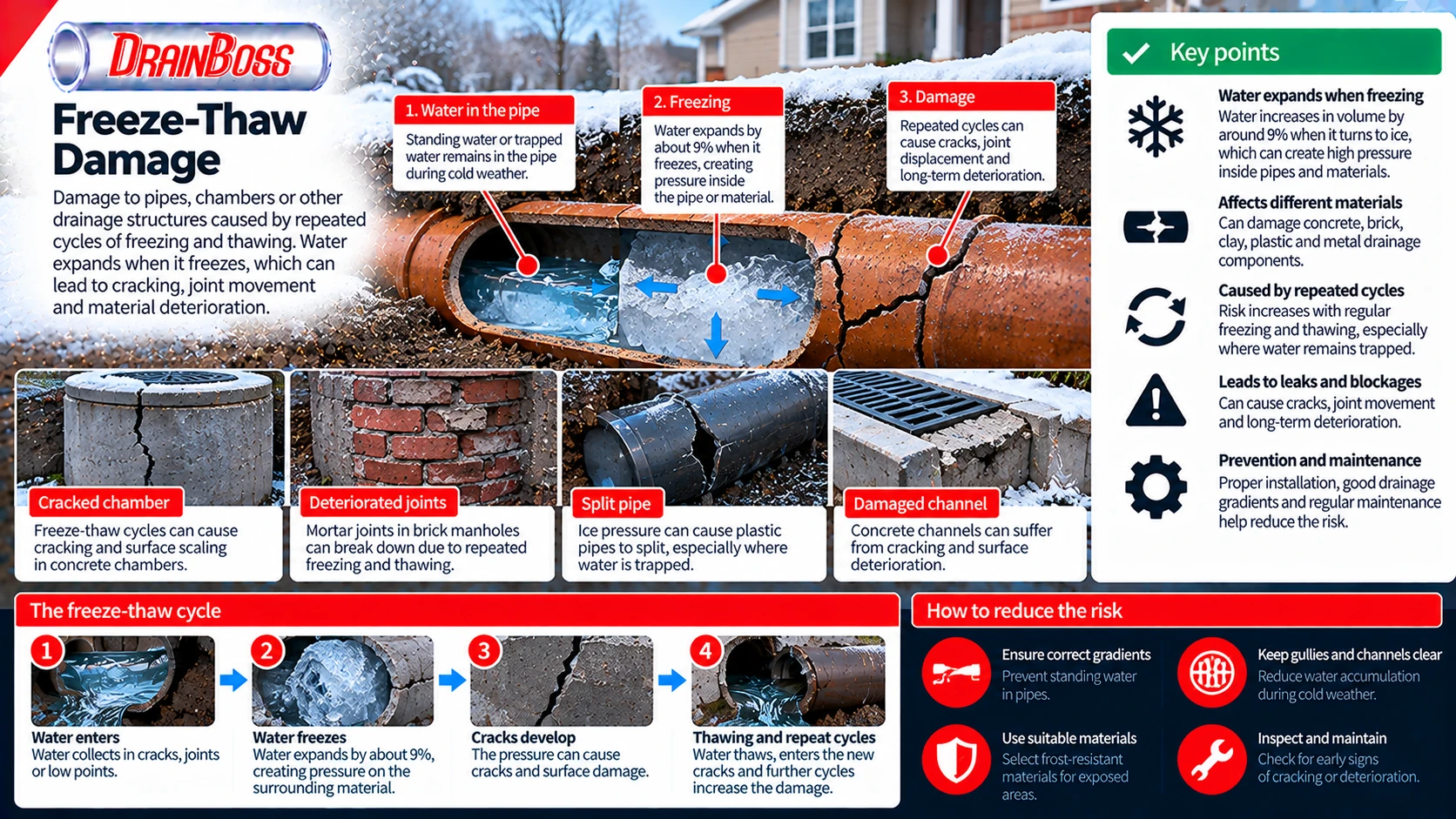
How Freezing and Thawing Damage Drainage Materials
Water expands by approximately 9% in volume when it changes from liquid to ice under ordinary atmospheric conditions. In an open container, this expansion may occur without significant damage. Inside a confined crack, saturated pore structure or blocked pipe, however, the expansion can generate stresses that exceed the strength of the surrounding material.
The behaviour of porous materials is more complex than simple volume expansion. In concrete, for example, freezing can generate hydraulic pressures as unfrozen water moves through the pore structure. Repeated freezing may progressively weaken the material, particularly when it is highly saturated and lacks sufficient resistance to frost action.
The typical deterioration process involves several stages:
-
Water enters a crack, joint, pore or other vulnerable part of the drainage structure.
-
Temperatures fall sufficiently for some of the retained water to freeze.
-
Ice formation and associated moisture movement generate internal stresses.
-
Existing cracks may widen, or small areas of material may become damaged.
-
Thawing allows water to penetrate newly formed openings.
-
Further freezing cycles can progressively increase the damage.
Not every freezing event causes deterioration. Materials with suitable pore structures, adequate strength and sufficient space to accommodate freezing water can withstand repeated exposure. Damage becomes more likely when the material remains close to saturation and experiences frequent temperature changes around freezing point.
The number of cycles is important because repeated exposure can extend existing defects. A concrete chamber wall with a small surface crack may initially remain functional, but water entering that crack can contribute to progressive deterioration during subsequent winters.
Drainage Components Most Vulnerable to Freeze-Thaw Damage
Different drainage components respond differently to freezing conditions. Concrete and masonry are susceptible to frost-related deterioration when moisture enters their pore structures, while plastic and metal pipes have different failure mechanisms. Installation quality and local drainage conditions often determine whether freezing causes permanent damage.
The table below summarises common vulnerabilities.
| Drainage component | Potential freeze-thaw damage | Main contributing factors |
|---|---|---|
| Concrete inspection chambers | Cracking, scaling and surface deterioration | Saturated concrete, exposed surfaces and existing defects |
| Brick manholes | Deteriorating mortar joints and damaged brick faces | Moisture penetration and frost-susceptible masonry |
| Shallow plastic pipes | Splitting or joint displacement under severe ice pressure | Trapped water, blocked outlets and inadequate protection |
| Clay drainage pipes | Cracking or deterioration at existing defects | Water trapped in cracks and vulnerable joints |
| Concrete drainage channels | Surface scaling and cracking | Repeated saturation and freezing |
| Gullies and trapped outlets | Cracking or deformation caused by expanding ice | Standing water and restricted drainage |
| Metal drainage components | Joint damage or deformation under ice pressure | Confined water and insufficient expansion capacity |
Concrete chambers and surface water channels can be particularly exposed because their upper sections experience direct atmospheric temperature changes. Water may enter through damaged covers, defective joints or cracks in the structure. If the material remains saturated, repeated freezing can accelerate surface deterioration.
Brick-built chambers present additional vulnerabilities. Mortar joints can deteriorate through prolonged moisture exposure, and frost action may contribute to the loss of mortar or damage to individual bricks. Older structures with existing defects may be more susceptible than sound masonry constructed using suitable materials.
Plastic drainage pipes are not porous in the same way as concrete. Their main freezing-related risk is generally associated with water trapped inside the pipe, particularly where ice formation produces significant pressure or movement. Whether the pipe fractures depends on the material, temperature, pipe geometry and degree of confinement.
Buried clay and concrete pipes may also experience frost-related problems where cracks or joints retain water. However, structural deterioration in underground drainage can have several other causes, including ground movement, loading and poor bedding. A cracked pipe should not automatically be attributed to freeze-thaw action without supporting evidence.
Installation Depth, Standing Water and Ground Conditions
The depth of a drainage installation strongly influences its exposure to freezing temperatures. Soil provides thermal insulation, so temperatures around deeply buried pipework generally fluctuate less than those at the ground surface. Shallow pipes, external gullies and exposed chamber components are more directly affected by cold weather.
There is no single frost-safe burial depth suitable for every drainage installation in the UK. Ground conditions, geographical location, surface construction and the type of drainage system all influence the appropriate arrangement. Installation requirements should be determined using relevant standards, manufacturer guidance and site-specific conditions.
Standing water is another important factor. A pipe installed with an unintended low point may retain water after normal discharge has stopped. During prolonged freezing weather, this retained water can form ice and reduce the available flow area.
A correctly graded gravity drain generally allows water to move towards the outlet, reducing the likelihood of large volumes remaining trapped in the pipe. However, some drainage components, including trapped gullies, are specifically designed to retain water. Their exposure to freezing must be considered separately.
Ground conditions can also contribute to frost-related damage. Frost-susceptible soils containing sufficient moisture may experience frost heave as ice lenses develop within the ground. This can cause upward movement and potentially disturb shallow pipes, chambers or their connections.
Frost heave differs from ice expansion inside a drainage pipe. It involves freezing processes within the surrounding soil and can affect the alignment or support of buried structures. After thawing, settlement may occur if the ground does not return uniformly to its previous condition.
The resulting movement can produce displaced joints, changes in pipe gradient or cracking around rigid connections. These defects may subsequently affect drainage performance even after the ground has completely thawed.
Recognising Freeze-Thaw Damage During Drainage Inspections
Freeze-thaw damage is not always visible from the surface. An exposed concrete channel may show cracking or scaling, while deterioration inside a buried chamber can remain unnoticed until inspection. Symptoms often become more apparent after cold weather when melting ice allows water to move through damaged sections.
Possible indicators include:
-
New or enlarged cracks in concrete chambers and drainage channels.
-
Flaking, scaling or loss of material from exposed concrete surfaces.
-
Deterioration of mortar joints in brick-built manholes.
-
Displaced pipe connections or changes in alignment.
-
Recurring leakage around chamber walls or pipe joints.
-
Localised settlement around shallow drainage structures.
-
Water escaping from pipework after freezing conditions have ended.
These observations are not conclusive evidence of freeze-thaw damage. Concrete scaling may also result from chemical exposure or abrasion, while displaced pipes may be associated with ground movement or inadequate installation. The inspection should consider the defect pattern, material condition and environmental exposure.
CCTV drain surveys can help identify cracks, joint displacement and deformation within accessible underground pipework. Chamber inspections may reveal damaged benching, deteriorating walls or water infiltration through defective joints. Where necessary, further investigation can establish whether structural repair is required.
Timing can provide useful evidence. Damage discovered immediately after a severe cold period may be consistent with freezing, particularly if the affected component contained standing water. However, defects may have existed beforehand, and freezing may simply have worsened an already vulnerable structure.
A reliable assessment should distinguish between superficial deterioration and damage affecting structural performance. Minor surface scaling does not necessarily mean that a chamber requires replacement, whereas significant cracking or displaced connections may compromise its integrity or watertightness.
Preventing Freeze-Thaw Damage in Drainage Systems
Prevention focuses on limiting water accumulation, reducing unnecessary exposure to freezing temperatures and selecting materials appropriate for the installation environment. The measures required for an exposed concrete channel differ from those needed for a buried foul drain. The drainage design should account for the expected operating conditions rather than relying on a single protective measure.
For underground pipework, suitable installation depth and adequate bedding help protect the system from temperature changes and ground movement. Correct gradients reduce unintended water retention, while properly constructed joints accommodate the requirements of the selected pipe material.
Exposed concrete drainage structures require particular attention to durability. Appropriate concrete specification, curing and construction quality influence resistance to freezing and thawing. Where concrete is expected to experience freezing while saturated, its frost resistance should be considered during material selection.
Drainage maintenance also plays a preventive role. Leaves, sediment and other debris can obstruct gullies and channels, causing water to accumulate in locations where freezing becomes more likely. Keeping these components clear reduces the amount of standing water exposed to low temperatures.
Inspection chambers should have suitable covers and properly maintained joints. Damaged covers can allow additional surface water to enter, while defective chamber walls may admit groundwater. Reducing uncontrolled water entry helps limit persistent saturation of vulnerable construction materials.
For exposed pipes carrying water intermittently, thermal insulation or other frost protection may be appropriate. Insulation slows heat loss but does not provide an unlimited guarantee against freezing, particularly during prolonged cold weather without a heat source.
Repairing Drainage Structures After Frost Damage
Repair methods depend on the material, defect severity and function of the affected component. A small area of surface deterioration in a concrete channel may require localised repair, while a fractured pipe or seriously damaged chamber may need partial or complete replacement. The underlying cause should be addressed before repairs are completed.
For concrete structures, loose or deteriorated material may need to be removed before a compatible repair system is applied. The suitability of the repair depends on the condition of the remaining concrete, the depth of damage and the exposure environment. Structural cracks require a different assessment from superficial surface scaling.
Damaged pipe sections may be repaired using suitable replacement components or, where appropriate, trenchless rehabilitation methods. However, lining or sealing a pipe will not necessarily correct inadequate support, severe displacement or continuing frost-related ground movement.
If the original problem involved standing water, restoring the damaged component without correcting the drainage gradient or outlet restriction may allow the same conditions to recur. Similarly, repairing a chamber wall without addressing persistent water ingress may leave the structure vulnerable to further deterioration.
Freeze-thaw damage is most effectively managed by combining appropriate construction materials, sound installation and reliable drainage of unwanted water. In existing systems, identifying where water becomes trapped or where materials remain persistently saturated is particularly important. Correcting these conditions can reduce the likelihood of further frost-related deterioration and extend the service life of the drainage infrastructure.