
What is a Buried Manhole
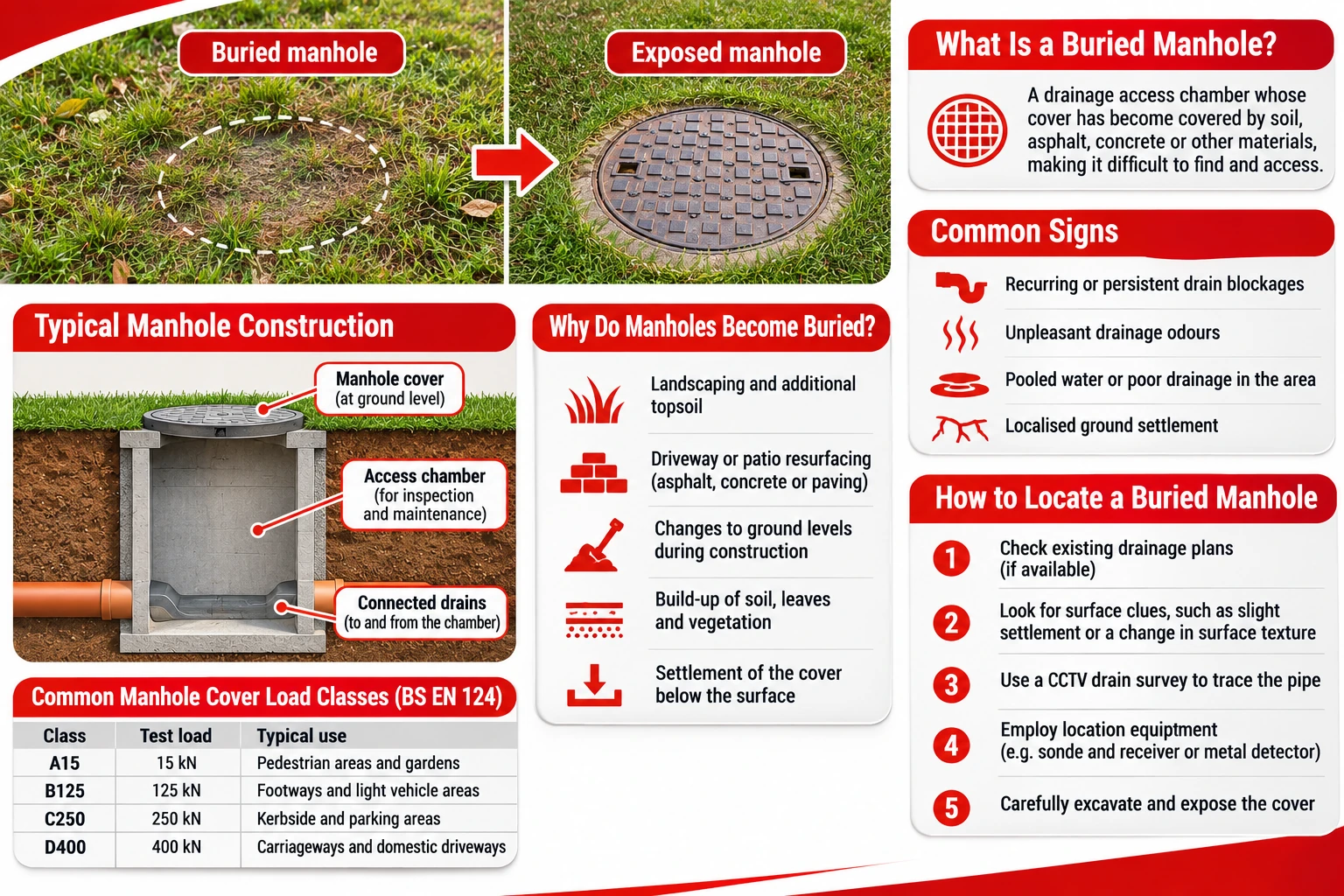
A buried manhole is an underground drainage access chamber whose cover has become concealed beneath soil, grass, asphalt, concrete, paving or other surface materials. Although the chamber may still be connected to an operational drainage system, its access point is no longer visible or readily accessible. This can make routine inspections, drain cleaning and emergency repairs more difficult, particularly when the exact location is unknown.
Buried manholes are commonly encountered on older residential properties, commercial premises and sites where landscaping or resurfacing work has altered the original ground level. A cover may have been deliberately concealed during construction or gradually covered by accumulated soil and vegetation. Locating and restoring access is important because manholes provide entry points for drainage inspection and maintenance equipment.
Why Do Manholes Become Buried?
Manholes are installed at selected points along underground drainage networks to provide access to pipes, junctions and changes in direction or level. Their covers are normally positioned at or near the finished ground surface so that maintenance personnel can open them when necessary. However, subsequent changes to the surrounding area can conceal the original access point.
One common cause is landscaping. When gardens are redesigned, additional topsoil, turf or decorative materials may be placed over existing drainage covers. Even a relatively shallow layer of soil can make a small cover difficult to identify, particularly if vegetation becomes established above it.
Driveway construction is another frequent cause. During resurfacing, contractors may install asphalt, concrete or paving over an existing manhole without raising its cover to the new finished level. The chamber remains beneath the surface, but its position may no longer be obvious.
Typical causes of buried manholes include:
-
Garden landscaping that introduces additional soil, turf or planting beds.
-
Driveway resurfacing using asphalt, concrete or block paving.
-
Construction work that changes the finished ground level.
-
Installation of patios, paths or other hard landscaping.
-
Accumulation of soil, leaves and vegetation over a recessed cover.
-
Settlement of the cover or its supporting frame below the surrounding surface.
-
Previous repairs where the original access point was not properly reinstated.
In some cases, a manhole is only partially concealed. The edges of its frame may remain visible beneath grass or loose gravel, making identification relatively straightforward. Other covers can be completely hidden beneath several layers of construction materials, requiring specialist investigation.
The distinction between a buried cover and a damaged chamber is important. A concealed manhole may remain structurally sound, while a visible cover can still have problems with its frame, chamber walls or connected drainage pipes.
How Can You Locate a Buried Manhole?
Finding a buried manhole usually begins with examining the property’s drainage layout. Existing inspection chambers, soil stacks and external drainage connections can provide clues about the likely route of underground pipes. However, the position of a hidden chamber should not be assumed from the location of individual fixtures.
Drainage plans can be useful, particularly for newer buildings or properties where previous construction records are available. These drawings may show inspection chambers, pipe routes and connection points, although the information should be verified because alterations may have occurred since the plans were prepared.
Professional drainage engineers can use several techniques to identify concealed access points.
| Location method | How it works | Main limitations |
|---|---|---|
| Drainage plans | Existing drawings indicate possible chamber locations | Plans may be outdated or incomplete |
| Visual inspection | Surface features and drainage routes are examined | Fully concealed covers may leave no visible evidence |
| CCTV drain survey | A camera follows the drainage pipe and identifies possible chamber positions | Requires suitable access to the drainage system |
| Sonde and receiver | A transmitting probe inside the drain is detected from the surface | Accuracy depends on depth, interference and site conditions |
| Metal detection | Detects suitable buried metal covers or frames | May also detect unrelated underground metal objects |
| Ground-penetrating radar | Uses reflected radar signals to identify subsurface features | Results depend on ground conditions, materials and operator interpretation |
CCTV inspection combined with a sonde and surface receiver is often a practical approach where suitable drainage access already exists. The camera can travel along the pipe while the transmitting probe is positioned near a suspected chamber. A receiver at ground level helps identify the approximate location and depth.
Metal detection may also help where the concealed cover or frame contains ferrous metal. However, nearby reinforcement, buried services and other metal objects can produce misleading signals. Plastic, composite and some recessed covers may be more difficult to detect using this method.
Ground-penetrating radar can provide additional information in suitable conditions, especially where the drainage layout is complicated. Nevertheless, it does not guarantee identification of every buried chamber, particularly in conductive soils or areas containing numerous underground services.
What Problems Can a Buried Manhole Cause?
A buried manhole does not necessarily prevent wastewater from flowing through the drainage system. If the chamber and connecting pipes remain unobstructed, the system may continue operating normally. The main problem is the loss of accessible inspection and maintenance facilities.
When a blockage develops, drainage engineers often use manholes to establish where wastewater is accumulating. If an upstream chamber is full while a downstream chamber is clear, the obstruction may lie between them. A buried access point removes one of the locations that could otherwise help narrow down the problem.
This can increase the time and complexity of investigations. Engineers may need to work from more distant access points, use additional CCTV equipment or locate the concealed chamber before attempting clearance.
Potential consequences include:
-
Delayed blockage clearance because the nearest suitable access point cannot be opened.
-
More complicated CCTV surveys when inspection equipment must travel longer distances.
-
Difficulty identifying the location of damaged pipes or drainage junctions.
-
Reduced access for cleaning equipment and maintenance operations.
-
Additional excavation or surface removal when the chamber must be exposed.
-
Increased disruption during emergency drainage repairs.
-
Difficulty inspecting the chamber walls, benching and connecting pipe openings.
A concealed manhole can also complicate building projects. If contractors are unaware of its location, excavation or foundation work may damage the chamber or connected drainage pipes. Similarly, placing heavy structures above an existing chamber can introduce loading conditions that were not considered in its original design.
The chamber itself may also deteriorate while hidden. Cracked walls, displaced pipe connections or damaged benching can remain undetected until drainage problems become apparent. However, burial alone does not establish that such defects are present.
How Is a Buried Manhole Exposed and Restored?
Once a buried manhole has been located, the next stage is determining how to expose it without damaging the cover, frame or surrounding drainage infrastructure. The appropriate method depends on the covering material, the depth of burial and whether other underground services are present.
A cover concealed beneath loose soil or turf may require relatively limited excavation. By contrast, a manhole beneath a concrete driveway may require controlled cutting and removal of the overlying surface. The work should be planned to avoid unnecessary damage to the surrounding area.
Before excavation begins, the position of underground electricity cables, gas pipes, water supplies and other services should be considered. Utility records and suitable detection methods may be necessary, particularly where mechanical excavation is proposed.
A typical restoration process involves:
-
Confirming the likely position of the manhole using suitable investigation methods.
-
Assessing the surrounding surface and identifying potential underground hazards.
-
Carefully removing the material covering the chamber.
-
Exposing the cover and frame without damaging their supporting structure.
-
Checking the condition of the cover, frame and accessible chamber components.
-
Adjusting or replacing the cover assembly where necessary.
-
Reinstating the surrounding surface to provide safe, practical access.
Simply removing the covering material may be sufficient where the original frame is sound and already positioned at an appropriate level. If the surrounding ground has been raised substantially, the chamber may require a suitable raising arrangement or reconstruction of its upper section.
Any adjustment must maintain adequate structural support and the correct relationship between the cover and surrounding surface. The selected cover should also be appropriate for its location, particularly where vehicles may pass over it.
Where a chamber is located beneath a driveway, the cover assembly must be suitable for the anticipated loading. A cover designed only for pedestrian use should not be assumed suitable for areas exposed to regular vehicle traffic.
Manhole Covers, Load Classes and Surface Requirements
Manhole covers are manufactured in different materials and load classifications. The correct specification depends on the location, expected traffic and supporting installation. In the UK, BS EN 124 is the relevant standards series for many manhole tops and gully tops installed in pedestrian and vehicular areas.
The classification system includes several load classes associated with different applications. The nominal test loads are expressed in kilonewtons (kN), although these values should not be interpreted as simple limits for the weight of an individual vehicle.
| Cover class | Nominal test load | Typical application |
|---|---|---|
| A15 | 15 kN | Areas used only by pedestrians and cyclists |
| B125 | 125 kN | Footways, pedestrian areas and certain parking areas |
| C250 | 250 kN | Kerbside channel areas |
| D400 | 400 kN | Carriageways and other areas used by road vehicles |
| E600 | 600 kN | Areas subject to high wheel loads |
| F900 | 900 kN | Areas subject to particularly high wheel loads |
The appropriate classification must be selected according to the actual installation conditions and applicable standards. For example, a domestic driveway may require a different cover specification from a garden path, depending on the vehicles using it and the cover’s position.
The frame and its supporting structure are just as important as the cover itself. Installing a correctly classified cover on an inadequate frame or poorly constructed chamber top can still result in failure.
Surface reinstatement should also prevent the cover from becoming concealed again. In paved areas, the finished level should allow safe use and maintenance access. In landscaped areas, the cover should remain identifiable and accessible without requiring substantial excavation each time inspection is needed.
Buried Manholes and UK Drainage Regulations
Drainage access is addressed within UK building regulations and associated technical guidance. In England, Approved Document H provides guidance on foul water drainage, including access arrangements for inspection and maintenance.
The guidance recognises that drains should be designed and installed so that blockages can be cleared and the system can be maintained. Access requirements depend on factors such as pipe size, changes in direction, junctions and the drainage layout.
A buried manhole may compromise the intended access arrangement, particularly where it is the only practical inspection point serving a section of underground pipework. Whether a particular installation fails to meet regulatory requirements depends on the circumstances and the standards applicable to the work.
Responsibility for restoring access also depends on ownership. A chamber serving a private drain may fall under the property owner’s responsibility, while a chamber forming part of an adopted public sewer will generally be maintained by the relevant sewerage undertaker.
In England and Wales, many private sewers and lateral drains transferred to sewerage undertakers in October 2011. This means that a manhole located within private land is not necessarily privately maintained. The status of the connected drainage system should be established before substantial alterations are undertaken.
Property owners should not independently modify public sewer access structures without appropriate authorisation. Work on adopted infrastructure may require the sewerage undertaker’s approval, even when the chamber is situated within a garden or driveway.
Can a Buried Manhole Be Permanently Covered?
Permanently covering a manhole is generally undesirable where it provides necessary access to an operational drainage system. The chamber may be needed for blockage clearance, CCTV inspection, repairs or maintenance of connected pipes. Removing that access can make future work more disruptive and expensive.
There are situations where an existing chamber may become redundant following an approved drainage alteration. For example, a redesigned pipe route may eliminate the need for a particular access point. However, any proposal to abandon or remove a chamber should be assessed as part of the drainage design.
Covering an operational manhole with concrete, asphalt or a permanent structure is different from installing a suitable recessed access cover. Recessed covers can accommodate compatible paving or other finishes while remaining removable for maintenance. Their load rating, frame support and installation must still be appropriate for the location.
Before covering or altering a chamber, several questions should be addressed:
-
Does the chamber provide essential access to an operational drain or sewer?
-
Are there alternative inspection points that provide adequate maintenance access?
-
Is the chamber privately owned or part of an adopted sewer network?
-
Will the proposed surface treatment allow the cover to be removed?
-
Is the cover and frame suitable for the expected loading?
-
Could future building or landscaping work restrict access?
-
Are approvals required before the drainage arrangement is changed?
These considerations are particularly important when constructing extensions, patios and driveways. Locating drainage chambers during the planning stage can prevent costly alterations after construction has begun.
Preventing Manholes from Becoming Buried Again
Once a buried manhole has been exposed, the surrounding surface should be arranged to preserve access. The most appropriate solution depends on whether the chamber is located in a garden, paved area, driveway or commercial surface.
In landscaped areas, the cover should remain visible or readily identifiable. Additional soil and turf should not be allowed to accumulate over the access point. Where ground levels are being raised, the chamber top may need to be adjusted to match the new finished level.
For driveways and patios, the cover should be incorporated into the finished surface using a suitable frame and cover assembly. Recessed covers can provide a more discreet appearance without eliminating access, provided they are correctly specified and installed.
Maintaining accurate drainage records is another useful preventative measure. Property owners can record chamber locations, pipe routes and access arrangements when drainage surveys or construction work are completed. This information can help future contractors avoid accidentally covering important drainage infrastructure.
A buried manhole is primarily an accessibility problem, but it can have wider consequences for drainage maintenance and repair. Restoring access allows the chamber and connected pipework to be inspected, cleaned and maintained when necessary. Identifying concealed manholes before landscaping or construction work is therefore an important part of protecting an existing drainage system.