
What is a Crushed Pipe
A crushed pipe is a drainage pipe that has been severely compressed, deformed or broken by external forces. The damage can reduce the internal diameter, obstruct wastewater flow or cause the pipe to lose its structural integrity. Crushed pipes are most commonly associated with excessive ground loading, inadequate bedding, construction activity and movement of the surrounding soil.
In underground drainage systems, the term is generally used to describe substantial structural damage rather than a minor crack or isolated joint defect. A rigid clay or concrete pipe may fracture and collapse under excessive loading, while a flexible plastic pipe may flatten or deform. The consequences depend on the pipe material, the extent of the damage and whether the surrounding ground continues to provide adequate support.
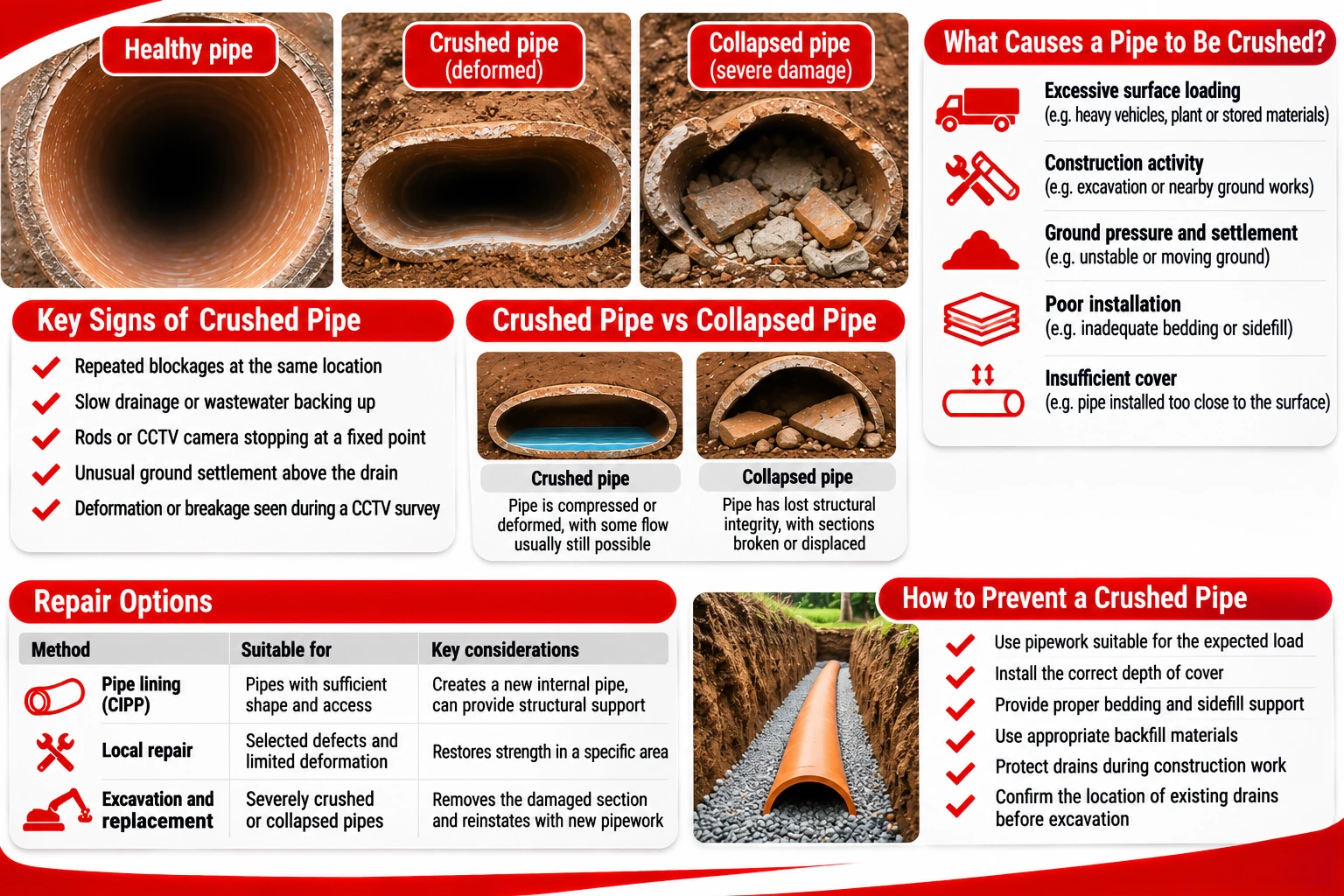
What Causes a Drainage Pipe to Become Crushed?
Underground drainage pipes must withstand loads from the soil above them, groundwater conditions and any additional pressure applied at the surface. Their ability to resist these forces depends on the pipe’s strength, the quality of its installation and the support provided by the surrounding material.
A correctly installed buried pipe works together with its bedding and sidefill to distribute external loads. If that support is inadequate, pressure may become concentrated on a relatively small section of the pipe, increasing the risk of deformation or fracture.
The main causes of crushed drainage pipes include:
-
Excessive surface loading. Heavy vehicles, construction machinery or stored materials can impose loads beyond those allowed for in the pipe installation.
-
Insufficient cover. Pipes installed at shallow depths may be more vulnerable to surface loads if suitable protection has not been provided.
-
Poor bedding. Uneven or unsuitable bedding can create concentrated contact pressures beneath the pipe.
-
Inadequate sidefill compaction. Flexible pipes rely on surrounding soil support to resist deformation, particularly at their sides.
-
Ground settlement. Uneven movement of the surrounding soil can leave sections unsupported or subject them to additional stress.
-
Construction damage. Excavators, compactors and other equipment can directly strike or overload buried pipes.
-
Deterioration of existing pipework. Corrosion, cracking or loss of material can reduce the pipe’s ability to withstand external loads.
The effect of these factors varies between rigid and flexible pipe materials. Vitrified clay and concrete pipes resist loading primarily through their structural strength and interaction with the surrounding ground. When their capacity is exceeded, they may crack or break into separate pieces.
Plastic drainage pipes, including PVC-U and polypropylene systems, behave differently. They can undergo some deformation without immediate fracture, provided the installation and pipe specification permit it. Excessive deformation, however, can compromise flow capacity, joints and long-term structural performance.
A crushed pipe does not necessarily indicate that a heavy vehicle has driven directly over it. Inadequate installation support, changes in ground conditions and progressive deterioration can also contribute to failure.
What Happens When a Pipe Is Crushed Underground?
Crushing changes the shape or structural condition of the pipe, often reducing the space available for wastewater to pass. The damage may be concentrated in a short section or extend over a longer length of the drainage run.
In a rigid pipe, crushing may produce multiple fractures, displaced fragments or a complete collapse of the internal opening. In a flexible pipe, the cross-section may become noticeably flattened or distorted.
The resulting defects can affect drainage in several ways.
| Type of damage | Typical condition | Possible consequence |
|---|---|---|
| Localised deformation | Pipe wall compressed in one area | Reduced flow area |
| Ovalisation | Circular pipe becomes noticeably oval | Restricted capacity and possible joint stress |
| Multiple fractures | Rigid pipe develops several structural cracks | Leakage and progressive deterioration |
| Displaced fragments | Broken pipe material projects into the flow channel | Debris accumulation and blockages |
| Partial collapse | Part of the pipe wall moves into the internal opening | Severe flow restriction |
| Complete collapse | Internal passage becomes obstructed or structurally destroyed | Loss of drainage function |
A reduction in internal dimensions can have a significant effect on the available flow area. For example, a circular pipe with an internal diameter of 100 mm has a cross-sectional area of approximately 7,850 mm². If deformation reduces the effective opening, the available area becomes smaller, although the exact reduction depends on the resulting shape.
Flow performance cannot be determined from the smallest internal dimension alone. The pipe gradient, roughness, wastewater depth and extent of deformation also influence its hydraulic capacity.
Crushed pipes can also create problems outside the drainage system. Where the pipe wall has fractured, wastewater may escape into the surrounding soil. Groundwater and fine soil particles may enter through the damaged section when external conditions allow.
Over time, the movement of soil into a broken drain can reduce support around the pipe. This may contribute to further settlement or localised ground instability, particularly if the damage remains unresolved.
How Can You Tell If an Underground Drain Is Crushed?
A crushed pipe can produce symptoms similar to those caused by an ordinary blockage. Slow drainage, repeated wastewater backups and overflowing inspection chambers may all occur when the pipe’s internal opening becomes restricted.
The difference is that conventional cleaning may not restore the original flow path. If the pipe has physically collapsed, removing accumulated debris will not correct the underlying structural defect.
Possible warning signs include:
-
Repeated blockages at the same location despite previous cleaning.
-
Wastewater backing up through several connected fixtures.
-
Drain rods or inspection equipment repeatedly stopping at a fixed point.
-
Unusual settlement or depressions in the ground above a drainage run.
-
Visible pipe fragments or structural damage during CCTV inspection.
-
Continued drainage problems following nearby excavation or construction work.
None of these symptoms confirms a crushed pipe on its own. A severe grease blockage, root intrusion or displaced joint can produce similar effects.
CCTV drain inspection is commonly used to assess the condition of accessible underground pipes. The camera may reveal deformation, fractured walls, missing sections or debris trapped around the damaged area.
Where the pipe is completely collapsed, the camera may be unable to travel beyond the obstruction. The inspection can establish the location of the accessible face of the damage, but it may not reveal the full extent of the affected section.
A camera sonde and surface receiver may help locate the inspection head above ground. This information can assist with planning excavation, although the position and depth should be verified as appropriate before digging.
For flexible pipes, measured deformation can provide useful information about structural condition. However, acceptable deformation limits depend on the pipe specification, installation requirements and relevant standards. A single percentage should not be applied to every plastic drainage pipe.
Crushed Pipe vs Collapsed Pipe: What Is the Difference?
The terms crushed pipe and collapsed pipe are sometimes used interchangeably, but they do not always describe exactly the same condition.
A crushed pipe has been compressed or structurally damaged by external loading. The pipe may still retain part of its internal opening, even if its shape has changed substantially.
A collapsed pipe has lost sufficient structural integrity for part or all of its wall to fall or move into the drainage channel. Collapse may result from crushing, but it can also develop through deterioration, corrosion, loss of ground support or other mechanisms.
The distinction is useful when assessing repair options:
-
A deformed plastic pipe may remain continuous but have an unacceptable reduction in its internal opening.
-
A fractured clay pipe may retain its general shape while allowing leakage or soil entry.
-
A partially collapsed pipe may contain displaced fragments that obstruct flow.
-
A completely collapsed pipe may have no usable internal passage remaining.
In practice, the important question is not simply which term is used. The engineer must determine whether the pipe can still perform its drainage function and whether its remaining structure is adequate.
Cracking, deformation and collapse can also occur together. For example, a rigid pipe may develop longitudinal fractures under excessive external loading before sections of its wall move inward.
Can a Crushed Drain Pipe Be Repaired Without Excavation?
The appropriate repair depends on how much the pipe has deformed, whether its walls remain intact and whether the surrounding ground provides sufficient support.
Trenchless rehabilitation methods can be suitable for some damaged drainage pipes, but they generally require a sufficiently open and stable passage for cleaning, inspection and installation equipment.
Cured-in-place pipe lining (CIPP) is one method used to rehabilitate suitable existing pipes. A resin-impregnated liner is installed and cured to form a new internal pipe. Depending on its design, a liner may provide structural rehabilitation, but it does not automatically restore the original shape of a severely crushed pipe.
Where a pipe is significantly flattened, fractured into displaced sections or completely collapsed, excavation and replacement are often necessary.
The main repair options include:
-
Localised structural repair. Suitable for selected defects where the pipe retains sufficient shape and access.
-
Full-length pipe lining. May be appropriate where the host pipe can accommodate the liner and the rehabilitation design meets the required performance.
-
Excavation and replacement. Used where the pipe has lost its shape, suffered severe fracture or cannot be rehabilitated internally.
-
Bedding and ground remediation. Required where inadequate support or settlement contributed to the failure.
High-pressure water jetting and mechanical cleaning can remove debris from a damaged pipe, but they do not restore its structural strength. Aggressive cleaning may also worsen the condition of fractured or unstable pipework.
When excavation is necessary, the affected section should be removed and replaced with suitable pipework. The surrounding bedding, sidefill and backfill must also be assessed because replacing the pipe without correcting the cause of the crushing may lead to another failure.
After repair, inspection and appropriate testing can help verify the condition and operation of the drainage system.
How Can Crushed Pipes Be Prevented?
Preventing pipe crushing begins with selecting suitable pipe materials and designing the installation for the expected ground and surface loads.
Pipe diameter alone does not determine structural strength. Wall construction, stiffness classification, material properties and installation conditions all affect the pipe’s resistance to external forces.
Important preventative measures include:
-
Select pipework suitable for the intended burial depth, ground conditions and loading.
-
Prepare the trench foundation and bedding according to the pipe specification.
-
Provide uniform support beneath the pipe barrel and appropriate support around joints.
-
Place and compact sidefill correctly, particularly around flexible pipes.
-
Use suitable backfill materials and avoid large stones directly against the pipe.
-
Protect shallow pipes where vehicle or construction loading is expected.
-
Prevent construction machinery from applying excessive loads before sufficient cover is in place.
-
Check the completed installation for alignment, damage and deformation where required.
In England, Approved Document H provides guidance on drainage installations, including pipe laying, protection and access. Detailed installation requirements also depend on the relevant product standards, design specifications and site conditions.
For buried plastic drainage systems, BS EN 1610 is among the relevant standards addressing the construction and testing of drains and sewers. The appropriate installation method must account for pipe characteristics and the surrounding ground.
Special consideration may be necessary beneath driveways, roads and areas used by heavy vehicles. A pipe suitable for a lightly loaded garden may require different protection or installation arrangements where substantial traffic loading is expected.
Existing drains should also be identified before excavation or building work begins. Damage caused by machinery can be avoided more effectively when the route and approximate depth of buried pipework are known.
When Does a Crushed Pipe Require Urgent Repair?
A crushed pipe should be assessed promptly when it causes sewage to back up, prevents normal drainage or allows significant leakage. Complete collapse can make a drainage system unusable, particularly where several fixtures discharge through the affected section.
Visible ground settlement, suspected void formation or damage beneath a building or heavily trafficked area may require additional investigation. These conditions can indicate problems extending beyond the pipe itself.
Where wastewater is backing up into a property, use of the affected drainage fixtures should be minimised until the problem has been assessed. If the damaged section belongs to a public sewer or a lateral drain maintained by the sewerage undertaker, the relevant water company should be contacted.
A crushed pipe is fundamentally a structural problem rather than an ordinary blockage. CCTV inspection can help establish the nature and location of the damage, while an assessment of the pipe and surrounding ground determines whether rehabilitation or replacement is appropriate. Correcting both the damaged section and the conditions responsible for its failure is essential to restoring reliable drainage.