What is a Drain Odour Test
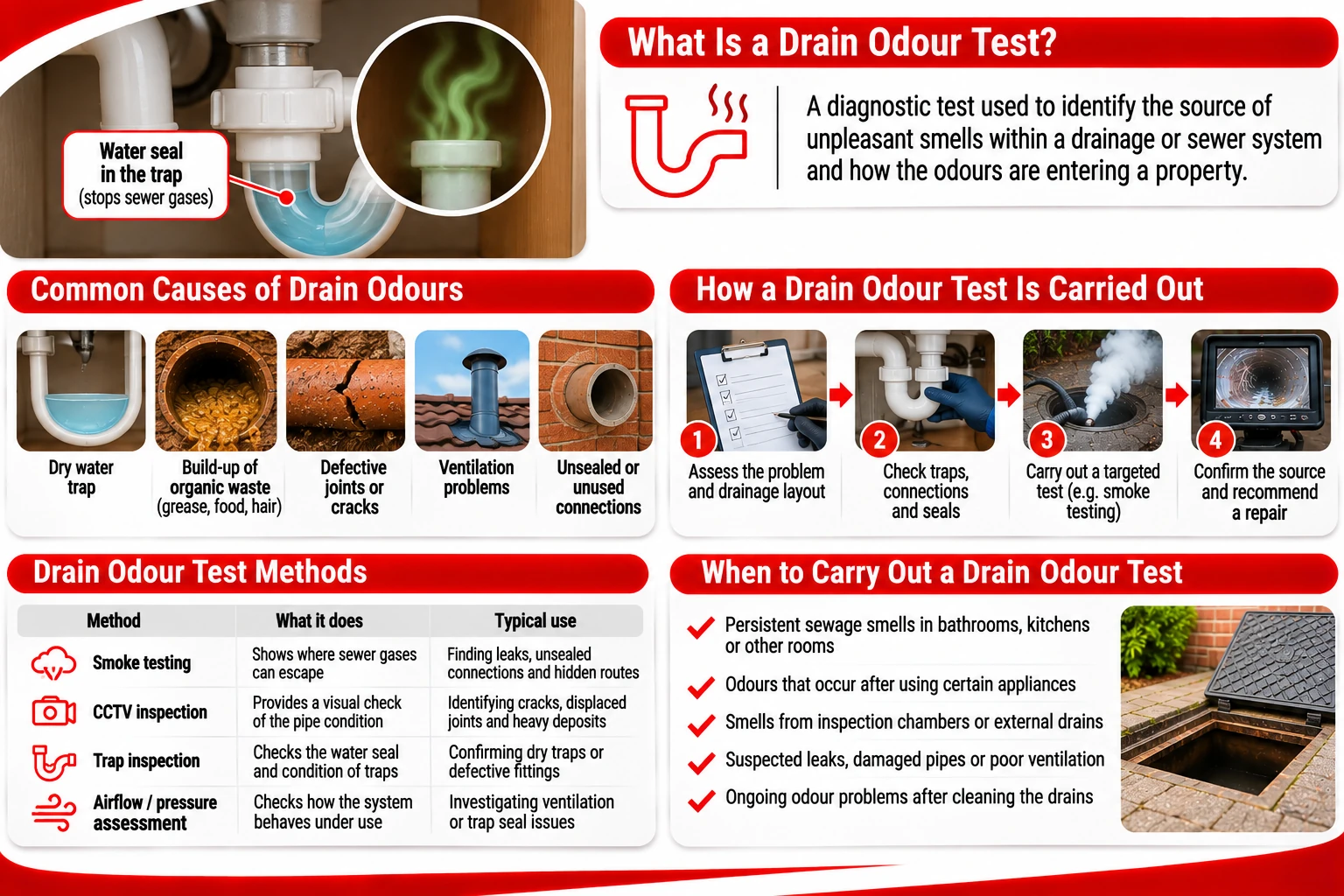
A drain odour test is a diagnostic investigation used to identify where unpleasant smells are originating within a drainage or sewer system and how they are reaching a property or surrounding area. The investigation may involve checking water traps, inspecting pipe connections, tracing airflow or introducing controlled test smoke into suitable drainage pipework. Its purpose is to distinguish between odours caused by accumulated waste and those escaping through defective seals, damaged pipes or incorrectly configured drainage connections.
Drain odours are commonly associated with hydrogen sulphide and other compounds produced during the decomposition of organic matter in wastewater. However, a noticeable sewage smell does not automatically mean that a pipe is leaking or blocked. Sewer gases can enter a building through a dry trap, an unsealed connection or a ventilation defect, even when wastewater continues to drain normally. An effective drain odour test therefore investigates both the source of the smell and the route by which it escapes.
What Causes Drain Odours and How Do They Enter a Property?
Unpleasant drainage smells generally arise from decomposing organic material, stagnant wastewater or gases present within the drainage system. Wastewater contains substances that microorganisms break down over time, particularly where oxygen is limited. This process can produce hydrogen sulphide, which is associated with a characteristic rotten-egg smell, alongside other volatile compounds.
The presence of these compounds inside a sewer is not necessarily evidence of a defect. Drainage systems are designed to carry wastewater containing organic matter, and properly functioning traps, joints and ventilation arrangements help prevent sewer gases from entering occupied spaces.
Odour problems develop when gases escape from the drainage system or when waste accumulates in locations where it can decompose. Several mechanisms can produce similar symptoms, making the smell alone an unreliable guide to the underlying problem.
Common causes include:
-
Dry water traps. Water evaporates from an infrequently used basin, shower, bath or floor drain, removing the barrier that normally prevents sewer gases from entering the room.
-
Trap seal loss. Negative pressure, positive pressure or unsuitable plumbing arrangements can disturb the water seal and allow odours to pass through.
-
Defective pipe joints. Damaged seals, loose connections or deteriorated fittings may allow gases to escape without producing an obvious wastewater leak.
-
Blocked or poorly functioning ventilation. Problems with drainage ventilation can contribute to pressure fluctuations and interfere with trap performance.
-
Organic deposits. Grease, food residue, hair and other waste can decompose inside traps, gullies and sections of pipework.
-
Damaged underground drains. Cracks, displaced joints and defective connections may allow sewer gases to escape into surrounding ground or nearby voids.
-
Unsealed or redundant connections. Disconnected appliances, abandoned pipe branches and missing access covers can provide direct routes for odour.
-
Standing wastewater. Poorly draining pipe sections or neglected gullies may retain organic material and encourage persistent smells.
The location of the smell provides useful initial evidence. Odours concentrated around a single basin may originate from its trap, waste pipe or overflow channel, whereas smells affecting several rooms may suggest a shared drainage or ventilation problem. External odours near an inspection chamber, gully or underground drain require a different investigation from smells emerging through a bathroom fitting.
Timing also matters. A smell that appears after a toilet is flushed or a washing machine empties may be associated with pressure changes in the drainage system. Odours that become noticeable after prolonged periods without using a fixture may instead indicate evaporation from its trap.
Weather conditions can influence how smells are perceived. Wind direction, atmospheric conditions and airflow around buildings may change the way gases disperse, while rainfall can alter wastewater levels and drainage conditions. These observations are useful diagnostic clues, but none proves a particular defect without supporting evidence.
How Is a Drain Odour Test Carried Out?
A drain odour investigation normally begins with a systematic assessment of the affected area rather than immediately introducing smoke or specialist equipment. The engineer needs to establish whether the smell is coming from the drainage system, from waste deposits around a fixture or from another source entirely.
The first stage involves discussing when the smell occurs, which rooms or external areas are affected and whether any drainage symptoms accompany it. Slow discharge, gurgling, recurring blockages and changes in trap water levels can help identify the sections requiring closer attention.
A typical investigation may include the following steps:
-
Identify the affected area. Establish where the odour is strongest and whether it is associated with particular fixtures, chambers or external drainage points.
-
Check accessible water traps. Confirm that traps contain water and inspect visible fittings for leakage, loose connections or accumulated waste.
-
Examine drainage ventilation. Check accessible ventilation arrangements for obvious defects, obstructions or unsuitable terminations.
-
Inspect exposed pipework and access fittings. Look for missing caps, defective seals, disconnected branches and damaged connections.
-
Assess operating conditions. Observe whether the odour changes when appliances discharge or several fixtures are used.
-
Select a targeted test. Use smoke testing, airflow assessment, CCTV inspection or another appropriate method where the initial checks do not establish the cause.
-
Verify the suspected defect. Relate the test findings to the drainage layout and confirm whether the identified opening or condition provides a plausible odour pathway.
This sequence avoids treating every drainage smell as evidence of a damaged underground sewer. A dried-out trap can often be identified through a simple inspection, whereas a concealed defective connection may require more extensive testing.
One important distinction is between the location where a smell is noticed and the location where gas enters the building. Sewer gas escaping beneath a suspended floor or into a service void may travel through openings around pipes before becoming noticeable elsewhere. Investigating only the room where the odour is strongest can therefore lead to an incorrect conclusion.
The engineer should also consider sources that are not directly connected to the drainage network. Mould, decaying material, contaminated ventilation equipment and other building defects can produce smells that occupants initially describe as sewage odours. A drain odour test should establish evidence of a drainage-related source rather than assuming one exists.
Smoke Testing, Trap Checks and Other Odour Investigation Methods
Different diagnostic methods answer different questions. Smoke testing can reveal unintended gas escape routes, while trap inspections and pressure observations help investigate whether sewer gases can pass through sanitary fittings. CCTV provides information about visible internal pipe conditions but is not, by itself, a direct test for gas leakage.
The following table summarises the main methods used in drainage odour investigations.
| Investigation method | What it helps identify | Main limitation |
|---|---|---|
| Water trap inspection | Dry traps, missing seals and visible fitting defects | Does not assess concealed pipework |
| Drain smoke testing | Openings or defective connections through which test smoke can escape | Results depend on isolation, airflow and test conditions |
| CCTV drain inspection | Visible cracks, displaced joints, deposits and other internal defects | Cannot reliably prove whether a joint is gas-tight |
| Trap seal observation | Changes in water levels during drainage discharge | May require repeated observations to reproduce intermittent problems |
| Drainage pressure assessment | Pressure behaviour associated with ventilation or trap seal problems | Requires suitable equipment and interpretation |
| Dye testing | Routes taken by water and possible drainage misconnections | Does not directly trace the movement of sewer gases |
| Gas detection equipment | Presence or concentration of specific gases at the measurement point | Does not necessarily identify the route or original source |
Smoke testing is particularly useful where a drainage system appears to function normally but sewer-like odours persist. In a controlled test, a suitable smoke-generating device introduces visible test smoke into an appropriately prepared section of pipework. The engineer observes where the smoke emerges and determines whether it is escaping through an intended ventilation opening or an unintended route.
Smoke emerging from a properly positioned open vent terminal may be expected. By contrast, smoke appearing around a disconnected waste pipe, an unsealed access fitting or a defective connection may indicate a pathway through which sewer gases could escape during normal operation.
The test requires careful preparation. Relevant openings may need to be isolated according to the test procedure, and occupants should be informed before smoke is introduced. The equipment, smoke product and test conditions must be suitable for the drainage system and building, particularly where sensitive occupants, smoke detectors or other building systems could be affected.
Smoke testing does not establish the exact rate of gas leakage, and an absence of visible smoke at a particular location does not guarantee that the system is completely gas-tight. Intermittent defects, inaccessible voids and variations in airflow may influence the findings.
Water trap assessment provides a different type of evidence. A typical 50 mm water seal offers a physical barrier against sewer gases, although actual requirements depend on the sanitary appliance, trap design and applicable installation guidance. The relevant issue is whether sufficient water remains in the trap during normal use and under the pressure conditions experienced by the system.
For example, a trap may initially contain water but lose part of its seal when another fixture discharges. This can occur where pressure conditions are unsuitable, the pipe arrangement encourages self-siphonage or the ventilation system is not functioning as intended. Observing the trap during representative appliance use may reveal a problem that would be missed during a static inspection.
Interpreting Test Results and Identifying the Correct Repair
The outcome of a drain odour test should identify a credible source or escape route and establish what action is required. Finding an odour near a drainage component is not sufficient evidence that the component is defective, particularly where several possible sources are present.
For instance, a strong smell near an external inspection chamber may originate from wastewater within the chamber, a defective cover seal or a nearby gully. The engineer must distinguish between an odour released when the chamber is deliberately opened and one escaping during normal operation.
Several findings have relatively direct implications. A missing access cap provides an obvious opening into the drainage system, while a visibly dry trap explains why gases may pass through a fixture. Other findings require further interpretation, particularly where odours are intermittent or where smoke emerges through a concealed building void.
The appropriate corrective action depends on the confirmed cause:
-
Dry trap: restore the water seal and investigate why the trap is losing water if the problem recurs.
-
Defective trap or waste connection: repair or replace the affected component and check the completed joint.
-
Organic deposits: clean the affected trap, gully or pipe section and remove retained waste.
-
Ventilation problem: investigate the drainage arrangement and correct the identified defect using a suitable design.
-
Unsealed redundant pipe: permanently seal or remove the unused connection using an appropriate method.
-
Defective underground pipe: assess whether localised repair, lining or excavation is suitable for the damage.
-
Repeated trap seal loss: investigate pressure conditions and the configuration of connected pipework rather than repeatedly refilling the trap.
Repairs should address the mechanism allowing the smell to escape. Installing an air freshener or repeatedly applying drain cleaner may temporarily mask an odour, but neither corrects a missing water seal or defective pipe connection.
Likewise, high-pressure drain cleaning is not automatically necessary whenever a property smells of drains. Cleaning is appropriate where accumulated waste or a blockage is contributing to the problem, but it will not correct a poorly sealed joint or an incorrectly configured ventilation arrangement.
Following corrective work, the relevant conditions should be checked again. A repaired connection may be examined for leakage or subjected to an appropriate test, while a trap seal problem may require observation during normal appliance discharge. Where smoke testing originally identified an escape route, repeating a suitable targeted test can help verify that the opening has been addressed.
Persistent odours following a repair do not necessarily mean the repair has failed. More than one source may be present, or the original investigation may not have captured the conditions under which the smell occurs. In such cases, a record of the timing, location and associated appliance use can help direct further investigation.
Drain Odours, Sewer Gases and Safety Considerations
Drainage odours are often treated as a nuisance, but some sewer gases can present health and safety hazards. Hydrogen sulphide is particularly important because it is toxic at elevated concentrations and can accumulate in poorly ventilated spaces. Methane may also be present in sewer atmospheres and can create a flammability hazard under certain conditions.
The characteristic rotten-egg smell associated with hydrogen sulphide must not be used as a reliable indication of safety. The human sense of smell cannot measure gas concentration, and exposure to higher concentrations can impair the ability to detect the gas. A faint odour does not establish a safe atmosphere, while the absence of a smell does not prove that hazardous gases are absent.
Drainage engineers should therefore distinguish between ordinary odour investigation in occupied areas and work involving potentially hazardous sewer atmospheres. Underground chambers, manholes and enclosed drainage spaces may require specialist assessment and atmospheric monitoring. Entry into confined spaces must be avoided unless the work has been properly assessed and suitable safety arrangements are in place.
Practical precautions during an odour investigation include:
-
Avoid entering inspection chambers, manholes or other confined drainage spaces without the necessary training, equipment and safety procedures.
-
Do not deliberately inhale gases from open drains or attempt to identify hazardous substances by smell.
-
Use appropriate gas detection equipment where a hazardous atmosphere is suspected.
-
Avoid introducing ignition sources where flammable gases may be present.
-
Stop the investigation and seek appropriate specialist assistance if there is evidence of a potentially dangerous atmosphere.
-
Ensure smoke testing and other diagnostic procedures are carried out using equipment and methods suitable for the premises.
A suspected natural gas leak must not be treated as an ordinary drain odour problem. If the smell could be associated with a gas supply, the appropriate gas emergency procedure should be followed rather than continuing drainage tests.
For routine domestic drainage odours, the investigation can often begin with accessible traps, fittings and ventilation arrangements without disturbing underground pipework. More complex cases may require coordinated examination of the drainage system and the building spaces through which odours travel.
A drain odour test is most effective when it identifies both the source of the unwanted gases and the route by which they reach the affected area. By combining observations of trap seals, pipe connections, ventilation behaviour and targeted testing, an engineer can distinguish a simple maintenance issue from a concealed drainage defect. This allows the repair to address the actual cause of the smell rather than relying on repeated cleaning or temporary odour control.