What is a Chemical Descaling
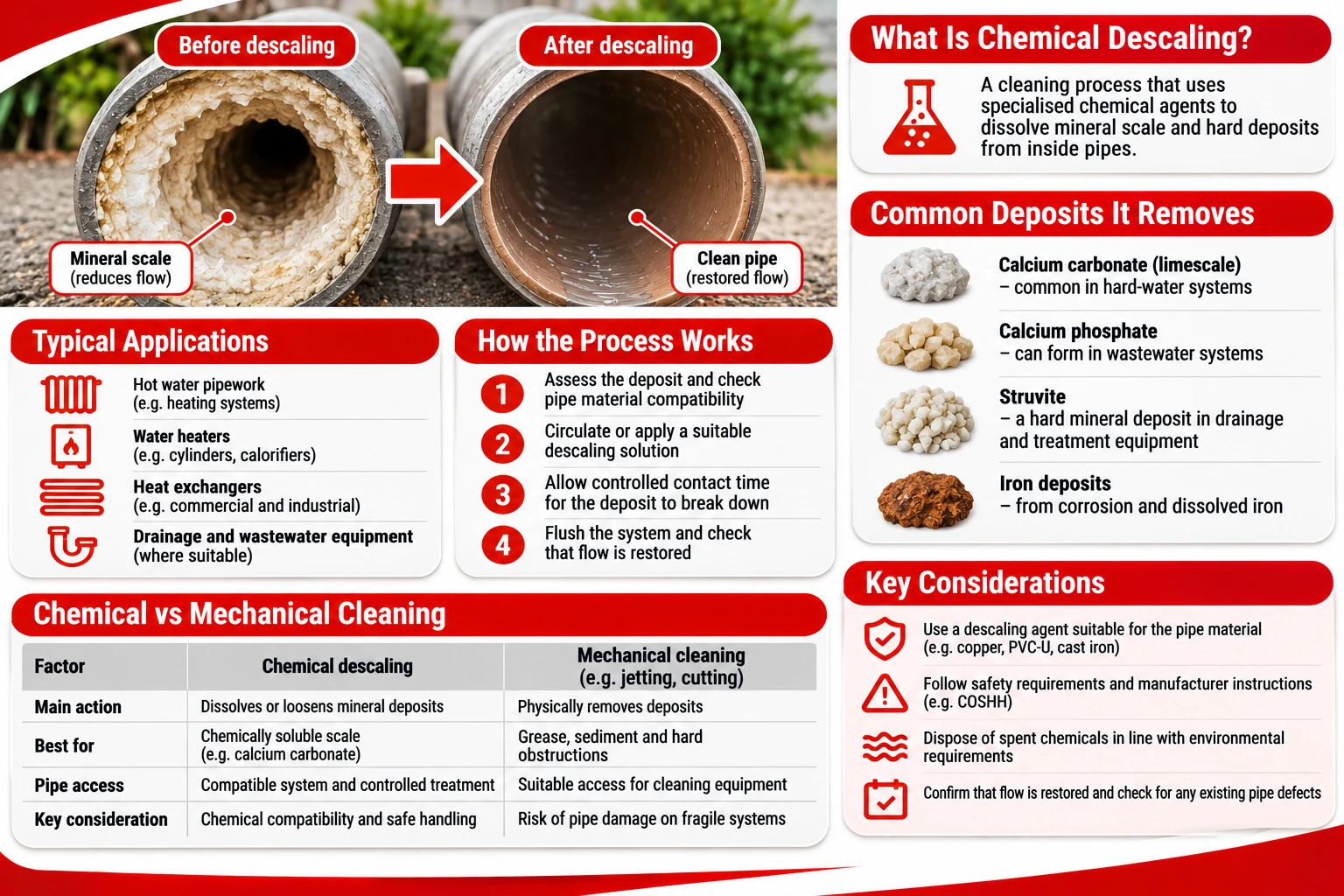
Chemical descaling is a specialist pipe-cleaning process that uses chemical agents to dissolve or loosen mineral scale and other chemically removable deposits. It is used in plumbing, water supply, heating and certain drainage systems where hard deposits accumulate on internal surfaces and restrict the movement of water. The cleaning agent is selected according to the deposit composition, pipe material and operating conditions.
Unlike conventional drain unblocking, which usually involves removing physical obstructions, chemical descaling targets deposits that can be broken down through controlled chemical reactions. It is particularly effective against certain calcium carbonate deposits, commonly known as limescale. However, not every hard obstruction is suitable for chemical treatment, and inappropriate chemicals can damage pipework, seals or connected equipment.
Why Does Mineral Scale Build Up Inside Pipes?
Mineral scale forms when dissolved substances in water become insoluble and accumulate on pipe surfaces. Calcium carbonate is one of the most common deposits in domestic water systems, particularly in hard-water areas. Water hardness is primarily associated with dissolved calcium and magnesium, although the formation of scale also depends on temperature, pH and other aspects of water chemistry.
Heating water can encourage calcium carbonate precipitation by changing the balance of dissolved carbonate compounds. This explains why scale frequently develops inside water heaters, heat exchangers and hot water pipework. In these systems, deposits can reduce heat transfer efficiency, restrict flow and increase the energy required to maintain operating temperatures.
Mineral deposits also occur in drainage infrastructure, although the mechanisms can differ from those found in drinking water systems. Groundwater infiltration, wastewater composition and chemical reactions within pipes can all contribute to the formation of hard deposits. In some sewer environments, calcium-rich material can accumulate around joints or areas where water enters through defects.
The most relevant types of deposits include:
-
Calcium carbonate: A common constituent of limescale, particularly in hard-water systems.
-
Calcium phosphate: A mineral deposit that can form under certain wastewater and industrial conditions.
-
Struvite: A crystalline magnesium ammonium phosphate mineral associated with some wastewater treatment processes.
-
Iron-containing deposits: Materials that may develop through corrosion or precipitation of dissolved iron.
-
Mixed deposits: Accumulations containing minerals, sediment, grease and organic material.
The composition of a deposit determines how readily it can be removed. A chemical suitable for calcium carbonate may have little effect on another mineral or may produce undesirable reactions. For this reason, identifying the deposit is an important part of selecting a cleaning method.
Scale reduces the internal space available for water to flow. For example, a pipe with an internal diameter of 50 mm has a cross-sectional area of approximately 1,963 mm². If a uniform 5 mm layer of scale forms around the internal circumference, the remaining diameter becomes 40 mm and the available area falls to approximately 1,257 mm².
This represents a reduction of about 36% in cross-sectional area. The actual effect on flow depends on the pipe gradient, pressure, roughness and operating conditions, but the example demonstrates why relatively modest deposits can cause noticeable restrictions in smaller pipes.
How Chemical Descaling Removes Hard Deposits
Chemical descaling relies on selecting a cleaning solution that reacts with the material being removed. Acid-based products are commonly used for suitable carbonate deposits because acids can convert calcium carbonate into soluble reaction products. The effectiveness of treatment depends on chemical concentration, contact time, temperature, deposit thickness and the characteristics of the cleaning solution.
For example, calcium carbonate reacts with suitable acids, releasing carbon dioxide as part of the reaction. This can help break down mineral deposits, but it also means that gas generation must be considered when designing a treatment process. Chemical cleaning should not be carried out in an uncontrolled sealed system where pressure could accumulate.
Specialist descaling products may contain organic or inorganic acids, corrosion inhibitors, wetting agents and other additives. The formulation is selected to achieve the required cleaning effect while limiting damage to compatible system materials. The presence of corrosion inhibitors does not automatically make a chemical safe for every pipe, fitting or seal.
The main factors influencing descaling performance are summarised below.
| Factor | Effect on chemical descaling |
|---|---|
| Deposit composition | Determines whether the cleaning agent can dissolve or loosen the material |
| Chemical concentration | Influences reaction rate and compatibility with system components |
| Contact time | Determines how long the cleaning solution can act on the deposit |
| Temperature | Can affect reaction speed and chemical stability |
| Flow and circulation | Helps bring fresh solution into contact with deposits and remove reaction products |
| Pipe material | Determines which cleaning agents can be used without unacceptable deterioration |
| Deposit thickness | Influences the amount of chemical and treatment time potentially required |
A controlled cleaning process may involve circulating the solution through an isolated section of pipework. Circulation helps maintain contact between the cleaning agent and the deposits while allowing the operator to monitor the treatment. This approach is commonly associated with suitable heating circuits, heat exchangers and industrial water systems.
Drainage systems present different challenges. Underground drains are generally not designed as closed circulation circuits, and their contents may include several types of waste material. Introducing chemicals without knowing the pipe condition or the nature of the obstruction can create additional hazards without resolving the problem.
Chemical descaling should therefore be distinguished from the routine use of domestic chemical drain cleaners. Many household drain products are formulated to attack organic obstructions such as grease or hair rather than mineral scale, and they are not interchangeable with specialist descaling agents.
Where Is Chemical Descaling Used in Plumbing and Drainage?
Chemical descaling is most appropriate where the deposit is known to be chemically removable and the system can be treated under controlled conditions. The method is widely associated with water heating and process equipment, but it can also be relevant to certain drainage applications.
In domestic plumbing, scale is particularly common in hot water systems. Deposits may accumulate on heating surfaces and within narrow water passages, reducing flow or interfering with heat transfer. Chemical cleaning may be considered where the equipment manufacturer permits it and the affected components are suitable for treatment.
In commercial buildings, mineral deposits can affect larger hot water installations, heat exchangers and water circulation systems. These systems may allow cleaning solutions to be circulated through isolated equipment, making controlled descaling more practical than in an ordinary underground drain.
Drainage applications are more specialised. Hard deposits may develop in wastewater pipes, pumping installations and treatment equipment where water chemistry encourages mineral precipitation. Chemical removal may be considered when the deposit composition and system conditions justify it.
Typical applications include:
-
Removing suitable calcium carbonate deposits from compatible hot water equipment.
-
Cleaning scale from heat exchanger passages where approved by the manufacturer.
-
Treating mineral deposits in certain industrial water circulation systems.
-
Removing selected inorganic deposits from wastewater treatment equipment.
-
Addressing chemically removable deposits in accessible drainage pipework where an appropriate treatment method has been established.
Not every pipe restriction described as scale requires chemical treatment. Some hard accumulations can be removed mechanically, while others may require a combination of methods. In underground drainage systems, high-pressure water jetting or specialist mechanical cleaning may be more appropriate, depending on the deposit and structural condition.
The presence of mineral scale can also indicate an underlying operating problem. For example, recurring deposits associated with groundwater infiltration may continue to form unless the defective joint or other source of water entry is addressed.
Chemical Descaling vs Mechanical Pipe Cleaning
Chemical and mechanical cleaning methods remove deposits through different mechanisms. Chemical descaling depends on a reaction between the cleaning solution and the material being removed, while mechanical cleaning uses physical force to detach or break down deposits.
High-pressure water jetting is commonly used in drainage systems to remove sediment, grease and other accumulated material. Specialist cutting or milling equipment may be used for certain hardened obstructions, subject to the pipe’s condition and the suitability of the equipment.
Chemical treatment can be advantageous where deposits coat internal surfaces or occupy narrow passages that are difficult to reach mechanically. However, it requires suitable chemical access, controlled exposure and appropriate management of the spent cleaning solution.
| Method | Main action | Suitable applications | Main limitations |
|---|---|---|---|
| Chemical descaling | Dissolves or loosens chemically reactive deposits | Compatible mineral scale in suitable systems | Chemical compatibility, handling and disposal requirements |
| High-pressure water jetting | Uses water pressure and flow to remove deposits | Grease, sediment and certain pipe obstructions | May not remove strongly bonded scale without specialist equipment |
| Mechanical descaling | Physically removes hardened deposits | Accessible hard deposits and selected pipe restrictions | Risk of damaging weakened or unsuitable pipework |
| Pipe replacement | Removes the affected pipe section | Severe deterioration or restrictions that cannot be effectively cleared | Requires installation work and potentially excavation |
Chemical descaling does not repair structural damage. If a pipe has cracked, collapsed or developed displaced joints, removing scale will not restore its structural integrity. In some cases, deposits may partially conceal existing defects, making post-cleaning inspection important.
Mechanical methods also require appropriate assessment. Aggressive cutting or jetting can damage fragile clay pipes, deteriorated joints and other vulnerable components. The cleaning method should therefore be selected according to both the deposit and the condition of the pipe.
How Is Professional Chemical Descaling Carried Out?
Professional chemical descaling begins with establishing whether chemical treatment is appropriate. The operator must identify the affected system, assess its materials and determine the likely composition of the deposits. In some cases, samples or compatibility testing may be necessary before treatment.
The procedure varies between a heat exchanger, a water circulation system and an underground drainage pipe. There is no single chemical concentration, treatment duration or temperature suitable for every application.
A controlled descaling operation generally includes the following stages:
-
Initial assessment. The system is inspected to establish the nature and extent of the restriction.
-
Material verification. Pipework, seals, fittings and equipment components are checked for compatibility with the proposed chemical.
-
Treatment planning. The cleaning agent, application method and necessary safety controls are selected.
-
System preparation. The affected equipment or pipe section is isolated where required, and suitable containment arrangements are established.
-
Chemical application. The solution is introduced or circulated according to the treatment specification and product instructions.
-
Process monitoring. Cleaning progress and relevant operating conditions are checked throughout the treatment.
-
Solution removal. Spent chemicals and reaction products are collected and managed appropriately.
-
Final inspection. The system is checked for remaining deposits, satisfactory operation and evidence of leakage or damage.
The cleaning process may require more than one treatment stage where deposits are thick or unevenly distributed. However, increasing chemical strength or extending contact time beyond the permitted conditions can damage system components and should not be used as an uncontrolled response to slow cleaning.
After treatment, the system may require flushing and other procedures specified by the chemical supplier or equipment manufacturer. The purpose is to remove residual cleaning agents and loosened material without introducing additional operational problems.
For drainage systems, CCTV inspection may be useful where access and pipe dimensions permit. It can help establish whether the restriction has been removed and whether structural defects are visible.
Risks, Pipe Compatibility and Chemical Safety
Chemical descaling involves substances that may be corrosive, irritating or otherwise hazardous. The risks depend on the chemical formulation, concentration, temperature and conditions of use. Even products marketed for descaling can damage incompatible metals, plastics, seals or protective coatings.
Acidic solutions can attack susceptible metals and cementitious materials. Some cleaning agents may also react with deposits or other substances to release gases. The possibility of chemical reactions must be considered before treatment begins, especially where the previous contents of a pipe or vessel are unknown.
A particularly serious hazard arises when acidic products are mixed with chlorine-based cleaners such as sodium hypochlorite. This can release toxic chlorine gas. Different cleaning chemicals should never be mixed unless the process has been specifically designed and assessed by competent personnel.
Important precautions include:
-
Checking the manufacturer’s instructions and safety data sheet before use.
-
Confirming compatibility with all exposed system components.
-
Assessing risks from chemical reactions, heat and gas generation.
-
Providing suitable ventilation and protective equipment.
-
Preventing uncontrolled contact with occupants, workers and surrounding surfaces.
-
Avoiding the mixing of incompatible cleaning products.
-
Managing chemical residues and spent solutions through appropriate disposal arrangements.
-
Following applicable workplace chemical safety requirements.
In the UK, professional chemical cleaning activities may fall under the Control of Substances Hazardous to Health Regulations 2002, commonly known as COSHH. Employers must assess relevant exposure risks and implement suitable control measures.
Waste disposal is another important consideration. Spent descaling solutions may contain dissolved metals, residual acids and other contaminants. They should not automatically be discharged into a drain or public sewer. Disposal arrangements depend on the chemical composition, applicable environmental requirements and any necessary permissions.
Chemical treatment can also reveal previously concealed leaks. Mineral deposits sometimes accumulate around damaged joints or other openings, and their removal may expose defects that were already present. This is another reason why the condition of the system should be considered before cleaning begins.
When Is Chemical Descaling the Right Solution?
Chemical descaling is appropriate when the obstruction consists of deposits that respond to a suitable chemical agent and when the system can tolerate the proposed treatment. It is particularly useful for certain mineral accumulations in water heating and circulation equipment, where controlled chemical cleaning can restore performance without dismantling every component.
The decision is less straightforward in underground drainage systems. A slow-draining pipe may contain grease, sediment, roots, foreign objects or structural defects rather than mineral scale. Applying a descaling chemical without identifying the cause can waste time, introduce hazards and delay the correct repair.
Several questions should be answered before selecting chemical treatment. What is the deposit made from? Which pipe materials and seals will be exposed? Can the solution be applied and removed safely? Is the system structurally sound, and will the treatment address the cause of the restriction?
If the deposit cannot be identified with reasonable confidence, further investigation is preferable to experimenting with stronger cleaning agents. In some cases, mechanical cleaning or replacement of a damaged component will provide a more appropriate solution.
Preventing repeated scale accumulation also requires attention to the conditions that caused it. In hard-water systems, suitable water treatment may reduce future calcium carbonate deposition. In wastewater infrastructure, recurring mineral deposits may require investigation of groundwater infiltration, chemical conditions or operating practices.
Chemical descaling is a specialised maintenance technique rather than a general-purpose drain-cleaning solution. When the deposit composition, pipe materials and treatment conditions are properly assessed, it can remove mineral restrictions and restore system performance. Its effectiveness depends on using a compatible cleaning agent, controlling the treatment process and addressing any underlying conditions responsible for repeated scale formation.