
What is a Circumferential Crack
A circumferential crack is a structural defect that extends around part or all of a pipe’s circumference, generally running across the pipe rather than along its length. In drainage systems, it can affect clay, concrete, cast iron and other rigid pipe materials. The crack may initially appear as a narrow fracture, but it can develop into a more serious defect if the pipe continues to experience ground movement, excessive loading or inadequate support.
Circumferential cracks are commonly identified during CCTV drain surveys. Their significance depends on several factors, including the width and extent of the fracture, whether the pipe sections have moved out of alignment, and whether the defect allows water or surrounding soil to enter or escape. Some cracks remain relatively stable, while others indicate progressive structural deterioration that requires repair.
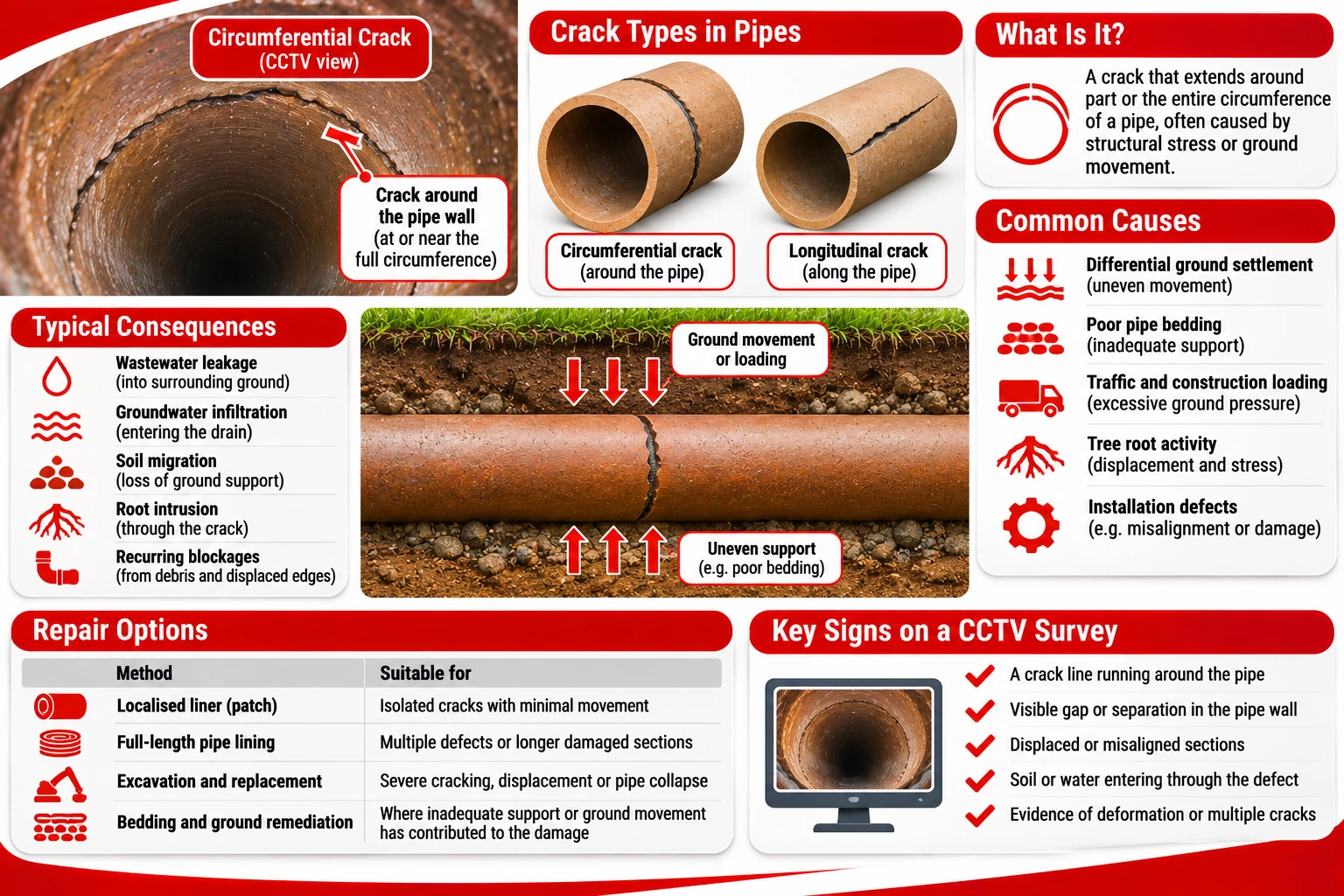
What Causes Circumferential Cracks in Drain Pipes?
A circumferential crack generally develops when a pipe is subjected to stresses that exceed its ability to resist them. Unlike a longitudinal crack, which runs along the pipe, a circumferential fracture is often associated with bending, differential settlement or movement between supported and unsupported sections.
Buried drainage pipes depend on the surrounding ground and bedding material for support. If that support becomes uneven, bending stresses can develop along the pipe. Rigid materials such as vitrified clay and concrete are particularly vulnerable to cracking when subjected to excessive tensile stress.
Common causes include:
-
Differential ground settlement. Uneven movement beneath a pipe can cause adjacent sections to shift relative to one another, creating bending stresses.
-
Poor pipe bedding. Inadequate or uneven bedding can leave sections of pipe unsupported, concentrating loads at particular points.
-
Traffic and construction loading. Heavy vehicles, construction machinery and additional surface loads can contribute to structural damage, especially where cover or support is inadequate.
-
Ground movement. Shrinkage and swelling of clay soils, excavation nearby or changes in ground conditions can impose additional stresses.
-
Tree root activity. Roots can contribute to displacement or loading around pipes, although their presence does not automatically mean they caused the crack.
-
Installation defects. Poor alignment, inappropriate jointing or damage during backfilling can introduce weaknesses that become apparent later.
Circumferential cracks may also develop near rigid connections, such as where a pipe enters an inspection chamber or building structure. If the pipe and adjoining structure move differently, stress can become concentrated near the connection.
The age of the drainage system is relevant, but it is not sufficient to establish the cause. A relatively new pipe can crack because of poor installation, while an older pipe may remain structurally sound where the ground conditions and bedding are stable.
How to Identify a Circumferential Crack During a CCTV Drain Survey
A CCTV drain survey allows an engineer to inspect the internal surface of a pipe without excavating the entire drainage run. The camera records visible defects, including cracks, displaced joints, deformation, root intrusion and evidence of infiltration.
A circumferential crack typically appears as a line crossing the internal surface of the pipe. Depending on the camera position and the extent of the damage, it may be visible as a curved fracture around the pipe wall. A complete circumferential crack can extend around the entire pipe, although a conventional forward-facing camera may not show the full circumference in a single view.
The appearance of a crack can vary according to its severity:
| Defect characteristic | What it may indicate |
|---|---|
| Fine circumferential fracture | Localised cracking without obvious displacement |
| Crack extending around much of the pipe | More extensive structural damage |
| Open fracture with a visible gap | Separation of pipe material and possible loss of watertightness |
| Crack with displaced edges | Movement or misalignment of the fractured sections |
| Soil or groundwater entering through the crack | Loss of pipe integrity and possible surrounding ground disturbance |
| Fracture with missing pipe material | More advanced deterioration requiring structural assessment |
It is important to distinguish a circumferential crack from a pipe joint. Both may appear as lines running around the internal surface, but a joint is an intentional connection between pipe sections. A crack is an unintended fracture through the pipe material.
During inspection, the engineer should record the location of the defect, its visible extent and any associated movement or deterioration. Where suitable equipment is available, the crack position can be established relative to an access chamber, and a camera sonde may help locate the affected section from ground level.
In the UK, drainage defects can be recorded using recognised CCTV inspection conventions, including those associated with BS EN 13508-2 and relevant industry coding guidance. Accurate defect descriptions help distinguish cracking from joint displacement, fractures and other structural conditions.
However, CCTV inspection has limitations. A camera shows the internal condition of the pipe but does not necessarily reveal the condition of the surrounding bedding or the full depth of a fracture through the pipe wall. Additional investigation may be required where substantial ground movement or structural failure is suspected.
Why Are Circumferential Cracks a Problem?
The main concern is that a circumferential crack can reduce the structural integrity of a pipe. A drainage pipe must maintain its shape and alignment while carrying wastewater and resisting external loads from soil, groundwater and surface activity.
A small crack does not necessarily cause an immediate blockage. However, if the fracture opens or the pipe sections move, the defect may interfere with flow, permit leakage or create an entry point for roots and surrounding material.
Potential consequences include:
-
Wastewater leakage. Where a crack penetrates the pipe wall, wastewater may escape into the surrounding ground, depending on operating conditions.
-
Groundwater infiltration. Where external water pressure is sufficient, groundwater can enter the drainage system through an open fracture.
-
Soil migration. Fine surrounding material may be washed into the pipe, potentially reducing ground support and contributing to settlement.
-
Root intrusion. Roots may exploit openings in damaged pipes where moisture and suitable growing conditions are present.
-
Recurring blockages. Displaced edges or accumulated material around the fracture can obstruct the passage of solids.
-
Progressive structural failure. Continued movement or loading may cause the fracture to widen or develop into more extensive damage.
The relationship between cracking and leakage is not always straightforward. A visible crack may not extend through the entire pipe wall, and leakage can depend on groundwater levels, internal water levels and the condition of the surrounding material.
Circumferential cracking can be particularly concerning where several defects occur close together. Multiple fractures, displaced sections or missing pipe material may indicate that the pipe is no longer adequately supported.
If the surrounding ground begins to move into the drainage system, voids may develop outside the pipe. In severe cases, loss of support can contribute to localised settlement at ground level. Such outcomes are not inevitable, but they explain why structural defects should be assessed rather than ignored.
Circumferential Cracks vs Longitudinal Cracks
The direction of a crack provides useful information about how a pipe may have been stressed. However, crack orientation alone cannot establish the cause or determine whether a pipe needs replacement.
A circumferential crack extends around the pipe, while a longitudinal crack runs along its length. Both can compromise structural integrity, but they may develop under different loading conditions.
| Feature | Circumferential crack | Longitudinal crack |
|---|---|---|
| Direction | Around part or all of the pipe circumference | Along the length of the pipe |
| Common stress mechanism | Longitudinal bending or differential movement | Circumferential bending, ring deformation or internal pressure |
| Typical appearance on CCTV | Curved or transverse fracture line | Fracture running parallel to the pipe axis |
| Possible associated defects | Displacement, separation or localised bending | Deformation, multiple fractures or loss of ring strength |
| Repair assessment | Crack extent, alignment, movement and pipe condition | Crack length, deformation and remaining structural integrity |
Rigid pipes can develop either type of cracking when loads exceed their capacity. The actual fracture pattern depends on pipe material, wall thickness, joint arrangement, bedding and the distribution of external forces.
For example, an inadequately supported section of rigid pipe may experience bending along its length, producing tensile stresses that contribute to a circumferential fracture. By contrast, excessive external loading that distorts the pipe’s cross-section can contribute to longitudinal cracking.
These are general engineering relationships rather than definitive diagnostic rules. A CCTV survey should consider the entire drainage run, not just the direction of one visible fracture.
How Are Circumferential Cracks Repaired?
The appropriate repair depends on the extent of the cracking, the pipe material, accessibility and whether the affected section has retained its original alignment. A narrow, stable fracture may be suitable for a localised repair, while a displaced or severely deteriorated pipe may require more substantial work.
Before selecting a method, the drainage engineer should assess whether the defect is isolated or part of a wider structural problem. Repairing the visible crack without addressing ongoing settlement or inadequate support may not provide a durable result.
Common repair options include:
-
Localised cured-in-place repair. A resin-impregnated liner or patch can be installed inside a suitable pipe to cover a localised defect. The repair must be designed for the pipe condition and required structural performance.
-
Full-length cured-in-place pipe lining. Where several defects affect a longer section, a continuous liner may provide a more appropriate rehabilitation solution.
-
Excavation and pipe replacement. A damaged section can be exposed and replaced where cracking is severe, alignment has been lost or trenchless repair is unsuitable.
-
Ground and bedding remediation. Where inadequate support or ground movement has contributed to the failure, the underlying cause may need to be addressed alongside the pipe repair.
A localised liner is not suitable for every circumferential crack. Significant displacement, severe deformation, missing pipe sections or continuing ground movement can prevent effective installation or compromise the long-term performance of the repair.
Pipe replacement may be necessary where the fracture has developed into a complete break or where the pipe has lost structural stability. Excavation also allows the condition of the surrounding bedding to be assessed and corrected where required.
After repair, CCTV inspection can help verify the visible condition of the rehabilitated section. Additional testing may be appropriate depending on the drainage system, the repair specification and the applicable requirements.
When Does a Circumferential Crack Require Urgent Attention?
Not every circumferential crack represents an immediate drainage emergency. A fine fracture with no visible displacement, leakage or associated deterioration may require planned investigation and monitoring rather than urgent excavation.
However, certain findings suggest a greater risk of failure. A crack accompanied by displaced pipe sections, significant soil entry or missing material should receive prompt professional assessment.
Warning signs include repeated blockages at the same location, visible groundwater entering the pipe, wastewater escaping through an open fracture, or evidence that the pipe has moved out of alignment. Surface settlement above the affected drainage run is another reason to investigate promptly, although settlement can have several possible causes.
The location of the damaged pipe also matters. A defect beneath a building foundation, heavily trafficked area or other sensitive structure may require a different level of assessment from a similar crack in an accessible garden drain.
In the UK, responsibility for repairing a damaged drain depends on its location, ownership and whether it forms part of a private drain, lateral drain or public sewer. Many shared drainage pipes and lateral drains connected to the public sewerage network are the responsibility of the sewerage undertaker, although exceptions apply. Establishing responsibility before arranging repair can prevent unnecessary costs.
A circumferential crack should ultimately be assessed as part of the overall condition of the drainage system. Its direction, width and visible extent provide useful evidence, but the most important considerations are whether the pipe remains structurally stable, maintains adequate flow and prevents unwanted leakage or infiltration. Where the defect threatens these functions, timely repair can help prevent further deterioration and more extensive excavation.