
What is a Concrete Ingress
Concrete ingress is the accidental entry of concrete, cement slurry, grout or cement-based construction materials into a drainage system. It usually occurs during building, renovation or groundwork activities when fresh material enters an open pipe, damaged drain or unprotected drainage connection. Once inside, the material can settle and harden, creating a rigid obstruction that restricts or completely blocks wastewater flow.
Unlike ordinary drain blockages caused by grease, wipes or sediment, hardened concrete cannot usually be removed by conventional flushing. It may bond to the pipe wall, form a solid plug or accumulate around bends and junctions. Severe concrete ingress can make a drainage system unusable and may require specialist mechanical removal or replacement of the affected pipe section.
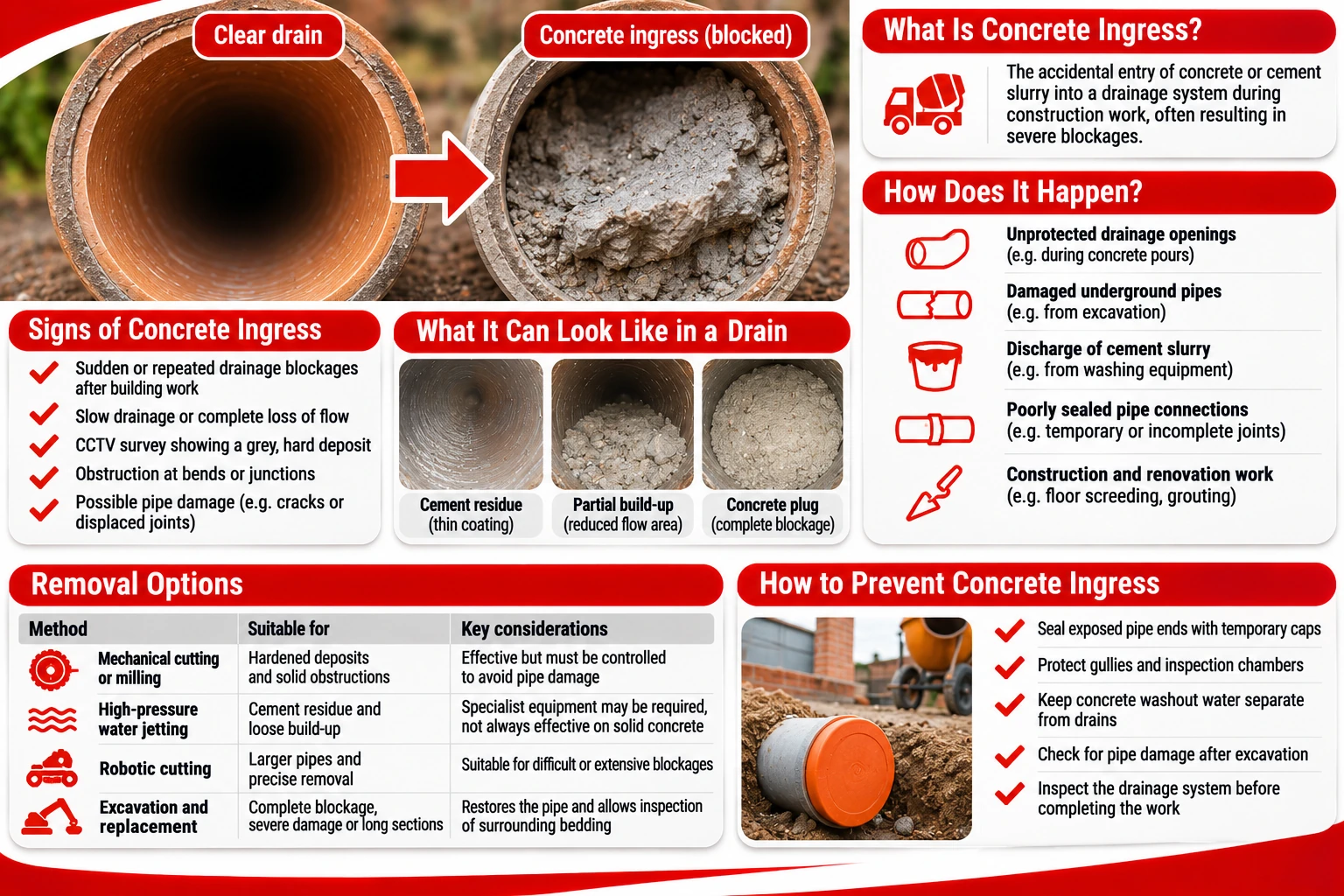
How Does Concrete Enter a Drainage System?
Concrete ingress is primarily associated with construction work carried out near existing drainage infrastructure. The risk is particularly high when pipes are exposed, disconnected or damaged during excavation, foundation construction or renovation.
Fresh concrete and cement slurry can flow into openings before the material sets. Even a relatively small quantity may cause problems if it accumulates at a bend, junction or section with a shallow gradient. Larger quantities can fill the pipe completely.
Common causes of concrete ingress include:
-
Unprotected drainage openings. Concrete enters exposed pipe ends during foundation pours, floor construction or other building work.
-
Damaged underground pipes. Excavation or construction equipment cracks or breaks a drain, allowing wet concrete to enter.
-
Accidental discharge of cement slurry. Wash water containing cement particles is directed into a surface water drain, gully or other drainage connection.
-
Poorly sealed pipe connections. Temporary drainage arrangements or incomplete joints allow construction materials to enter the system.
-
Grouting operations. Cement-based grout escapes through unintended openings or enters nearby drainage infrastructure.
-
Floor screeding and renovation. Cementitious material reaches waste pipes or floor drainage outlets that have not been adequately protected.
Concrete ingress can also occur when contractors wash equipment near drainage gullies. Water used to clean concrete mixers, tools or pumping equipment may contain cement particles and fine aggregates. If this material enters a drain, solids can settle and gradually form deposits.
The distinction between fresh concrete and cement slurry is important. Concrete contains cement, water and aggregates, while cement slurry generally contains finer particles suspended in water. Both can create obstructions, but the resulting deposits may differ in hardness, thickness and distribution.
Once cement hydration progresses, the material becomes increasingly rigid. The rate of hardening depends on the cement formulation, temperature, water content and other conditions. A deposit that might have been removable while fresh can become significantly more difficult to clear after setting.
What Happens When Concrete Hardens Inside Drain Pipes?
Concrete ingress can produce several types of obstruction depending on how much material enters the system and where it settles. A small amount of slurry may form a relatively thin deposit along the invert, which is the lowest internal surface of a drainage pipe. A larger volume may create a substantial accumulation or completely fill the pipe.
The effect on drainage performance depends on the remaining flow area and the location of the obstruction. Deposits at bends and junctions can be particularly disruptive because they interfere with the movement of wastewater and solid material.
Typical forms of concrete-related obstruction include:
| Type of deposit | Typical appearance | Effect on drainage |
|---|---|---|
| Thin cement residue | Hard coating on the pipe wall or invert | Increases roughness and may trap debris |
| Partial concrete build-up | Solid deposit occupying part of the pipe | Reduces flow area and encourages blockages |
| Concrete plug | Hardened material filling most or all of the pipe | Causes severe restriction or complete blockage |
| Cement accumulation at a bend | Rigid deposit concentrated around a change in direction | Restricts flow and makes cleaning difficult |
| Concrete around a damaged joint | Hardened material entering through a crack or opening | May obstruct the pipe and conceal structural damage |
Concrete ingress can be especially problematic in smaller domestic drainage pipes. Common nominal pipe sizes include 110 mm for many underground foul drainage connections and smaller diameters for individual waste pipes. A hardened deposit occupying a substantial proportion of these pipes can significantly reduce their capacity.
The problem is not limited to the original concrete deposit. Rough surfaces and protruding material can catch toilet paper, grease and other waste, producing recurring blockages even when some water can still pass through.
Concrete entering a damaged pipe may also become embedded around broken edges or displaced joints. In these situations, the obstruction and structural defect must be considered together. Removing the concrete does not necessarily restore the pipe’s original condition.
How Is Concrete Ingress Identified During a CCTV Drain Survey?
A CCTV drain survey is one of the main methods used to investigate suspected concrete ingress. A drainage camera allows an engineer to examine the internal surface of accessible pipework and identify the position, extent and visible characteristics of the obstruction.
Hardened cement-based material may appear as a pale grey or off-white deposit, although its colour can vary depending on the aggregate, cement type and contamination. Larger deposits may have an irregular surface or contain visible aggregate particles.
Colour alone cannot confirm that a deposit is concrete. Mineral scale, mortar, grout and other construction materials may have a similar appearance. The inspection findings should therefore be considered alongside the history of building work and, where necessary, physical examination of the material.
A typical investigation involves:
-
Establishing when drainage problems began and whether recent construction work took place.
-
Identifying which drainage fixtures or pipe sections are affected.
-
Inspecting the pipe from an accessible chamber or suitable access point.
-
Recording the location and visible extent of the suspected concrete deposit.
-
Checking for associated cracks, displaced joints or other structural defects.
-
Assessing whether specialist removal equipment can reach the obstruction safely.
The camera may be unable to pass through a complete concrete plug. In that situation, the engineer can identify the obstruction from the accessible side, but further investigation may be required to determine its full length.
A camera sonde and compatible surface receiver can help locate the camera head above ground. This is useful when the obstruction lies beneath a driveway, floor slab or landscaped area and excavation may be necessary.
CCTV inspection is also valuable after removal. It allows the engineer to check for remaining deposits and identify damage that may have been concealed by the hardened material.
How Is Hardened Concrete Removed from Drains?
Removing concrete from drainage pipes is more difficult than clearing most ordinary blockages. Once the material has hardened, conventional drain rods may be ineffective, particularly where the deposit is thick or firmly attached to the pipe wall.
The appropriate method depends on the concrete’s hardness, the pipe diameter, the length of the affected section and the condition of the pipe. Older clay, concrete and cast iron drains may require particular care because aggressive cleaning can damage already weakened materials.
Specialist removal methods include:
-
Mechanical cutting or milling. Purpose-designed equipment can break down or grind certain hardened deposits inside suitable pipes.
-
High-pressure water jetting. Specialist jetting equipment may remove some cementitious deposits or loosen fragmented material, although conventional jetting may be ineffective against solid concrete.
-
Robotic cutting. Remotely controlled equipment may be used in suitable larger pipes where precise removal is required.
-
Excavation and replacement. Where the pipe is completely obstructed, severely damaged or unsuitable for internal cleaning, the affected section may need to be exposed and replaced.
Mechanical removal must be carefully controlled. Cutting equipment can damage pipe walls if the operator cannot distinguish between the obstruction and the surrounding pipe material. The risk increases where the concrete has entered through a broken joint or become bonded to an irregular surface.
High-pressure water jetting is not automatically suitable for concrete removal. Its effectiveness depends on the equipment, deposit characteristics and available access. Extremely high-pressure specialist systems require appropriate safety controls and should only be operated by competent personnel.
Chemical treatment is generally not a practical first choice for substantial hardened concrete obstructions. Some specialist chemicals can attack cementitious materials, but they may also damage concrete pipes, mortar joints or other vulnerable components. Chemical compatibility and environmental risks must be assessed before any such treatment is considered.
Where removal would create an unacceptable risk of pipe damage, excavation and replacement may be the more reliable option. Although more disruptive, it allows the affected pipe section and surrounding bedding to be inspected and reconstructed correctly.
How Can Concrete Ingress Be Prevented During Construction?
Preventing concrete ingress is considerably easier than removing hardened material from an underground drain. The most effective precautions involve identifying existing drainage connections, protecting exposed openings and controlling the disposal of construction wastewater.
Before excavation or concrete pouring begins, contractors should establish the location of relevant drainage pipes and inspection chambers. Existing drainage plans may help, but the actual position and condition of underground pipes should be confirmed where necessary.
Practical preventative measures include:
-
Seal exposed pipe ends with suitable temporary caps before concrete pouring or screeding.
-
Protect drainage gullies, inspection chambers and other openings from cement-based materials.
-
Check for damaged drainage pipes after excavation or groundwork activities.
-
Keep concrete washout water separate from foul and surface water drainage systems.
-
Use designated containment arrangements for washing concrete equipment and tools.
-
Inspect drainage connections before reinstating surfaces or completing construction work.
-
Arrange a CCTV survey where accidental concrete entry is suspected.
Concrete washout water requires particular attention. It is often highly alkaline and can contain suspended cement particles and other contaminants. Allowing it to enter surface water drains can create environmental risks in addition to physical blockages.
Construction wastewater should be collected and managed through appropriate arrangements rather than discharged into drainage systems without authorisation. The relevant requirements depend on the material, site conditions and receiving system.
Temporary protection must also be removed correctly before the drainage system is returned to service. A forgotten cap, plug or other construction fitting can itself create a blockage.
Where major building work takes place close to existing underground drains, a pre-construction CCTV survey can provide a useful record of their condition. A subsequent inspection may help identify new damage or construction-related obstructions.
When Does Concrete Ingress Require Pipe Replacement?
Not every concrete deposit requires excavation. Some localised obstructions can be removed using suitable specialist equipment, particularly where the pipe remains structurally sound and the deposit can be reached from an existing access point.
Replacement becomes more likely when the pipe is completely filled with hardened concrete, the obstruction extends over a substantial distance or removal would damage the surrounding pipe wall. Severe cracking, displaced joints and collapsed sections may also make internal cleaning unsuitable.
The decision should consider the pipe material, accessibility, structural condition and the likely effectiveness of available cleaning methods. A short affected section beneath an accessible garden may be relatively straightforward to replace, while a similar obstruction beneath a building or heavily trafficked surface may require a more detailed repair plan.
Concrete ingress should be investigated promptly when it causes wastewater to back up, repeated blockages or a complete loss of drainage. Continuing to use affected fixtures can increase the risk of internal flooding, particularly where sewage has no alternative route through the system.
The most important step is to establish the location and extent of the hardened material before attempting removal. CCTV inspection, supported by suitable locating equipment where necessary, helps determine whether specialist cleaning can restore the drain or whether excavation is required. Early identification can prevent further disruption and reduce the risk of unnecessary damage during clearance.