
What is a Drain Camera Reel
A drain camera reel is a specialist CCTV inspection device consisting of a flexible push cable wound onto a reel, with a compact waterproof camera head fitted at its end. It allows drainage engineers to examine the inside of pipes without excavation or dismantling the drainage system. The cable is fed through an accessible opening, carrying the camera along the pipe while images are transmitted to a monitor or recording unit.
Drain camera reels are particularly useful for inspecting small-diameter drains, domestic sewer connections, underground pipework and sections that cannot be examined directly. They help identify blockages, displaced joints, cracks, root intrusion and other defects that may affect drainage performance. Unlike motorised crawler cameras, a push-rod camera is moved manually by advancing or withdrawing its cable, making it a practical option for many domestic and light commercial drainage inspections.
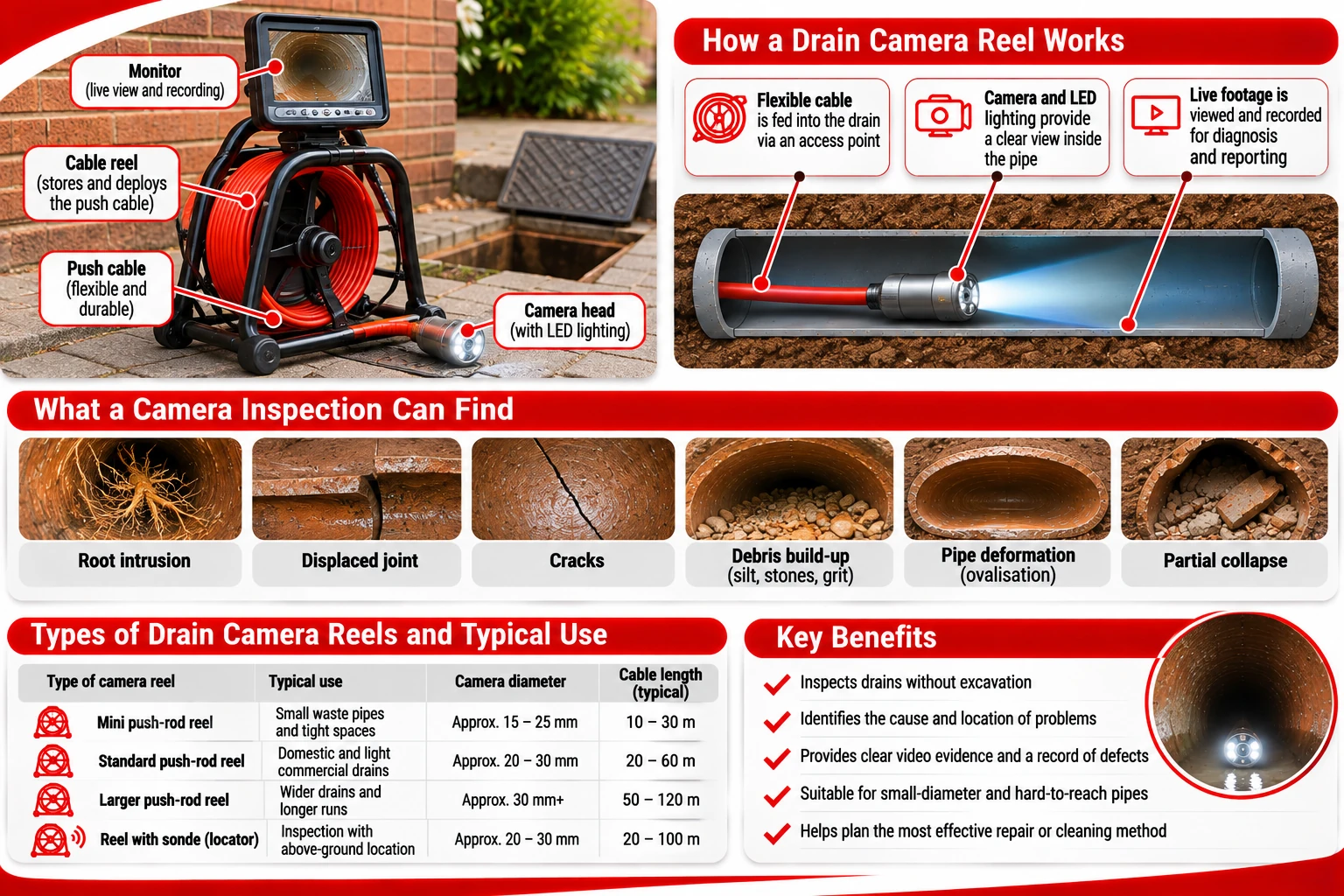
How Does a Drain Camera Reel Work?
A drain camera reel combines a camera head, a semi-rigid push cable and a storage drum. The cable must be flexible enough to negotiate suitable bends while retaining sufficient stiffness to push the camera through the pipe. Its construction is important because a cable that is too flexible may buckle, while one that is excessively rigid may struggle to pass through changes in direction.
The camera head contains an imaging sensor and built-in illumination. Since underground drains are normally dark, integrated LED lighting allows the engineer to examine the pipe wall, joints and deposits as the camera advances.
A typical system consists of several components:
-
Camera head. A compact waterproof unit containing the lens, image sensor and lighting.
-
Push cable. A reinforced flexible cable that transmits electrical signals and allows the operator to move the camera through the drain.
-
Cable reel. A rotating drum that stores the cable and helps control deployment and retrieval.
-
Monitor or control unit. Displays live footage and provides camera, lighting and recording controls.
-
Distance counter. Measures the approximate length of cable deployed from the reel.
-
Recording equipment. Stores photographs or video footage for inspection reports.
-
Sonde transmitter. An optional or integrated device that emits a signal detectable using a compatible surface locator.
Some systems use a self-levelling camera head that keeps the displayed image approximately upright as the camera rotates. Others provide a fixed view that turns with the cable. Self-levelling improves viewing convenience but does not prevent the camera from rotating physically inside the pipe.
During an inspection, the engineer introduces the camera through a suitable access point, such as an inspection chamber or rodding eye. The cable is then advanced gradually while the operator observes the internal condition of the pipe.
The camera can reveal visible defects, but it cannot see through the pipe wall or directly determine the condition of surrounding bedding and soil. It also cannot reliably establish the chemical composition of deposits from their appearance alone.
When a defect is found, the operator may record its position using the distance counter and, where available, a sonde locator. These measurements help identify the affected section, although cable distance should not be confused with an exact surveyed position.
Types of Drain Camera Reels and Their Applications
Drain camera reels vary considerably in size, cable stiffness, camera diameter and available inspection length. Equipment designed for a narrow waste pipe may be unsuitable for a larger underground sewer, even when both systems use similar recording technology.
The most important distinction is between compact systems intended for restricted pipework and larger push-rod systems designed for longer drainage runs.
| Camera reel type | Typical application | Main advantage | Principal limitation |
|---|---|---|---|
| Mini push-rod reel | Small waste pipes and restricted drainage connections | Compact camera head and flexible cable | Limited pushing distance and ability to negotiate complex bends |
| Standard push-rod reel | Domestic underground drains and lateral connections | Suitable for many routine CCTV drain surveys | Manual pushing becomes difficult over long distances |
| Larger push-rod reel | Wider drains and relatively long accessible runs | Stiffer cable provides greater pushing capability | Less suitable for tight bends and small pipes |
| Portable inspection reel | Properties with restricted working space | Lightweight and convenient to transport | Cable capacity and camera features vary |
| Reel with integrated sonde | Locating defects and buried pipe sections | Supports above-ground position tracing | Requires compatible locating equipment |
Camera head diameters can range from approximately 15 mm on some compact systems to more than 30 mm on larger push-rod units. These figures are illustrative rather than fixed equipment categories, and the manufacturer’s stated operating range must always be checked.
Push cables are available in different lengths, including 20 m, 30 m, 40 m and longer configurations. However, a reel containing 40 m of cable does not necessarily allow the camera to travel 40 m through every drain.
The practical inspection distance depends on pipe diameter, bends, internal friction, deposits and cable stiffness. A relatively straight drain may permit much greater travel than a narrow pipe containing several tight changes in direction.
For larger sewers, motorised CCTV crawler systems may be preferable. These use a wheeled or tracked camera unit that travels along the pipe under remote control, reducing the need to push the camera manually.
A drain camera reel should therefore be selected according to the actual drainage layout rather than cable length alone.
What Can a Drain Camera Reel Detect?
The primary purpose of a drain camera reel is to provide visual evidence of conditions inside drainage pipework. This makes it useful both for diagnosing existing problems and for assessing the condition of a system before repairs or property alterations.
Many defects that produce similar symptoms can be distinguished through CCTV footage. For example, repeated blockages may result from accumulated grease, root intrusion, a displaced joint or a deformed pipe. Each problem may require a different response.
Common findings include:
-
Root intrusion. Roots entering through cracks or defective joints and extending into the drainage channel.
-
Displaced joints. Pipe sections that are no longer correctly aligned, potentially trapping solids or affecting watertightness.
-
Cracks and fractures. Visible damage to the pipe wall, including longitudinal and circumferential cracking.
-
Debris accumulation. Sand, silt, stones, grease and other materials restricting the available flow area.
-
Pipe deformation. Flattening or distortion of the pipe’s original cross-section.
-
Connection intrusion. A lateral connection projecting into the main drain and obstructing flow.
-
Standing water. Water remaining in a section of pipe, potentially indicating a low point, downstream restriction or other hydraulic condition.
-
Partial collapse. Broken or displaced pipe material reducing the internal opening.
The camera can also identify changes in pipe material, visible connections and certain installation irregularities. These observations are valuable when existing drainage drawings are incomplete or unavailable.
However, the quality of the diagnosis depends on visibility. Wastewater, suspended sediment, grease deposits and heavy obstructions can conceal defects. Cleaning may be necessary before a reliable structural assessment can be completed.
CCTV inspection also has limitations when assessing gradients. A camera may show standing water, but this does not establish the precise pipe fall or prove that the entire run has an inadequate gradient. Accurate measurements may require additional surveying methods.
Similarly, a standard camera image cannot provide an exact percentage of pipe deformation without appropriate dimensional measurement equipment. Visual distortion may indicate a problem, but quantitative assessment requires a suitable technique.
How Is a Drain Camera Reel Used During a CCTV Survey?
A drain camera reel inspection begins with identifying a suitable access point and determining which section of drainage needs examination. The engineer considers the pipe diameter, likely direction of flow, accessibility and any known obstructions before selecting equipment.
Where a drain is completely blocked or heavily contaminated, preliminary clearance may be necessary. Forcing a camera into an obstructed pipe can damage the equipment or leave the camera head trapped.
A typical inspection involves the following stages:
-
Identify the drainage access point and establish the intended inspection direction.
-
Check the camera head, cable, lighting, monitor and recording equipment.
-
Introduce the camera carefully into the pipe.
-
Advance the cable while observing joints, pipe walls, connections and deposits.
-
Record relevant defects and their approximate distance from the inspection starting point.
-
Use a compatible sonde locator where a particular underground position needs to be traced.
-
Withdraw the camera and review the recorded footage.
-
Prepare findings and recommendations appropriate to the inspection purpose.
The engineer should advance the camera at a speed that allows significant defects to be observed. Moving too quickly can result in small cracks, defective joints or lateral connections being overlooked.
The distance counter is useful for recording the approximate location of observations. However, its accuracy may be affected by cable movement, calibration, the position of the measuring mechanism and the route taken through the pipe.
A sonde provides a different type of information. It emits a signal that can be detected from above ground using a compatible receiver, allowing the camera head’s approximate location and, under suitable conditions, depth to be estimated.
This can help identify where excavation may be required, particularly when a defect is located beneath paving or a garden. The accuracy of the result depends on the equipment, signal conditions and operator technique.
For formal condition surveys, defects may be recorded using coding conventions associated with BS EN 13508-2 and applicable UK industry guidance. A simple diagnostic inspection may instead produce a shorter report focused on the specific drainage problem.
The level of reporting should match the purpose of the survey. A homeowner investigating a blocked drain may need a clear explanation of the obstruction, while a structural condition assessment may require more comprehensive defect records.
Choosing and Maintaining a Drain Camera Reel
The suitability of a drain camera reel depends on more than image resolution. Camera dimensions, cable construction, lighting, access requirements and recording functions all influence the quality of an inspection.
A camera that produces sharp images in a straight pipe may be difficult to use in a drainage system with several tight bends. Likewise, a long cable offers little benefit if its stiffness prevents it from negotiating the available route.
Important selection criteria include:
-
Pipe compatibility. The camera head and cable must suit the internal diameter and geometry of the drain.
-
Camera head construction. The housing should withstand normal contact with pipe surfaces and exposure to wastewater.
-
Waterproofing. The camera and relevant connections must have suitable protection for the intended operating conditions.
-
Lighting. Adjustable illumination helps reveal defects without excessive reflection from wet pipe surfaces.
-
Cable stiffness. The cable must provide an appropriate balance between flexibility and pushing capability.
-
Recording quality. Clear footage and still images support accurate reporting.
-
Distance measurement. A reliable counter assists with documenting defect locations.
-
Locating capability. A sonde can be valuable where underground positions need to be established.
Maintenance is equally important. Push cables experience repeated bending, friction and contact with abrasive deposits. Over time, this can damage their outer covering or affect the electrical connections.
After use, the cable and camera head should be cleaned and disinfected using methods compatible with the manufacturer’s instructions. The equipment should also be inspected for damage before being returned to storage.
Particular attention should be paid to the camera lens, seals, cable termination and any areas showing excessive wear. Damaged waterproof seals can allow moisture into the camera housing, potentially causing electrical failure.
The reel should be operated without exceeding the manufacturer’s recommended bending limits. Excessive force can kink the cable, damage internal conductors or cause the camera head to become detached.
Although drain camera reels are relatively compact compared with crawler systems, they remain specialist inspection equipment. Their effective use requires an understanding of drainage layouts, common pipe defects and the limitations of CCTV observations.
A drain camera reel provides a practical way to examine otherwise inaccessible drainage pipework and record visible defects without unnecessary excavation. Its greatest value lies in identifying the nature and approximate location of problems so that cleaning, further investigation or repairs can be planned appropriately.