
What is a Drainage Responsibility Boundary
A drainage responsibility boundary is the point at which legal responsibility for maintaining, repairing or replacing a drain or sewer changes from one party to another. In the UK, this boundary commonly separates privately maintained drainage from pipes owned by a statutory sewerage undertaker, although responsibility may also involve landlords, management companies, highway authorities or other organisations. Establishing the boundary is important when dealing with blocked drains, damaged underground pipes, sewer flooding and proposed building work.
The responsibility boundary is not always located at the edge of a property. A pipe can run beneath a private garden and still belong to a sewerage undertaker, while another pipe within the same garden may remain the homeowner’s responsibility. Ownership depends on the type of pipe, the properties it serves, its legal status and the rules applicable in the relevant part of the UK. Understanding these distinctions can prevent unnecessary repair costs, delays and disputes over who should arrange drainage work.
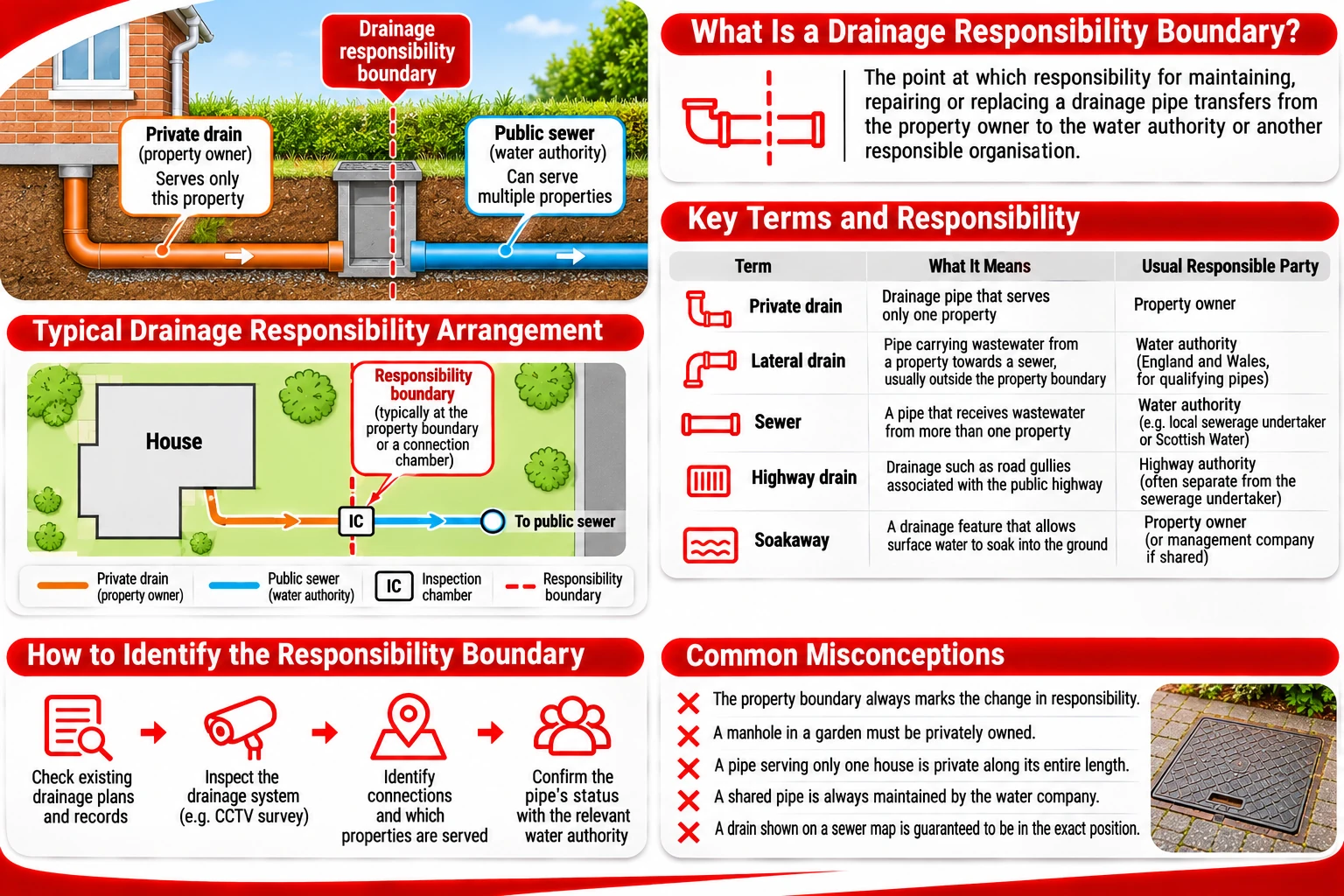
How Are Drainage Responsibility Boundaries Determined?
Drainage responsibility is generally determined by the legal status and function of the pipe rather than its physical position alone. The most important distinction is between a private drain, a lateral drain and a sewer. Although these terms are sometimes used interchangeably in everyday conversation, they have different meanings in drainage legislation and asset management.
A private drain normally carries wastewater from a single property and remains the responsibility of the property owner or another legally responsible party. A lateral drain is generally the section of drainage pipe carrying wastewater from a building’s drain towards a sewer, where it lies outside the boundary of the property it serves. A sewer typically receives wastewater from more than one building or property, although statutory definitions and ownership arrangements require more careful interpretation in individual cases.
In England and Wales, the transfer of many private sewers and lateral drains to statutory sewerage undertakers in October 2011 significantly changed maintenance responsibilities. Before that transfer, property owners could be responsible for shared drainage pipes serving several homes. Many qualifying pipes became the responsibility of sewerage undertakers, even where they ran beneath privately owned land.
This means that the traditional assumption that homeowners are responsible for every pipe within their property boundary is incorrect. Equally, it would be wrong to assume that every underground pipe outside a house is publicly maintained.
Several factors are relevant when identifying a drainage responsibility boundary:
-
Number of properties served. A pipe receiving wastewater from multiple properties may be classified as a sewer rather than an individual private drain.
-
Position relative to the property boundary. This helps identify lateral drains, but does not establish ownership by itself.
-
Legal status of the drainage asset. Public sewers, private drains and other drainage systems are subject to different responsibilities.
-
Date and circumstances of construction. Newer drainage systems may not have been included in historic transfers of private sewers.
-
Adoption arrangements. Some drainage infrastructure becomes publicly maintained following formal adoption by the relevant sewerage undertaker.
-
Type of drainage. Foul water, surface water, highway drainage and private land drainage may fall under different arrangements.
-
Property ownership and management. Leasehold agreements, estate management arrangements and shared private systems can affect maintenance obligations.
The point where one pipe joins another does not necessarily mark the responsibility boundary. For example, a homeowner’s private drain may connect to a shared sewer within the garden, with the shared section falling under the sewerage undertaker’s responsibility. In another arrangement, a private drainage system may discharge into a privately maintained treatment plant, leaving responsibility with the relevant property owners.
The correct boundary must therefore be established from the actual drainage arrangement and applicable legal framework, not simply from the position of the nearest manhole or inspection chamber.
Who Is Responsible for Drains and Sewers in Different Parts of the UK?
Drainage ownership arrangements vary across the UK. England and Wales share important elements of the legal framework governing public sewers and transferred private drainage, while Scotland and Northern Ireland operate under different legislation and institutional arrangements.
In England, statutory sewerage undertakers are responsible for maintaining public sewers and qualifying lateral drains within their networks. The same broad principle applies in Wales, although the relevant undertaker and regulatory arrangements depend on the location. Property owners generally remain responsible for private drains serving their premises up to the applicable responsibility boundary.
In Scotland, Scottish Water is the national publicly owned water and wastewater provider. Responsibility for drainage connections depends on the classification of the pipe and the applicable Scottish legal framework. The ownership arrangements should be confirmed rather than inferred from the rules used in England and Wales.
In Northern Ireland, Northern Ireland Water operates the public sewerage network. Private drainage responsibilities and the status of connections are governed by Northern Ireland’s own legislation and arrangements, which should be checked separately.
The following table summarises common drainage responsibility situations.
| Drainage component or situation | Usual responsible party | Important qualification |
|---|---|---|
| Private drain serving one property within its boundary | Property owner | Leasehold or other legal arrangements may affect who arranges maintenance |
| Qualifying lateral drain outside the property boundary in England or Wales | Sewerage undertaker | Depends on the pipe’s legal status and whether it forms part of the undertaker’s network |
| Public sewer serving multiple properties | Sewerage undertaker | A sewer can run beneath private land |
| Private sewer not adopted or transferred | Relevant private owner or owners | Responsibility may be shared or governed by agreements |
| Public highway drainage gullies and associated highway assets | Relevant highway authority or other responsible body | Connections to public sewers may have separate ownership |
| Private soakaway serving one property | Property owner | Shared systems may involve several owners or a management company |
| Private septic tank or package treatment plant | Owner or responsible operator | Shared ownership and environmental obligations may apply |
| Adopted public sewer within a new development | Sewerage undertaker | Adoption must be confirmed rather than assumed |
| Unadopted drainage on a managed private estate | Developer, management company or other responsible owner | Depends on ownership, agreements and the asset’s status |
These are general arrangements rather than a definitive legal determination for every property. A particular pipe may have a different status because of its construction history, adoption arrangements or the way the development is managed.
Surface water drainage requires particular care. Rainwater from a roof may enter a private soakaway, an adopted surface water sewer or another permitted drainage system. Road gullies may belong to the highway authority, while the sewer receiving water from those gullies may be maintained by a sewerage undertaker. A single drainage route can therefore involve more than one responsible organisation.
The same applies to newer housing developments. Roads, drainage systems and communal infrastructure may remain privately maintained until the relevant adoption processes have been completed. The fact that a development has been occupied for several years does not automatically mean that all its drainage assets have been adopted.
Where Does Private Drainage Responsibility End?
For many homes in England and Wales, the practical distinction is between the private drain serving the individual property and the public sewerage network. However, identifying the precise transition requires understanding the pipe connections.
Consider a detached house with a drainage pipe running from the kitchen and bathroom towards a public sewer. The section serving only that property within its boundary will normally be privately maintained. If the pipe continues beyond the property boundary as a qualifying lateral drain, the section outside the boundary will generally be the sewerage undertaker’s responsibility.
Now consider two neighbouring houses whose drains join within one garden. If the combined pipe is a public sewer, it may be maintained by the sewerage undertaker from the relevant junction onwards, even though the pipe remains within private land. The individual branches leading to that junction may still be private drains.
This difference explains why two properties with apparently similar drainage layouts can have different responsibility boundaries. The number of connections, legal classification and adoption status can be more important than the distance between the building and the public sewer.
Several common assumptions should be avoided:
-
The property boundary always marks the change in responsibility. This is not necessarily true where a public sewer runs through private land.
-
A manhole in a garden must be privately owned. Public sewer inspection chambers and manholes can be located on private property.
-
A pipe serving only one house must be private along its entire length. A qualifying lateral drain may be publicly maintained beyond the property boundary.
-
A shared pipe is automatically maintained by the water company. Some shared systems remain private or fall outside the relevant statutory arrangements.
-
A drainage connection shown on a sewer map is guaranteed to be accurately positioned. Records can be incomplete or approximate, particularly for older infrastructure.
-
A newly constructed sewer is automatically public. Formal adoption or another applicable legal mechanism may be necessary.
The responsibility boundary can also be affected by the distinction between a drain serving a building and drainage infrastructure serving an entire development. For example, communal drainage within an apartment complex may involve a freeholder, residents’ management company or other responsible organisation. The precise obligations may be set out in property documents and maintenance agreements.
For leasehold properties, responsibility for arranging repairs may differ from the question of who ultimately pays for them. A lease may allocate certain maintenance obligations to the landlord or management company, while allowing the costs to be recovered through service charges. The drainage asset’s legal ownership and the financial arrangements between property parties should therefore be considered separately.
How to Identify the Responsibility Boundary Before Drainage Work
The most reliable approach is to combine available drainage records with an understanding of the actual pipe network. Property boundaries, inspection chamber positions and sewer maps can provide useful evidence, but none should be treated as conclusive in isolation.
A homeowner experiencing a blockage should first establish which fixtures are affected and whether neighbouring properties are experiencing similar problems. If only one sink is draining slowly, the issue may be confined to the private waste pipe. If several properties are experiencing wastewater backing up at the same time, a shared or public sewer problem becomes more likely, although the cause still needs to be investigated.
The investigation can then focus on the location and status of the affected section.
A practical process involves:
-
Check available drainage plans. Review building records, previous CCTV reports and any existing drainage layout drawings.
-
Identify the relevant sewerage undertaker. Confirm which organisation maintains the public sewerage network in the area.
-
Request available sewer records. Public sewer maps can help identify adopted pipes, although smaller connections may not be fully recorded.
-
Examine accessible inspection chambers. Establish which pipes enter and leave each chamber without entering confined drainage spaces.
-
Determine which properties connect to the affected pipe. Shared connections may indicate a sewer rather than an individual private drain.
-
Locate the suspected defect or blockage. CCTV inspection and appropriate drain tracing equipment can help establish where the problem lies.
-
Confirm the asset’s legal status. Contact the relevant sewerage undertaker or responsible organisation where ownership remains uncertain.
-
Obtain confirmation before significant repairs. Clarify responsibility before commissioning excavation or structural rehabilitation, except where immediate safety measures are necessary.
CCTV drain surveys are particularly useful when a defect is located underground and its position relative to a boundary or junction is uncertain. The camera can identify the distance to a blockage, fracture or displaced joint, while suitable locating equipment can help establish its position at ground level.
However, CCTV inspection does not determine legal ownership. It provides evidence of the pipe’s route, connections and condition, which must then be considered alongside the applicable ownership rules and available records.
Sewer records also have limitations. A public sewer map may show the approximate route of a main sewer without displaying every lateral connection or private branch. Older pipes may have been diverted or extended, and some transferred drainage assets may not be fully represented on available plans.
Where responsibility is disputed, written confirmation from the relevant organisation can be important. This is particularly relevant before excavation beneath a driveway, garden or building, where repair costs and disruption may be substantial.
What Happens When a Blockage or Pipe Failure Crosses the Responsibility Boundary?
A drainage defect does not necessarily remain within one ownership area. Tree roots may enter a public sewer through a damaged joint, while grease and other waste discharged from private drains may accumulate farther downstream. The location of the obstruction and the legal status of the affected pipe are generally more relevant to maintenance responsibility than identifying which property originally contributed the material.
For example, a blockage may develop in a public sewer serving several houses. Although wastewater originates from the connected properties, the sewerage undertaker will normally be responsible for maintaining that public sewer. Conversely, a blockage within a private drain serving one property will usually remain the responsibility of the relevant private owner.
A complicated situation can arise when a private drain is damaged close to its connection with a public sewer. The repair may require access to or work affecting the publicly maintained infrastructure. In such cases, the responsible parties may need to coordinate the work, and permission may be required before altering the public connection.
The distinction is also important for structural defects. If a public sewer is damaged beneath a private garden, the homeowner should not assume that they must arrange and fund the sewer repair simply because the pipe crosses their land. Equally, the presence of a public sewer nearby does not transfer responsibility for a separate private drainage defect to the sewerage undertaker.
When a blockage or failure is reported, the responsible organisation may investigate the affected section and determine whether the problem falls within its maintenance obligations. If the defect is outside its network, the property owner may need to arrange further investigation or repair through a drainage contractor.
The situation becomes more urgent where wastewater is flooding a property or creating a health hazard. Immediate precautions should focus on reducing exposure to contaminated water, avoiding unsafe access to chambers and contacting the appropriate organisation. Responsibility can be clarified alongside the response, but uncertainty over ownership should not delay necessary action to protect people from immediate danger.
It is also important to distinguish responsibility for maintaining a pipe from liability for damage caused by a failure. Questions about compensation, negligence, insurance and property damage depend on the circumstances and applicable law. The fact that an organisation maintains a sewer does not automatically establish liability for every loss associated with it.
For planned works, responsibility should be confirmed before altering or connecting to a public sewer. Drainage contractors may be able to identify the physical problem and recommend a repair, but ownership confirmation and statutory permissions may need to come from the relevant authority or sewerage undertaker.
A drainage responsibility boundary is therefore both a legal and a practical consideration. It identifies who is expected to maintain a particular section of the drainage network, but it cannot always be established from the property boundary, chamber position or pipe route alone. Accurate drainage records, investigation of the actual connections and confirmation of the asset’s status provide the strongest basis for deciding who should arrange and fund the necessary work.