
What is a Fractured Pipe
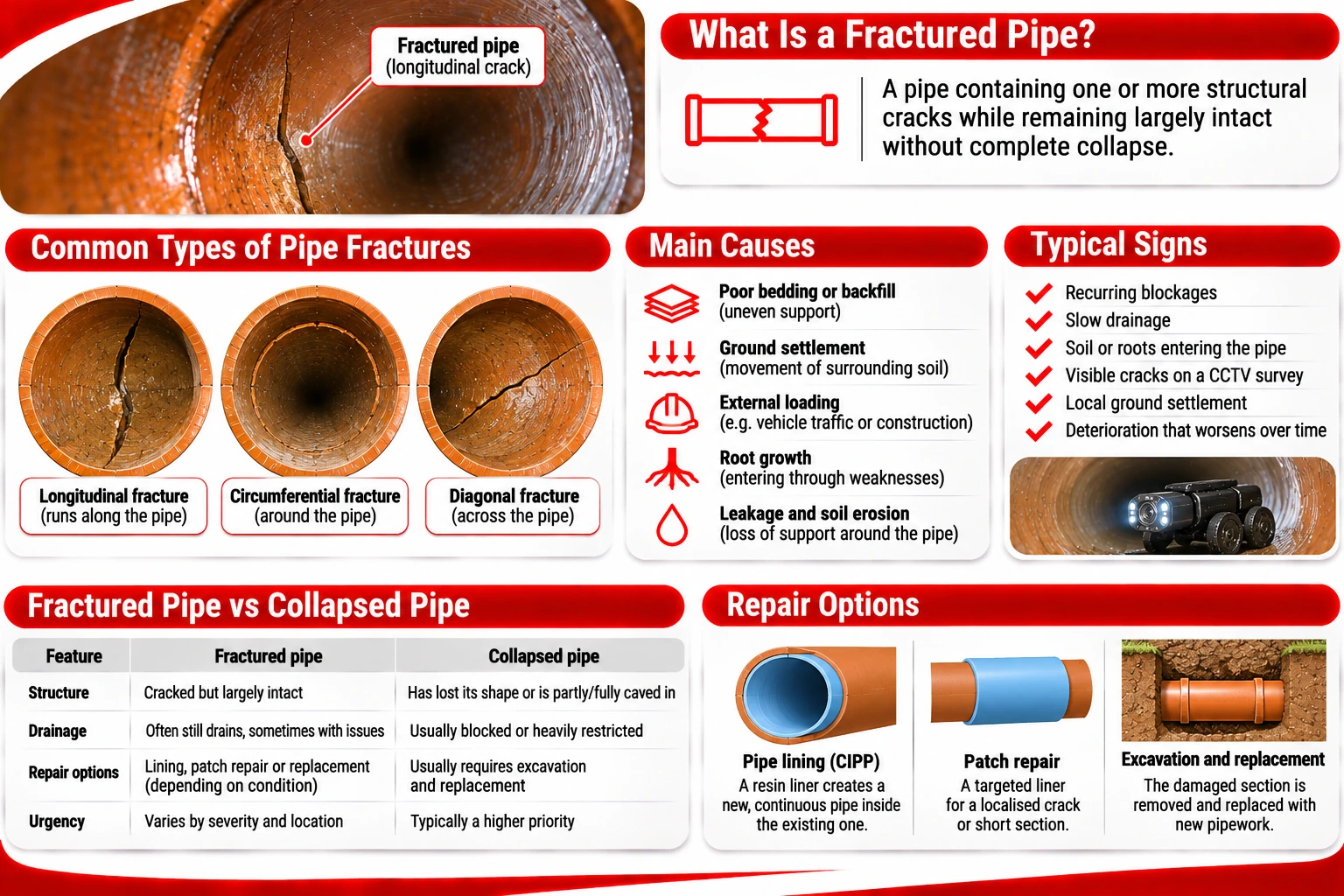
A fractured pipe is a drainage or sewer pipe containing one or more structural cracks while its overall shape remains largely intact. The pipe has suffered damage to its wall, but it has not completely collapsed or lost its original cross-sectional form. Fractures may extend along the pipe, around its circumference or in several directions, depending on the material, loading conditions and underlying cause.
Fractured pipes are a significant concern in underground drainage systems because a crack can affect structural strength, watertightness and long-term serviceability. A pipe may continue to carry wastewater despite having visible fractures, making the defect difficult to recognise without an inspection. However, continued operation does not mean that the pipe is structurally sound. Cracks can widen, allow water to escape or enter, and develop into more serious defects if the forces responsible for the damage remain.
The distinction between a fractured pipe and a collapsed pipe is important when assessing repair options. A fractured pipe may still be suitable for certain trenchless rehabilitation techniques, provided its condition and geometry meet the requirements of the selected system. A collapsed section, by contrast, may require excavation or other measures to restore the original drainage route.
What Types of Fractures Occur in Drainage Pipes?
Fractures are classified partly by their orientation and extent. The direction of a crack can provide useful information about the stresses affecting the pipe, although it does not establish the cause on its own. Pipe material, installation conditions and the pattern of surrounding damage must also be considered.
A longitudinal fracture runs broadly parallel to the pipe’s axis. It may develop when the pipe wall experiences excessive circumferential tensile stress or bending associated with deformation and loading. In rigid pipes, longitudinal cracking can occur when the surrounding ground does not provide adequate support or when external loads exceed the pipe’s capacity.
A circumferential fracture extends around part or all of the pipe circumference. These cracks can be associated with longitudinal bending, differential settlement or concentrated forces. They may occur near joints or at locations where support conditions change.
More complex fracture patterns can involve several intersecting cracks. These may indicate that the pipe has experienced multiple loading conditions or progressive deterioration. However, the number of visible cracks alone is not sufficient to determine whether a pipe is close to collapse.
Common fracture configurations include:
-
Longitudinal fracture. A crack running along the length of the pipe, potentially affecting its resistance to external loading.
-
Circumferential fracture. A crack extending around the pipe, sometimes associated with bending or movement between supported sections.
-
Diagonal fracture. A crack crossing the pipe wall at an angle, potentially reflecting a combination of stresses.
-
Multiple fractures. Two or more cracks affecting the same pipe section, sometimes forming an interconnected pattern.
-
Fracture with displacement. A crack where the adjacent edges have moved relative to one another.
-
Fracture with an open gap. A separation between crack edges that may permit water or surrounding material to pass through.
A fracture should also be distinguished from a superficial surface mark. Manufacturing marks, staining, scratches and deposits may resemble cracks in CCTV footage. A structural fracture involves damage to the pipe wall itself, rather than a change in surface appearance.
The significance of a fracture depends on more than its direction. A narrow crack with no visible displacement may present a different level of concern from an open fracture accompanied by deformation, soil ingress or loss of support.
Pipe material also affects how damage develops. Vitrified clay and concrete are relatively rigid materials that can crack under excessive bending or external loading. Thermoplastic pipes, including PVC-U, generally accommodate greater deformation before brittle failure under suitable conditions, although they can still crack due to impact, damage, ageing or inappropriate loading.
Older metallic drainage pipes may experience cracking alongside corrosion or deterioration of the pipe wall. In these cases, the remaining wall thickness and extent of corrosion can be as important as the visible fracture.
Why Do Underground Drain Pipes Fracture?
Underground pipes rely on both their own structural properties and the surrounding ground for support. The pipe, bedding and backfill act together to resist external loads and maintain the intended alignment. When this support system becomes inadequate, stresses may develop that exceed the pipe’s capacity.
Poor bedding is one potential cause. A pipe laid on uneven material or supported only at isolated points can experience concentrated loading. Instead of distributing forces along its length, the pipe may bend between support points or develop localised stresses.
Differential settlement is another important mechanism. If one section of ground moves more than an adjacent section, the pipe may be forced to bend or change alignment. Rigid pipes are particularly sensitive to movement that exceeds the flexibility available at their joints.
External loading can also contribute to fractures. Vehicle traffic, construction machinery, stored materials and changes in ground cover may increase the forces acting on buried drainage pipes. The effect depends on burial depth, soil properties, pipe stiffness, installation quality and the distribution of the load.
Other recognised contributing factors include:
-
Inadequate bedding or backfill. Poorly compacted or unsuitable surrounding material may fail to provide consistent support.
-
Ground settlement. Movement beneath or around the pipe can produce bending and concentrated stresses.
-
Nearby excavation. Construction work may disturb the supporting ground or expose the pipe to additional movement.
-
Root growth. Roots entering through existing defects or joints can contribute to further damage as they enlarge.
-
Heavy external loads. Traffic or construction activity may impose forces beyond those anticipated in the original installation.
-
Pipe deterioration. Age-related material changes, corrosion or chemical attack may reduce structural resistance.
-
Installation damage. Impact, inappropriate handling or excessive force during construction can create weaknesses that become more apparent later.
-
Ground movement. Subsidence, erosion or changes in soil conditions may alter the loads and support acting on the pipe.
Tree roots deserve particular attention because their relationship with pipe fractures is sometimes misunderstood. Roots commonly exploit existing openings, such as defective joints or cracks, where moisture and nutrients are available. Although root growth can worsen damage, the presence of roots does not prove that they caused the original fracture.
Water escaping from a defective pipe can also affect the surrounding ground. Where leakage removes fine soil particles or contributes to erosion, the pipe may progressively lose support. This can create a cycle in which structural damage and ground movement reinforce one another.
However, not every fracture is associated with visible leakage or settlement. Some cracks remain relatively stable for extended periods, particularly where the surrounding ground continues to provide support and loading conditions do not change significantly.
How Is a Fractured Pipe Identified and Its Severity Assessed?
A fractured underground drain may produce few obvious symptoms. Wastewater can continue flowing through the pipe because the internal opening remains substantially intact. Problems may become noticeable only when the fracture allows soil to enter, roots to penetrate or the pipe to deform.
Recurring blockages can be associated with fractures, but they are not a reliable diagnostic sign by themselves. Grease deposits, displaced joints, foreign objects and other restrictions can cause similar symptoms. Identifying a fracture generally requires direct inspection of the affected pipe.
CCTV drain surveys are commonly used to examine accessible underground drainage systems. A camera travels through the pipe and records visible defects, including cracks, fractures, displacement and changes in cross-sectional shape.
The inspection should establish the fracture’s location, orientation, extent and relationship to other defects. Particular attention should be given to visible movement between crack edges, soil ingress, root penetration and deformation of the pipe.
The following table illustrates how different observations can influence the assessment.
| Inspection finding | What it may indicate | Assessment consideration |
|---|---|---|
| Narrow fracture without visible displacement | Localised cracking with retained pipe geometry | Check extent, watertightness and surrounding condition |
| Longitudinal fracture extending through a pipe section | Structural stress affecting the pipe wall | Assess deformation, loading and additional cracking |
| Circumferential fracture near a joint | Possible bending or differential movement | Examine alignment and support conditions |
| Open fracture with separated edges | Loss of continuity in the pipe wall | Investigate leakage, ingress and structural stability |
| Fracture with soil entering the pipe | Communication with surrounding ground | Assess risk of material loss and further deterioration |
| Multiple fractures with deformation | More extensive structural distress | Consider whether rehabilitation can provide adequate support |
| Fracture accompanied by missing wall material | Loss of part of the pipe structure | Determine whether local repair or reconstruction is required |
These descriptions are not a universal severity grading system. Formal defect classification should follow the inspection and reporting methodology specified for the survey, such as the relevant UK sewer condition assessment conventions.
A useful inspection report should identify the pipe section, record the position of the defect and provide clear visual evidence. Where the fracture is significant, the report should also explain any limitations affecting the assessment.
CCTV can show the internal surface of the pipe, but it does not directly reveal the condition of the surrounding soil or measure the remaining structural strength. A pipe may appear largely circular while having inadequate support outside its wall.
Similarly, a visible crack does not establish the rate at which deterioration is occurring. Determining whether damage is active may require comparing inspections over time or investigating the surrounding ground and loading conditions.
Where leakage is suspected, appropriate testing may provide additional evidence. Water or air testing can be used in suitable circumstances, subject to the characteristics of the drainage system and the applicable test procedure. A CCTV survey alone cannot always confirm that a fractured pipe is watertight.
Can a Fractured Pipe Continue to Function Without Repair?
A fractured pipe can remain operational because cracking does not necessarily obstruct the internal drainage channel. Gravity drains do not normally operate under continuous internal pressure, and wastewater may pass through a fractured section without immediately backing up.
Nevertheless, hydraulic function and structural integrity are different considerations. A pipe that drains normally may still have a defect that compromises its ability to resist ground loads or maintain a watertight connection with the surrounding environment.
The decision to repair depends on several factors, including the extent of the fracture, the condition of the surrounding pipe, the consequences of leakage and the likelihood of further deterioration.
A small fracture with no displacement or associated defects may be assessed differently from a crack through which soil is visibly entering. In the latter case, the immediate concern may extend beyond the pipe itself because the loss of surrounding material can create voids and reduce ground support.
Location also influences the consequences of failure. A fractured drain beneath a building foundation, road or heavily used surface may present different risks from an accessible pipe in an area where excavation would be relatively straightforward.
The following factors are relevant when deciding how urgently a fracture should be addressed:
-
Whether the crack is open or accompanied by visible displacement.
-
Whether wastewater is escaping or groundwater is entering the pipe.
-
Whether soil, sediment or roots are passing through the damaged section.
-
Whether the pipe has become deformed or lost part of its wall.
-
Whether there are several fractures in the same pipe length.
-
Whether previous inspections indicate progressive deterioration.
-
Whether the drain is located beneath a structure or another sensitive area.
-
Whether the defect is contributing to blockages, flooding or other operational problems.
Fractures that permit soil ingress or show substantial displacement generally warrant prompt investigation because they may indicate an ongoing loss of structural support. However, the appropriate response should be based on the actual condition rather than an arbitrary crack width.
It is also important to distinguish a fractured pipe from a broken pipe with displaced fragments. A fractured pipe may retain its original wall continuity and general shape, whereas a more advanced defect can involve separated pieces, missing material or significant deformation.
If the pipe loses enough structural support, fractures may eventually develop into a partial or complete collapse. This progression is possible but not inevitable. The outcome depends on the pipe material, the surrounding ground and the forces acting on the damaged section.
How Are Fractured Drain Pipes Repaired?
Repairing a fractured pipe involves restoring the required structural and operational performance of the drainage system. The most suitable technique depends on the condition of the host pipe, the extent of the damage, access arrangements and whether the pipe retains a suitable internal profile.
Trenchless rehabilitation is often considered where the fractured pipe remains sufficiently intact to accept a lining system. Cured-in-place pipe lining involves installing a flexible resin-impregnated liner inside the existing pipe and curing it to form a new internal lining.
Depending on the selected system and its design, the cured liner may provide structural reinforcement or act as a replacement pipe within the existing drainage route. The required performance must be established through appropriate design rather than assuming that every liner provides the same level of structural support.
For localised defects, a short repair sleeve or patch may be suitable. These systems are installed over a limited length of pipe and can seal or reinforce a specific damaged section, provided the host pipe condition and repair specification permit their use.
Where fractures extend through a substantial pipe length, a continuous liner may be more appropriate than several separate local repairs. The decision depends on the distribution of defects and the overall condition of the pipe.
Common repair approaches include:
-
Localised patch repair. A short lining system is installed over a suitable isolated fracture.
-
Full-length CIPP lining. A continuous liner rehabilitates a longer pipe section containing multiple defects.
-
Excavation and pipe replacement. The damaged section is exposed, removed and replaced with suitable pipework and bedding.
-
Pipe realignment and reconstruction. Where movement or deformation has altered the drainage route, the affected section may need to be rebuilt.
-
Ground support remediation. Where loss of bedding or soil movement contributed to the fracture, the underlying support problem may also require attention.
Trenchless methods have limitations. A liner must be installed through a pipe that provides sufficient access and suitable geometry for the selected technique. Severe deformation, substantial missing wall sections or unstable ground conditions can complicate rehabilitation.
The structural design is particularly important where the existing pipe can no longer be relied upon to carry external loads. A lining system intended mainly to seal a local defect should not automatically be treated as a fully structural replacement.
Excavation remains an important option when the pipe has lost its shape, is severely displaced or requires reconstruction of its bedding and surrounding support. Although excavation causes greater surface disruption, it allows the damaged pipe and adjacent ground conditions to be examined directly.
Cleaning alone does not repair a fractured pipe. High-pressure water jetting may remove debris or roots associated with the damaged section, but it does not restore the structural continuity of the pipe wall. Cleaning methods must also be selected carefully where the pipe is already weakened.
After repair, an appropriate inspection should confirm the condition of the rehabilitated section and any relevant connections. Depending on the repair specification, additional testing may be required to verify watertightness or other performance requirements.
How Can the Risk of Pipe Fractures Be Reduced?
The risk of fracture is strongly influenced by the original pipe design and installation. Suitable bedding, correct backfilling and adequate protection from external loads help distribute forces and maintain the pipe’s alignment.
For new underground drainage installations, pipe material and strength should be selected to suit the expected ground conditions, burial depth and loading. The surrounding bedding and backfill should be installed in accordance with the relevant specification because the structural performance of buried pipework depends on the complete installation, not the pipe alone.
Where drainage pipes pass beneath roads, driveways or other loaded areas, the design must account for the expected loads and the way those forces are transferred through the ground. Insufficient cover or unsuitable installation details can increase the risk of damage.
Existing drainage systems require a different approach because their original construction may not be fully documented. Preventative work should focus on identifying conditions that could lead to deterioration and addressing known defects before they become more extensive.
Practical measures include:
-
Investigating repeated blockages where they occur at the same location.
-
Assessing visible ground settlement near known drainage routes.
-
Avoiding uncontrolled excavation or heavy loading over buried pipework.
-
Checking the condition of drains before substantial building work where appropriate.
-
Repairing defective joints and openings that allow soil or roots to enter.
-
Addressing persistent leakage that may affect surrounding ground support.
-
Using suitable drainage materials and installation methods when replacing damaged sections.
Routine CCTV inspections are not necessary for every domestic drain at fixed intervals. However, inspection may be justified where a property has a history of structural drainage problems, repeated ground movement or planned construction work that could affect existing pipes.
A fractured pipe should ultimately be assessed as a structural defect rather than simply a potential blockage. Its immediate effect on wastewater flow may be limited, but the crack can indicate that the pipe has experienced loading or movement beyond its capacity. Identifying the fracture pattern, checking for associated defects and selecting a repair that addresses both the pipe and any underlying support problems are essential to maintaining a reliable underground drainage system.