
What is a Gully Grating
A gully grating is a removable metal, plastic or composite cover fitted over the opening of an external drainage gully. Its primary function is to allow surface water to enter the drainage system while preventing leaves, litter, stones and other relatively large debris from passing into the gully chamber or connected pipework. The grating also provides a physical barrier over the opening, reducing the risk of objects falling into the drain.
Gully gratings are commonly found on roads, driveways, patios, paved areas and around buildings where rainwater needs to be collected and directed away from the surface. They form the visible upper part of a drainage assembly, while the gully body, outlet and connecting pipes are usually located below ground. Although the component appears simple, its design and condition influence how effectively water enters the drainage system, particularly during heavy rainfall.
A gully grating should not be confused with the complete drainage gully. The grating is the cover through which water passes, whereas the gully beneath it collects and conveys the water towards an appropriate drainage outlet. Some gullies also incorporate a sump for sediment or a water seal to help prevent foul air escaping from the drainage system.
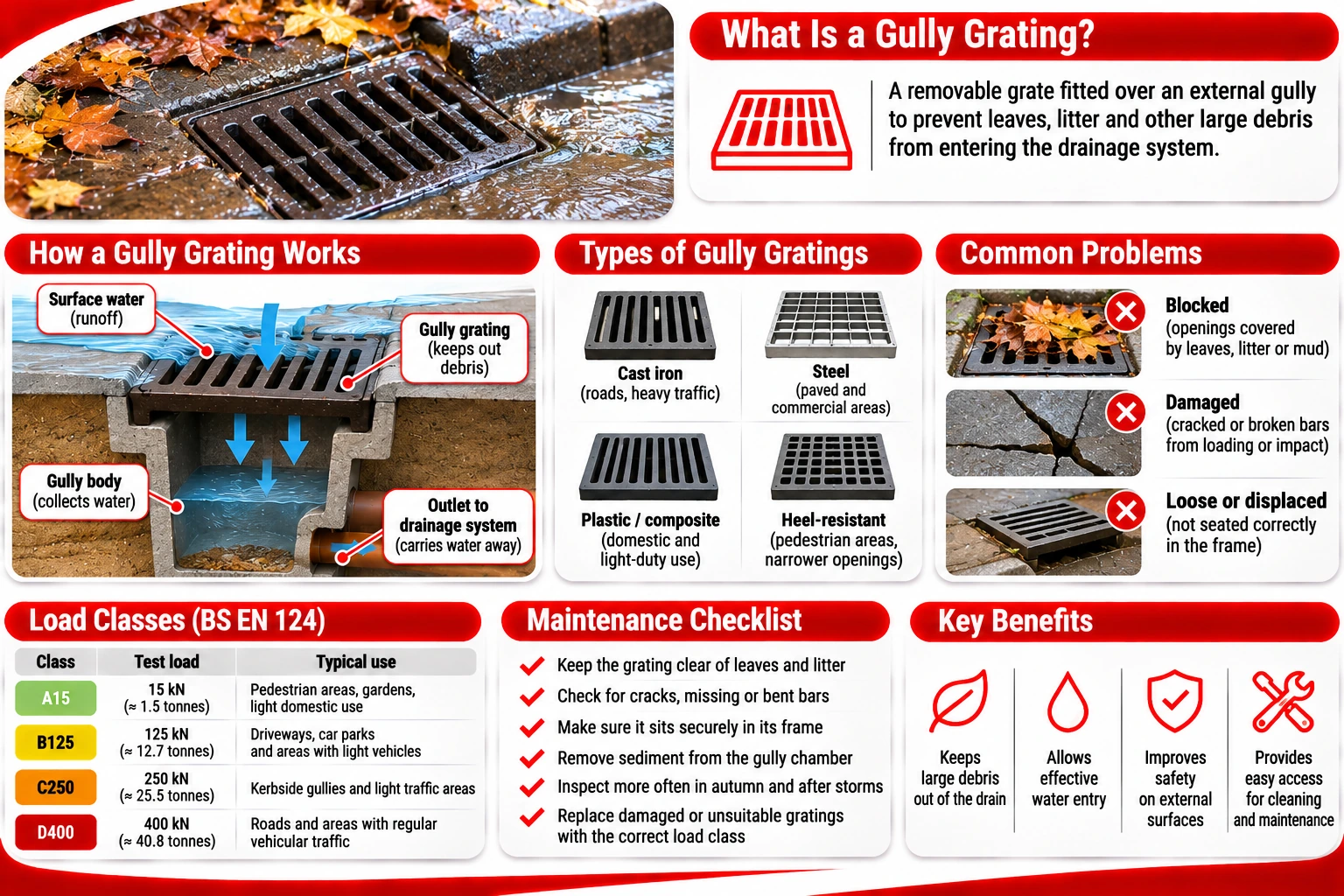
How Does a Gully Grating Work?
A gully grating operates as a coarse screening and inlet component. Rainwater flows across the surrounding surface towards the grating, passes through its openings and enters the gully below. The gully then directs the collected water into the connected drainage system, which may discharge to a surface water sewer, soakaway or another suitable drainage arrangement.
The grating contains slots, bars or other openings designed to admit water while retaining larger objects. The size, shape and distribution of these openings affect both the amount of water that can enter and the likelihood of debris becoming trapped.
A grating with relatively large openings may admit water efficiently but allow smaller stones, leaves and other material to enter the gully. A grating with narrow openings may retain more debris, although it can also become blocked more quickly when leaves or litter collect across its surface.
The main functions of a gully grating include:
-
Allowing rainwater and surface runoff to enter the drainage system.
-
Preventing larger pieces of debris from entering the gully chamber.
-
Providing a removable cover for inspection and maintenance.
-
Reducing the likelihood of objects accidentally falling into the drainage opening.
-
Providing a suitable surface for pedestrians or vehicles where the product is designed and rated for that application.
-
Helping maintain the intended drainage inlet geometry.
The grating does not normally filter fine sediment from the water. Sand, small particles and dissolved contaminants can pass through its openings and collect in the gully or travel farther into the drainage system.
Where a gully includes a sediment sump, heavier particles may settle below the outlet level. The sump requires periodic cleaning because accumulated material reduces its available storage volume.
The hydraulic performance of the grating depends on more than its total open area. Water must approach the openings in a way that allows it to enter efficiently. The surrounding surface gradient, inlet position, water depth and direction of flow all influence the amount of runoff captured.
For example, a grating installed at a local low point may receive water from several directions. A kerbside grating on a sloping road may need to intercept water flowing along the gutter, and some runoff may continue past the inlet if the flow exceeds its interception capacity.
A grating can also become partially blocked without the drainage pipe itself being obstructed. Leaves covering the upper surface may prevent water from reaching the openings, causing temporary ponding even when the gully and connecting pipe are clear.
Types of Gully Gratings and Where They Are Used
Gully gratings are available in different shapes, materials and load classifications. Their selection depends on the drainage application, expected traffic, dimensions of the gully opening and the amount of water that must be collected.
Road gullies commonly use cast iron gratings designed to withstand traffic loads. Domestic drainage installations may use smaller cast iron, steel, plastic or composite products, depending on the location and specification.
The most common arrangements include rectangular, square and circular gratings. Rectangular gratings are frequently used in road and paved-area drainage, while smaller square or circular covers are found in domestic and light-duty applications.
Some gratings are flat and sit approximately level with the surrounding paving. Others are designed for installation alongside a kerb or incorporate a dished profile that helps direct water towards the openings.
The following table outlines typical applications and selection considerations.
| Gully grating type | Typical application | Important consideration |
|---|---|---|
| Cast iron road gully grating | Roads and vehicle-access areas | Suitable load classification and secure seating |
| Steel grating | Paved areas and certain commercial installations | Corrosion protection and load capacity |
| Plastic or composite grating | Suitable domestic and light-duty drainage applications | Product rating, durability and installation conditions |
| Square or rectangular grating | Patios, driveways and road gullies | Opening dimensions and water collection requirements |
| Circular grating | Small external gullies and certain domestic installations | Compatibility with the gully body and frame |
| Hinged or secured grating | Locations requiring controlled access or resistance to displacement | Hinge condition, locking mechanism and maintenance access |
| Heel-resistant grating | Pedestrian areas where narrow openings are desirable | Slot geometry and suitability for the intended users |
These categories can overlap. A cast iron grating may be rectangular, hinged and designed for road use, while a composite product may be suitable for a particular pedestrian or light-vehicle application.
Load classification is particularly important where the grating forms part of a trafficked surface. BS EN 124 is the relevant European standard series used in the UK for gully tops and manhole tops in vehicular and pedestrian areas.
The standard identifies load classes for different installation environments. Common classes include A15, B125, C250, D400, E600 and F900, with increasing test load requirements.
The class designation corresponds to a specified test load expressed in kilonewtons. For example, D400 corresponds to a 400 kN test load, equivalent to approximately 40.8 tonnes-force. This is a standardised test requirement, not a statement that a grating may safely carry a vehicle weighing that amount in every installation.
The intended installation location is fundamental to selecting the correct class. A product suitable for a pedestrian-only area should not automatically be installed where cars or heavier vehicles will pass over it.
In addition, the grating must be compatible with its frame and correctly supported. A high-rated grating installed in a damaged or inadequately supported frame may still move, crack or fail under loading.
What Causes Gully Gratings to Become Blocked or Damaged?
The most common operational problem is obstruction of the grating openings. Leaves, litter, grass cuttings and other debris can accumulate on the surface, particularly during autumn or after heavy rainfall.
The problem is often concentrated where runoff carries material towards a low point. A gully located beneath trees, beside a heavily used road or near a landscaped area may collect substantially more debris than one in an open paved area.
The grating’s geometry influences how material accumulates. Long, narrow slots may become bridged by leaves or fibrous waste, while closely spaced openings can become covered by a layer of fine debris.
Once the openings are obstructed, water may pond around the inlet or flow past it towards another low point. This does not necessarily indicate a blocked underground drain because the restriction may be entirely at surface level.
Common causes of obstruction include:
-
Fallen leaves accumulating across the openings.
-
Plastic bags, packaging and other litter covering the grating.
-
Grass cuttings and garden waste washed from surrounding surfaces.
-
Mud and sediment deposited during storms or construction activity.
-
Loose stones and gravel becoming trapped between the bars.
-
Ice or compacted snow restricting openings during freezing conditions.
-
Debris accumulating inside the gully chamber and reducing its capacity.
Damage is a separate issue. A grating may become cracked, bent, displaced or insecure even when its openings remain clear.
Vehicle loading is one potential cause. Repeated traffic over an unsuitable or poorly supported grating can damage the cover or its frame. The surrounding pavement may also deteriorate, allowing the frame to move under load.
Corrosion can affect some metallic gratings, particularly where protective coatings have deteriorated or the component is exposed to aggressive conditions. The extent and rate of corrosion depend on the material and environment.
Plastic and composite gratings have different deterioration characteristics. They may be affected by impact, excessive loading, ageing or environmental exposure, depending on their composition and design.
A loose or rocking grating is particularly important because movement can damage the frame and surrounding surface. It may also create a trip hazard or become displaced when a vehicle passes over it.
Missing gratings present a more immediate safety concern. An uncovered gully opening can create a hazard for pedestrians, cyclists and vehicles, particularly where the opening is difficult to see.
How to Inspect and Maintain a Gully Grating
Routine maintenance should focus on keeping the inlet openings clear, checking the grating’s physical condition and confirming that the gully below is functioning correctly.
The appropriate inspection frequency depends on the location and surrounding environment. A gully beneath deciduous trees may require additional attention during autumn, while a drainage inlet in an area with little debris may need less frequent cleaning.
Inspections are particularly useful before periods of expected heavy rainfall and after significant storms, once conditions are safe. The aim is to identify restrictions before they cause repeated ponding or contribute to surface flooding.
A basic visual inspection should consider several points:
-
Are the grating openings clear of leaves, litter and other material?
-
Is the grating seated correctly within its frame?
-
Are any bars cracked, broken, bent or missing?
-
Does the grating move or rock when subjected to normal use?
-
Is the surrounding paving cracked, sunken or displaced?
-
Is sediment visibly accumulating immediately beneath the grating?
-
Does water appear to enter the gully normally during rainfall?
-
Are there signs of persistent ponding around the inlet?
Loose surface debris can sometimes be removed without lifting the grating, provided the work can be carried out safely. Gloves and suitable tools should be used because drainage debris may contain sharp objects or contaminated material.
Lifting the grating is a different task. Road gully covers can be heavy and may require specialist lifting equipment. Some are secured, hinged or designed to resist unauthorised removal.
A grating should not be lifted casually, particularly on roads, public footways or during flooding. The exposed opening creates a hazard, and traffic management or other safety precautions may be required.
Professional gully cleaning may involve removing the grating and extracting accumulated sediment, leaves and other material from the chamber. Vacuum equipment is commonly used for road gullies and other installations where substantial quantities of waste have collected.
The cleaning method should be appropriate for the gully construction. Where a sump is present, removing accumulated material helps restore its sediment storage capacity.
After cleaning, the grating should be correctly refitted and checked for stable seating. Any damaged or missing securing components should be addressed before the area is returned to normal use.
Water testing may help identify whether the inlet and connected drainage route are functioning, but the results need to be interpreted carefully. A small quantity of water passing through the grating does not necessarily demonstrate that the system has sufficient capacity during intense rainfall.
Choosing and Replacing a Gully Grating
Replacing a damaged gully grating requires more than matching its approximate length and width. The replacement must fit the frame correctly, provide the required loading performance and offer suitable openings for the drainage application.
An incorrectly sized cover may rock, leave gaps or fail to transfer loads properly to the supporting frame. Even small differences in seating dimensions can affect how securely the grating sits.
Where the existing frame is damaged, replacing the grating alone may not resolve the problem. The frame and its surrounding support may need repair or replacement to provide a stable installation.
Before selecting a replacement, the following details should be checked:
-
The dimensions of the existing grating and frame, including the seating arrangement.
-
The intended installation location and applicable load classification.
-
The grating material and its suitability for the environment.
-
The arrangement and size of the drainage openings.
-
Whether a hinged, secured or removable design is required.
-
Compatibility with the existing gully body and surrounding surface.
-
Whether the frame and adjacent paving remain structurally sound.
A replacement should not be selected solely because it looks similar to the original. Products with comparable external dimensions may have different seating details, load ratings or fixing arrangements.
Drainage capacity is another consideration. A grating with a much smaller effective opening area than the original may restrict water entry, particularly during intense rainfall. Conversely, larger openings may be unsuitable in areas where pedestrian safety or the entry of debris is a concern.
The relationship between opening area and actual inlet capacity is not straightforward. Flow interception depends on the grating geometry, approach conditions and water depth, so the nominal open area alone does not establish the amount of runoff the inlet can collect.
Where an existing gully repeatedly fails to capture surface water despite being clean and unobstructed, the problem may involve its position, surrounding gradients or inlet capacity rather than the condition of the grating. In such circumstances, a broader drainage assessment may be needed.
For public roads and other adopted drainage infrastructure, maintenance and replacement responsibilities depend on the ownership and management arrangements. Road gullies are commonly maintained by the relevant highway authority, while gullies serving private property may fall under the property owner’s responsibility.
Responsibility should be confirmed before undertaking work on a gully in a public area. A blocked or damaged road grating should normally be reported to the appropriate authority rather than removed or altered by an unauthorised person.
A gully grating is a small but essential component of an external drainage system. Its openings determine how surface water enters the gully, while its material, load rating and seating arrangement influence safety and durability. Keeping the grating clear, identifying damage promptly and ensuring that replacement components are correctly specified helps maintain reliable drainage and reduces the risk of avoidable surface water accumulation.