
What is a Excavation Pit
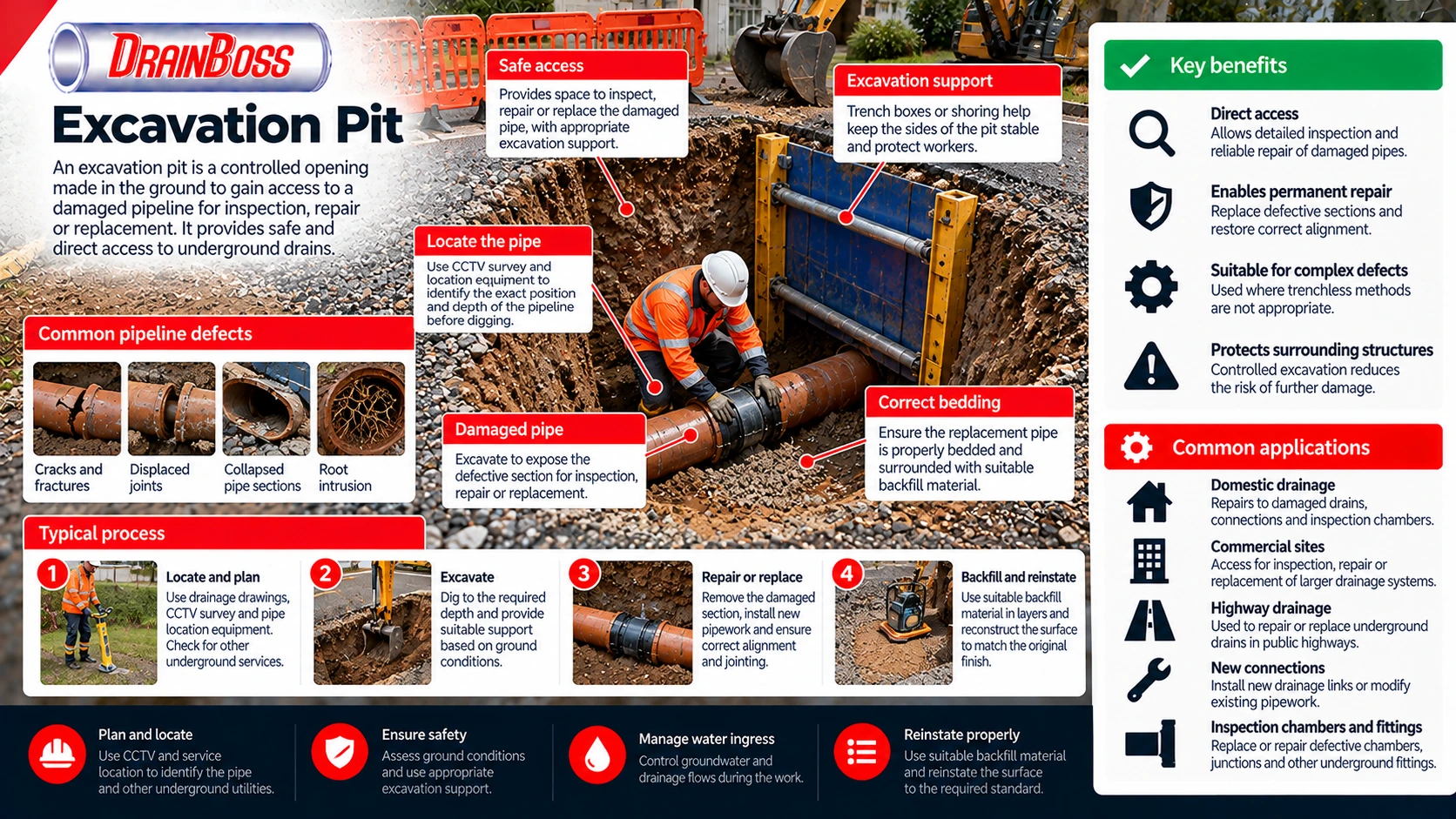
An excavation pit is a controlled opening made in the ground to expose an underground pipeline for inspection, repair, connection or replacement. In drainage engineering, excavation pits provide direct access to buried drains, sewers and associated fittings when work cannot be completed entirely from existing inspection chambers or other access points. The excavation may be relatively small, exposing a single damaged joint, or large enough to accommodate the removal and replacement of a substantial pipe section.
Excavation pits are commonly required when underground drainage pipes have collapsed, become severely displaced, suffered structural damage or developed defects that cannot be repaired satisfactorily using trenchless methods. They may also be necessary when installing new drainage connections, replacing defective inspection chambers or correcting pipe gradients. The size and configuration of the excavation depend on the depth of the pipeline, ground conditions, surrounding structures and the work that must be carried out.
An excavation pit is not simply a hole dug above a damaged drain. It is a temporary engineering work area that must provide safe access while protecting workers, nearby structures, buried utilities and the exposed pipeline. Its design must consider ground stability, water ingress, excavation support and the loads imposed by equipment, vehicles and excavated material.
When Is an Excavation Pit Required for Drainage Repairs?
The decision to excavate a drainage pipe should be based on the nature and location of the defect rather than the presence of a blockage alone. Many drainage restrictions can be investigated through existing access points, and suitable deposits can often be removed without disturbing the ground. Excavation becomes necessary when direct physical access is required to correct a structural problem or complete a connection.
A CCTV drain survey can help identify the location and extent of damage before excavation begins. Camera inspection may reveal fractured pipes, displaced joints, root intrusion, deformation, collapsed sections or changes in alignment. Where the defect can be located accurately, excavation can be concentrated around the affected section rather than opening a long trench unnecessarily.
The most common reasons for constructing an excavation pit include:
-
Collapsed pipe sections where the original bore has been partially or completely lost.
-
Severely displaced joints that prevent reliable drainage or cannot be repaired internally.
-
Fractured pipes requiring removal and replacement.
-
Incorrect pipe gradients that cause persistent standing water or sediment accumulation.
-
Damaged junctions where a branch connection must be reconstructed.
-
Defective inspection chambers, gullies or underground fittings requiring external access.
-
New drainage connections that cannot be installed through an existing access arrangement.
-
Localised excavation to create an access point for a trenchless repair or replacement operation.
Not every cracked or displaced pipe requires excavation. Some structurally defective drainage runs may be suitable for cured-in-place pipe lining or other trenchless rehabilitation techniques, provided the existing pipe geometry and condition allow the method to be used.
Conversely, a pipe that has lost its shape or collapsed completely may not provide a suitable passage for conventional lining equipment. The damaged section may first need to be exposed and reconstructed, or a different replacement technique may be required.
Excavation may also be selected where the pipe is shallow, readily accessible and located beneath a surface that can be reinstated without disproportionate disruption. In these circumstances, a localised excavation and conventional repair can sometimes be more practical than a specialist trenchless operation.
The choice should account for the complete repair rather than the excavation cost alone. Removing paving, supporting the excavation, replacing the pipe, backfilling and reinstating the surface all contribute to the work involved.
Locating the Pipeline and Establishing the Excavation Area
Accurate location of the underground pipe is one of the most important stages of excavation planning. Drainage drawings can provide useful information, but they may not reflect alterations made after the original installation. The actual pipe route and depth should therefore be verified where practicable.
CCTV inspection equipment fitted with a suitable sonde can help locate a particular point within a drainage run. A compatible surface receiver detects the signal transmitted by the sonde, allowing the operator to identify its position and estimate its depth.
The accuracy of this process depends on the equipment, surrounding conditions and correct operation. It should not be treated as a substitute for checking the location of other buried services.
Before excavation, the site should be assessed for electricity cables, gas pipes, water mains, telecommunications ducts and other underground infrastructure. In the UK, HSE guidance HSG47, Avoiding Danger from Underground Services, provides established principles for planning work, locating services and carrying out excavation safely.
The presence of nearby services may affect where machinery can operate and how the final section of ground is removed. Service drawings, locating equipment and carefully controlled trial excavations may be required to establish the position of buried utilities.
The excavation area must also accommodate more than the exposed pipe. Workers may need space to cut the damaged section, prepare pipe ends, position replacement fittings and inspect completed joints. Additional space may be necessary for excavation support, pumping equipment and safe access.
For example, a damaged joint in a 110 mm domestic drain may occupy only a short length of pipe, but the excavation must expose enough undamaged pipe on either side to permit a reliable repair. The required opening will depend on the jointing system, depth and ground conditions.
A deeper excavation may need a substantially larger working area because of the support system or the space required for safe access. The dimensions cannot be determined reliably from pipe diameter alone.
Site constraints can make a localised excavation difficult. Drainage pipes may run beneath driveways, extensions, boundary walls, mature trees or other features that limit access. In such cases, the excavation method and repair strategy may need to be adjusted to avoid destabilising adjacent structures.
Excavation Depth, Ground Stability and Temporary Support
The principal safety risk associated with an excavation pit is the possibility of ground collapse. Soil can fail suddenly, and even a relatively shallow excavation can be dangerous where the sides are unstable or a person is working in a restricted space.
There is no universally safe excavation depth below which support is automatically unnecessary. Ground stability depends on soil type, moisture content, excavation geometry, nearby loading, groundwater and the presence of previous disturbances.
Clay, sand, gravel and made ground behave differently when excavated. Some cohesive soils may temporarily retain a near-vertical face under favourable conditions, but this does not establish that the excavation will remain stable. Rainfall, vibration, drying, water ingress or additional loading can change the conditions rapidly.
Made ground can be particularly unpredictable because it may contain mixtures of soil, rubble, voids and poorly compacted material. Previous drainage repairs or service installations may also have disturbed the ground surrounding the pipe.
The excavation support method should be selected following an appropriate assessment of these conditions.
| Excavation arrangement | Typical application | Important consideration |
|---|---|---|
| Unsupported excavation | Only where a competent assessment establishes that the ground will remain stable | Ground conditions can change during the work |
| Battered excavation | Sites with sufficient space to slope excavation sides | Requires additional surface area and suitable slope design |
| Benched excavation | Excavations where stepped sides are appropriate | Bench dimensions depend on ground stability and excavation geometry |
| Trench box or excavation box | Suitable trench-shaped excavations | Must be used within its design limitations |
| Hydraulic or mechanical shoring | Excavations requiring controlled lateral support | Installation and removal must follow an engineered procedure |
| Sheet piling or engineered retaining system | Deeper or more constrained excavations | Requires assessment of soil pressures, water and nearby structures |
An excavation box is designed to protect workers within its supported area, but it does not necessarily prevent all ground movement outside the box. This distinction can be important where the excavation is close to foundations, roads or other sensitive structures.
Excavated spoil should be positioned away from the edge so that it does not impose excessive loading or fall back into the opening. Vehicles, plant and stored materials can also increase pressure on excavation sides.
Where machinery operates nearby, vibration and dynamic loading may affect stability. The position of equipment should therefore be considered as part of the excavation arrangement rather than determined solely by convenience.
Safe access and egress must be provided for anyone entering the excavation. Depending on the arrangement, this may involve suitable ladders, steps or other access systems. Workers should not rely on unsupported pipework, excavation braces or loose ground as climbing points.
Excavations must be inspected by a competent person at appropriate stages and when circumstances require it. Under the Construction (Design and Management) Regulations 2015, specific inspection requirements apply to excavations, including checks before work begins and following events likely to affect stability.
Water Ingress and the Condition of the Exposed Drain
Water can complicate excavation work in several ways. Groundwater may enter through the excavation sides or base, surface runoff may flow into the opening, and wastewater may escape from the damaged pipe itself.
Water ingress can soften the ground, reduce stability and make it difficult to prepare a suitable pipe foundation. It may also conceal defects or prevent workers from inspecting the exposed pipe properly.
Where water is entering the excavation, suitable control measures may be required. These can include diverting surface runoff, managing upstream drainage flows or using an appropriately designed dewatering arrangement.
Pumping water from an excavation is not always straightforward. In certain soils, uncontrolled pumping can remove fine particles and contribute to ground instability. Lowering groundwater may also affect nearby structures or services.
The method should therefore reflect the ground conditions and the amount of water involved. More complex dewatering operations may require specialist design and monitoring.
If the damaged pipe is part of an active foul drainage system, wastewater flow must be considered before the pipe is opened. Discharge from connected properties may continue during the repair unless it is controlled.
For a short domestic repair, it may be possible to coordinate the work with temporary restrictions on appliance use. Larger or continuously operating drainage systems may require temporary flow diversion or overpumping.
Overpumping involves transferring wastewater around the isolated section using suitable pumping equipment and temporary pipework. The arrangement must be capable of handling the expected flow and should account for the consequences of pump failure or unexpected increases in discharge.
Once the pipe has been exposed, its condition can be assessed directly. This may reveal damage that was not fully visible during CCTV inspection, such as external cracking, inadequate bedding, poorly formed joints or movement of surrounding ground.
The exposed section should be examined for evidence of differential settlement, voids and localised loss of support. Replacing the broken pipe without correcting the cause of movement may leave the new installation vulnerable to similar problems.
Pipe Removal, Replacement and Connection Details
The method of repair depends on the pipe material, defect and condition of the adjoining sections. Older drainage systems may contain vitrified clay, cast iron or concrete pipes, while many modern domestic underground drains use PVC-U or other suitable plastic systems.
When a damaged section is removed, the remaining pipe ends must be assessed for soundness. A repair connection should not rely on severely cracked, distorted or deteriorated material.
The replacement section must maintain the intended internal diameter and drainage alignment. Changes in level at the joints can create internal steps that interfere with the movement of wastewater and solids.
Flexible mechanical couplings are commonly used for certain underground drainage repairs. These fittings may connect pipes of the same material or different materials, provided the coupling is correctly specified for the actual outside diameters and installation conditions.
Not all flexible couplings are suitable for every location. Some applications require additional shear resistance or other support, particularly where pipes of different stiffnesses are joined or where ground loading may affect alignment.
The condition of the bedding beneath the replacement pipe is equally important. The pipe should be supported along the intended bearing surface rather than resting on isolated stones or hard points.
A repair that restores the pipe wall but leaves an unsupported void beneath the joint may be vulnerable to settlement. Appropriate bedding and side support help distribute loads and maintain the pipe alignment.
The existing gradient must also be checked. If the original failure was associated with settlement, the replacement section should not simply reproduce an incorrect level.
Where practical, the completed repair can be inspected before backfilling. This may involve visual examination, suitable joint testing or CCTV inspection, depending on the pipe system and the scope of work.
The purpose is to establish that the repair is properly connected, aligned and supported before access is lost.
Backfilling and Reinstatement After Drain Excavation
Backfilling is an essential part of a drainage excavation because the surrounding material helps support the pipe and distribute external loads. Poor backfilling can contribute to settlement, pipe deformation and damage to the reinstated surface.
The materials and procedures used depend on the pipe specification, ground conditions and whether the excavation is beneath a garden, driveway, pavement or road.
For flexible plastic drainage pipes, the interaction between the pipe and surrounding soil is particularly important. Correct bedding, sidefill and compaction help the pipe resist external loading while maintaining its intended shape.
The initial backfill should be compatible with the pipe manufacturer’s requirements and the applicable installation specification. Large stones or unsuitable material placed directly against the pipe can create concentrated loads and damage.
Backfilling is generally carried out in controlled layers, with compaction appropriate to the material and location. Excessive compaction forces close to a pipe can be harmful, while insufficient compaction can lead to later settlement.
The main stages of reinstatement normally include:
-
Confirming that the repaired pipe and joints are correctly installed.
-
Completing the required inspection or testing before concealment.
-
Placing and compacting suitable bedding and sidefill around the pipe.
-
Installing the initial backfill in accordance with the pipe system requirements.
-
Completing the remaining backfill in suitable layers.
-
Reconstructing the surface foundation and finishing layers.
-
Checking the reinstated area for defects and recording the completed work where necessary.
The reinstatement requirements can vary considerably. A garden excavation may involve replacing topsoil and turf, while a paved driveway requires suitable sub-base preparation and accurate reconstruction of the surface.
Excavations in public highways are subject to additional controls. In England, street works reinstatement is governed by the relevant statutory framework and the applicable Specification for the Reinstatement of Openings in Highways.
Where work affects a public highway, permissions, traffic management and reinstatement requirements must be established before excavation. The responsibilities depend on the nature of the work and the organisation carrying it out.
Settlement after reinstatement is not always evidence of a defective pipe repair. It may result from inadequate compaction of the backfill or failure of the surface construction. However, significant settlement can also impose new loads on the buried pipe and should be investigated.
Excavation Pits Compared with Trenchless Drain Repairs
Excavation and trenchless repair methods address different site conditions and are not universally interchangeable. An excavation pit provides direct access to the pipe, while trenchless techniques attempt to repair or replace it with less extensive surface disruption.
Cured-in-place pipe lining can rehabilitate suitable existing pipes by forming a new lining within the original pipe. It may be appropriate for certain cracks, defective joints and other structural problems, depending on the condition and geometry of the host pipe.
However, lining cannot reliably correct every defect. Severe collapse, substantial deformation, major displacement or an unsuitable pipe alignment may prevent installation or compromise the result.
Pipe bursting is another trenchless technique used for selected replacement projects. It involves fracturing or splitting the existing pipe while drawing a replacement pipe through the route. The method generally requires access excavations and must be assessed against the surrounding ground, nearby services and existing pipe material.
The term trenchless therefore does not necessarily mean that no excavation is required. Access pits may still be needed for equipment, connections or localised repairs.
For a single damaged joint beneath an accessible garden, a small excavation may be an efficient solution. For a long defective pipe beneath a substantial paved area, trenchless rehabilitation may reduce surface disturbance if the pipe is suitable.
The comparison should consider the extent of structural damage, excavation depth, ground conditions, access, reinstatement requirements and expected service performance.
A localised excavation can also complement trenchless work. For example, a collapsed section may be excavated and replaced to restore continuity before a longer section is rehabilitated internally.
Excavation Near Buildings, Foundations and Existing Services
Drainage pipes frequently run close to buildings, particularly where they connect to soil stacks, kitchen waste outlets or inspection chambers. Excavating these locations can create additional risks because removing ground may affect the support provided to nearby structures.
The relationship between excavation depth and foundation level is especially important. An excavation extending below or close to the bearing level of a foundation may require specialist assessment and temporary works.
It is not possible to establish a universally safe distance from a building using a single measurement. The appropriate approach depends on foundation depth, ground conditions, excavation geometry and the loads carried by the structure.
Boundary walls, retaining walls and nearby paved surfaces may also be affected by excavation. Even where a structure is not directly above the pipe, removing adjacent ground can reduce lateral support or contribute to settlement.
Where a drain passes beneath a building, conventional excavation may involve opening floors or working in restricted spaces. The consequences for structural elements and building services must be assessed before work begins.
Excavation close to existing utility services requires similarly careful planning. Damage to an electricity cable or gas pipe can have consequences far beyond the immediate drainage repair.
Mechanical excavation may be restricted near known services, and suitable hand-digging or other controlled methods may be required. The actual procedure should follow the risk assessment and relevant guidance rather than an assumed universal clearance distance.
The excavation may also expose previously unidentified services. Work should be reassessed if unexpected cables, pipes or ducts are encountered.
For complex sites, the drainage repair may require coordination between drainage engineers, utility operators, structural engineers and temporary works specialists.
How Excavation Quality Affects the Long-Term Drainage Repair
A successful excavation repair depends on more than replacing the visibly damaged section of pipe. The surrounding ground, joint alignment, bedding and reinstatement all influence the performance of the completed drainage system.
One recurring cause of failure is inadequate support beneath a replacement pipe. If the new section bridges a void or rests on uneven material, loads may become concentrated around the joints. Subsequent ground movement can then create displacement or cracking.
Another risk is connecting a new pipe to an existing section that is already deteriorating. The immediate defect may be removed, but the adjoining pipe can remain vulnerable. The repair should therefore extend far enough to reach material capable of forming a reliable connection.
The excavation also provides an opportunity to identify the cause of the original damage. Evidence of root activity, soil movement, poor bedding or external loading may influence how the replacement section is installed.
Where a pipe has repeatedly fractured in the same location, simply installing another short section without investigating these conditions may lead to further repairs.
Accurate records are valuable once the excavation has been reinstated. Photographs of the exposed pipe, measurements of depth and location, details of replacement materials and inspection results can assist with future maintenance or alterations.
For buried drainage, these records may be the only direct evidence of the repair arrangement after the surface has been restored. They can also help distinguish the repaired section from older pipework if further defects are discovered elsewhere in the system.
An excavation pit should therefore be planned as part of the complete drainage repair process, from defect location and ground assessment through to pipe installation and final reinstatement. The quality of the finished work depends on maintaining pipe alignment, providing suitable support and ensuring that the excavation itself has not introduced new risks to the drainage system or surrounding structures.