
What is a Camera Sonde
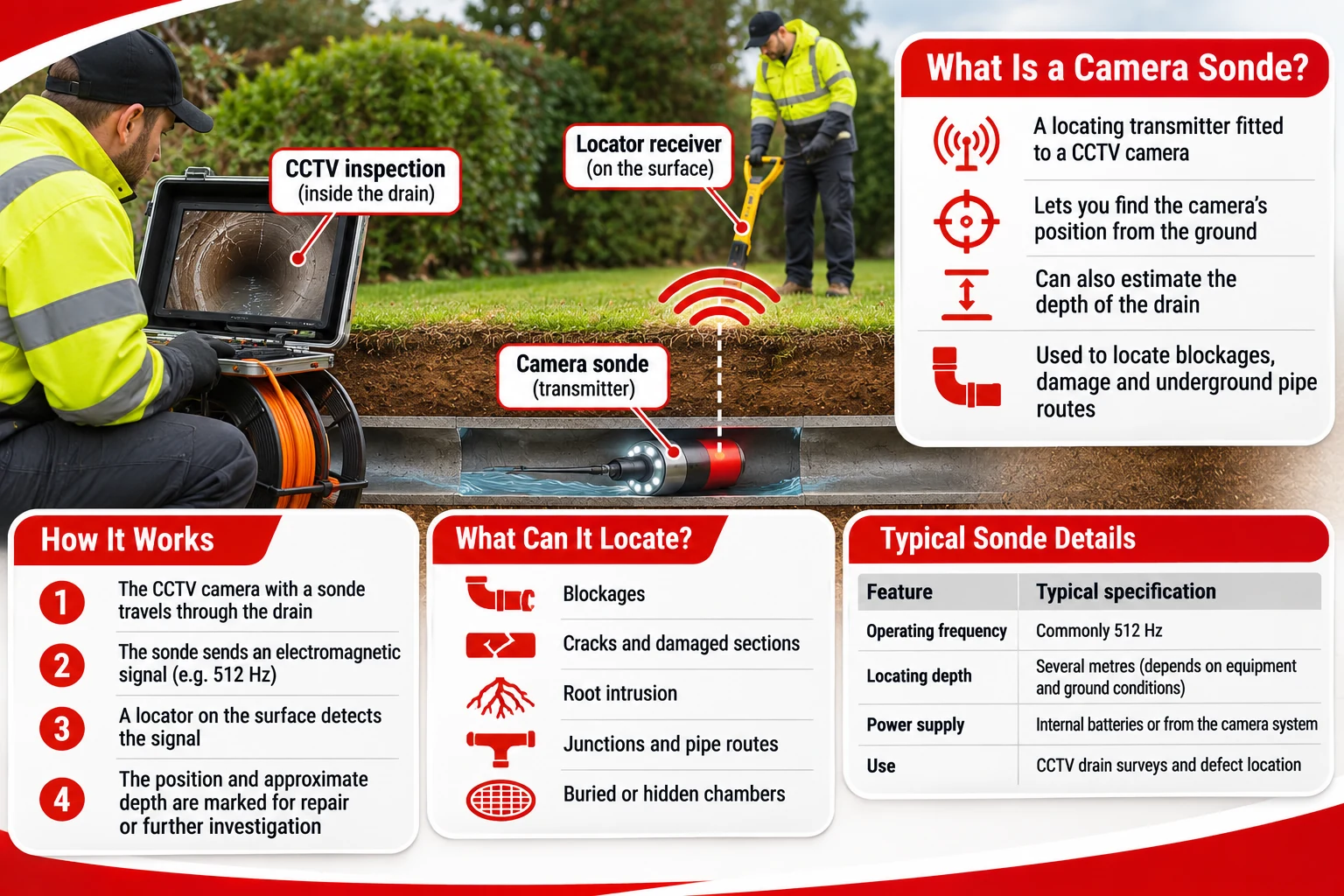
A camera sonde is a small electronic locating transmitter fitted to the head of a CCTV drain inspection camera or positioned close to it. It emits a low-frequency electromagnetic signal that can be detected from the ground surface using a compatible receiver. This allows drainage engineers to identify the approximate position and depth of the camera while it travels through an underground pipe.
Camera sondes are commonly used during CCTV drain surveys to locate blockages, damaged pipe sections, hidden inspection chambers and underground drainage routes. They are particularly useful where drainage plans are unavailable or inaccurate. By identifying the position of a defect before excavation begins, engineers can plan targeted repairs and reduce unnecessary disturbance to driveways, gardens and other surfaces.
How Does a Camera Sonde Work?
A camera sonde contains a battery-powered or camera-powered transmitter that produces an electromagnetic field at a specific operating frequency. The transmitter is usually integrated into the CCTV camera head or installed in a separate housing immediately behind it. As the camera moves through the drainage pipe, the sonde travels with it and provides a signal that can be detected above ground.
A drainage engineer uses a handheld sonde locator to identify this signal. The receiver measures the electromagnetic field and provides visual or audible indications that help the operator determine the transmitter’s position. Many compatible receivers also calculate an estimated depth when used correctly and under suitable conditions.
The locating process normally involves several stages:
-
The CCTV camera is inserted into the drain through an accessible inspection chamber, rodding point or another suitable opening.
-
The camera is advanced along the pipe while the engineer examines the internal condition.
-
When a blockage, crack or other defect is identified, the camera head is positioned close to the relevant location.
-
The sonde transmitter is activated or confirmed to be operating.
-
A second operator, or the same engineer where practical, uses a receiver above ground to detect the transmitted signal.
-
The surface position is identified and marked for further investigation or repair.
The sonde does not transmit video images to the surface receiver. Its purpose is to provide a locating signal, while the CCTV system records the internal pipe condition. The two technologies work together to connect visual inspection findings with a physical location above ground.
Most sonde systems use electromagnetic frequencies suitable for underground locating. A common operating frequency is 512 Hz, although equipment using other frequencies is available. The receiver must support the frequency transmitted by the sonde, otherwise reliable detection may not be possible.
Camera Sonde Frequencies, Depth and Accuracy
The performance of a camera sonde depends on its transmitter frequency, signal strength, burial depth and surrounding conditions. Lower-frequency signals are often used for underground pipe locating because they can be detected through soil and many non-metallic materials.
A 512 Hz sonde is widely used in drainage inspection equipment, but frequency alone does not determine locating performance. The transmitter’s output, receiver sensitivity and the presence of nearby conductive materials can significantly influence the result.
The following characteristics are important when selecting or using a camera sonde.
| Characteristic | Typical information | Why it matters |
|---|---|---|
| Operating frequency | Commonly 512 Hz, with other frequencies available | Transmitter and receiver must be compatible |
| Power supply | Internal batteries or power from the camera system | Determines operating arrangements and available working time |
| Installation | Integrated into the camera head or fitted nearby | Affects the relationship between the camera image and located position |
| Locating depth | Depends on equipment specification and site conditions | Determines whether the signal can be detected from the surface |
| Depth measurement | Estimated by a compatible receiver | Helps assess excavation depth |
| Pipe compatibility | Commonly used in plastic, clay and concrete drains | Metallic pipes and nearby metal can affect signal detection |
| Position marking | Surface mark made after locating the transmitter | Supports targeted excavation and repair planning |
Some professional sonde systems are specified for locating depths of several metres, but the manufacturer’s maximum detection range should not be treated as a guaranteed working depth. Signal quality may deteriorate because of electromagnetic interference, ground conditions or nearby metal structures.
Depth readings also require careful interpretation. The receiver estimates the distance to the transmitter based on the detected electromagnetic field. This is not necessarily the same as the depth to the top of the pipe or the excavation depth required to expose it.
For example, if the sonde is positioned near the centre of a drainage pipe, the displayed depth generally relates to the transmitter rather than the pipe crown. Pipe diameter and transmitter position must therefore be considered when planning excavation.
Accurate locating also depends on the operator identifying the correct signal position. Simply following the strongest apparent signal without checking its field characteristics can produce misleading results, particularly where the field is distorted.
What Can a Camera Sonde Locate During a Drain Survey?
The main advantage of a camera sonde is its ability to identify the ground position of a feature already observed during CCTV inspection. This makes it particularly useful for investigating drainage systems where the pipe route is unknown or where excavation must be kept to a minimum.
For example, a CCTV camera may reveal a displaced joint beneath a paved driveway. Without locating equipment, engineers may know the approximate distance from the inspection chamber but not the exact position above ground. A camera sonde allows the defect to be marked on the surface before repair work is planned.
Common applications include:
-
Locating blocked sections of underground drainage pipes.
-
Identifying the position of cracked or fractured pipework.
-
Finding displaced joints and sections affected by root intrusion.
-
Tracing drainage routes beneath gardens, driveways and paved areas.
-
Locating buried inspection chambers and concealed drainage connections.
-
Identifying the position of pipe bends and junctions.
-
Establishing approximate pipe depth before excavation.
-
Supporting the preparation or correction of drainage layout plans.
Camera sondes can also help identify previously undocumented drainage arrangements. Older properties may have undergone extensions, renovations or changes to their drainage systems without accurate records being retained. A CCTV survey combined with sonde locating can provide information about the current pipe route.
However, the sonde identifies its own position rather than independently detecting every nearby pipe or underground structure. To trace a drainage route, the camera must be moved through the relevant pipe and located at suitable intervals.
A sonde also cannot confirm the presence of a defect without supporting inspection evidence. The CCTV image, pipe condition and other survey findings remain essential when determining what repair work is necessary.
Camera Sonde vs Other Drain Locating Equipment
Camera sondes are one of several technologies used to locate underground drainage infrastructure. They are particularly useful when a camera can travel through the pipe, but other equipment may be more suitable depending on the investigation.
A conventional cable and pipe locator detects electromagnetic signals associated with conductive underground services. Some systems can also trace a signal applied to a suitable conductive cable or tracing rod. This differs from a camera sonde, which acts as a point transmitter travelling inside the drainage pipe.
Ground-penetrating radar is another method used to investigate subsurface features. It sends radar signals into the ground and analyses reflections from changes in material properties. Although useful in certain conditions, radar results can be affected by soil moisture, ground composition and the depth of the target.
The main differences are summarised below.
| Locating method | Main purpose | Important limitation |
|---|---|---|
| Camera sonde | Locates the position of a transmitter inside a drain | Requires suitable access and a compatible receiver |
| CCTV camera without sonde | Provides visual inspection of pipe interiors | Does not independently establish the surface position |
| Electromagnetic pipe locator | Traces suitable conductive services or applied signals | Cannot directly trace ordinary non-conductive pipes without an appropriate signal source |
| Tracing rod with sonde | Locates accessible underground pipe routes | May not pass through severe blockages or tight bends |
| Ground-penetrating radar | Investigates subsurface structures and material changes | Performance depends heavily on ground conditions |
A camera sonde is particularly effective when the engineer needs to connect a specific CCTV finding with its location above ground. For broader underground utility investigations, several locating methods may be required.
Limitations and Common Sources of Locating Errors
Although camera sondes provide valuable location information, their accuracy is not unlimited. The electromagnetic field generated by a transmitter can be distorted by nearby conductive materials, including metal pipes, reinforced concrete and other underground infrastructure.
Surface conditions can also affect the locating process. A receiver may be difficult to position directly above the transmitter if the drain passes beneath a building, parked vehicle or inaccessible area. In these situations, the engineer may need to use additional measurements or alternative investigation methods.
Several factors can reduce locating reliability:
-
Incorrect frequency selection on the receiver.
-
Weak transmitter batteries or insufficient signal strength.
-
Nearby metallic objects that distort the electromagnetic field.
-
Excessive depth relative to the equipment’s practical detection range.
-
Incorrect receiver orientation or locating technique.
-
Interference from other electrical or electromagnetic sources.
-
Misinterpretation of the displayed depth measurement.
The position of the sonde relative to the camera head is another consideration. If the transmitter is fitted behind the camera rather than inside its head, the located position may be offset from the defect shown on the CCTV image. This distance should be considered when marking the repair location.
Depth readings should also be checked against available drainage information where possible. A measurement that appears inconsistent with the known pipe route or surrounding ground levels may indicate field distortion or an incorrect locating position.
For excavation work, sonde locating should not replace appropriate checks for other underground services. Electricity cables, gas pipes and water mains may be present near the drainage route. Suitable utility detection, records and safe excavation procedures remain necessary.
How Camera Sondes Help Reduce Drain Repair Excavation
One of the most practical uses of a camera sonde is identifying where excavation should take place. Underground drainage defects are often concealed beneath finished surfaces, making it difficult to determine the correct repair position from visible symptoms alone.
Consider a drainage pipe running beneath a 12-metre driveway. A CCTV survey identifies a damaged joint approximately 7 metres from the nearest inspection chamber. The camera distance counter provides a useful indication, but the pipe may contain bends or follow a route that is not visible from the surface.
By positioning the sonde at the damaged joint, the engineer can locate its approximate surface position and mark the area requiring further investigation. This can help limit excavation to a smaller section rather than opening the driveway along an assumed pipe route.
The same approach can be used for collapsed pipes, root-damaged joints and hidden connections. It is particularly valuable where access is restricted or where surface reinstatement would be expensive.
However, locating a defect does not automatically determine the appropriate repair method. A cracked pipe may be suitable for localised repair or lining, while a severely collapsed section may require excavation and replacement. The decision depends on the CCTV findings, pipe material, structural condition and accessibility.
The sonde therefore supports repair planning rather than replacing engineering assessment. Its value lies in combining underground visual evidence with a practical surface location.
Using Camera Sondes in Professional Drainage Surveys
Camera sondes are commonly incorporated into professional CCTV drainage inspection systems because they provide information that ordinary video footage cannot establish on its own. They are particularly useful when investigating recurring blockages, preparing drainage plans or identifying defects beneath buildings and hard landscaping.
During a survey, engineers should record the relevant camera footage, approximate distance along the pipe, located surface position and estimated depth. Where appropriate, the findings can be included in a drainage survey report with photographs, defect descriptions and recommendations for further work.
The quality of the results depends on both the equipment and the survey procedure. A suitable transmitter and receiver must be used correctly, and any limitations affecting the location should be recorded. Where precise positioning is critical, additional verification may be necessary before excavation.
Camera sondes provide an effective connection between CCTV drain inspection and underground pipe locating. By identifying where a camera head is positioned beneath the surface, they help drainage engineers trace pipe routes, locate defects and plan repairs more efficiently. Their greatest benefit comes from using the locating information alongside CCTV evidence, drainage records and appropriate site investigations.