What is a Cross Bore
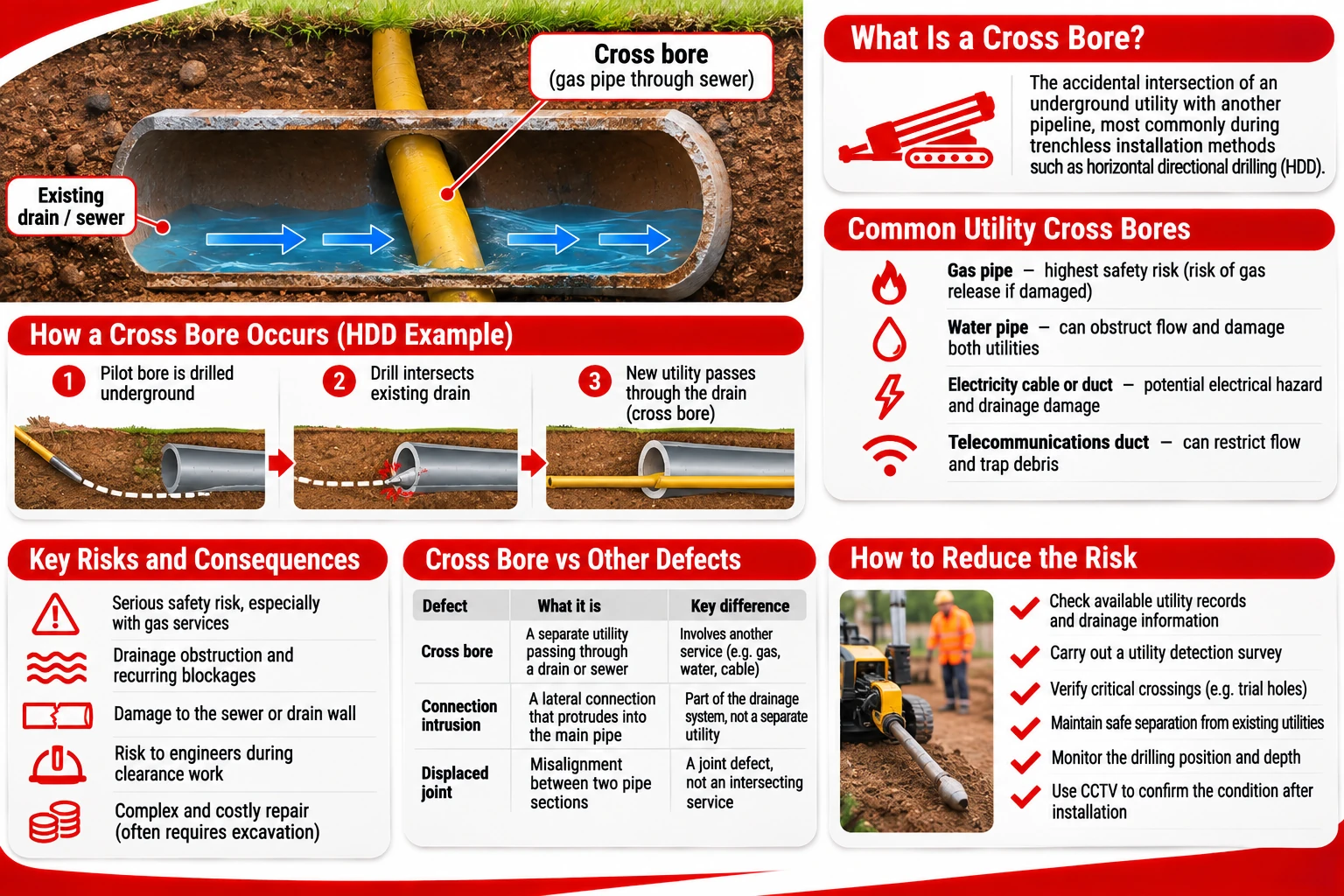
A cross bore is an accidental intersection between two underground utilities, usually occurring when a new pipe, cable or duct is installed through an existing pipeline. The term is particularly associated with trenchless construction methods, including horizontal directional drilling (HDD), where an installation passes beneath the ground without excavating a continuous trench. A cross bore can damage an existing drain or sewer, obstruct wastewater flow and create serious safety hazards.
One of the most dangerous situations occurs when a gas service pipe passes through an existing sewer. The gas pipe may remain intact initially, but a drainage contractor attempting to clear a blockage could accidentally damage it with cutting or cleaning equipment. Although cross bores are frequently discussed in connection with gas utilities, they can involve water mains, telecommunications ducts, electricity cables and other underground infrastructure.
In the UK, the term cross bore is less commonly used than in North American utility safety guidance. However, the underlying risks are relevant to British drainage engineers, utility contractors and anyone carrying out trenchless work near existing underground services.
How Do Cross Bores Occur During Underground Construction?
Cross bores develop when the route of a new underground installation intersects an existing utility that has not been correctly identified, located or avoided. The risk is particularly significant during trenchless operations because the drilling or boring equipment moves through the ground without continuous visual access to surrounding infrastructure.
Horizontal directional drilling typically involves creating a pilot bore along a planned route, enlarging it where necessary and pulling the new pipe or duct into position. If an existing drain crosses that route, the drilling equipment may penetrate the drain wall and continue through its internal space.
The resulting damage depends on the relative position of the two utilities, their materials and the installation method. A new pipe may pass directly through the centre of a sewer, clip its upper wall or damage a joint without fully crossing the internal opening.
Common contributing factors include:
-
Incomplete utility records. Existing drainage pipes may be absent from plans or shown in inaccurate positions.
-
Incorrect depth assumptions. The actual depth of a drain may differ from the depth indicated on drawings.
-
Inadequate site investigation. Underground services are not sufficiently identified before drilling begins.
-
Unrecorded drainage connections. Private drains and lateral connections may not appear on available utility plans.
-
Changes in drilling alignment. The actual bore path may deviate from the intended route.
-
Insufficient separation. The proposed installation passes too close to an existing utility.
-
Poor coordination. Information about underground services is not adequately shared between contractors.
Older drainage systems can present additional difficulties because historical alterations may not have been documented. A property may have a private drain, an abandoned connection or a rerouted sewer that differs from the available drawings.
Cross bores are not limited to HDD. Other trenchless installation techniques, including certain forms of impact moling and auger boring, can create similar risks where the equipment intersects an existing service.
The defining feature is the unintended intersection of underground utilities, not the particular machine used to create it.
What Types of Cross Bore Can Affect Drainage Pipes?
A cross bore can involve different combinations of underground services. The consequences depend on whether the new installation damages the drainage pipe, obstructs its internal space or creates a pathway for leakage.
The most serious examples involve utilities carrying hazardous substances or electrical energy, but even a relatively small telecommunications duct can produce a significant drainage obstruction.
| Cross bore type | Possible effect on drainage | Additional concern |
|---|---|---|
| Gas pipe through a sewer | Obstruction and damage to the sewer wall | Gas release if the pipe is damaged during cleaning |
| Water service through a drain | Reduced flow area and possible cracking | Water leakage or damage to the service pipe |
| Electricity cable or duct through a sewer | Obstruction and structural damage | Electrical hazards if the installation is damaged |
| Telecommunications duct through a drain | Localised restriction and debris accumulation | Damage to communication infrastructure |
| New drainage pipe through an existing sewer | Damage to the original pipe and possible flow restriction | Leakage, infiltration or defective connections |
A cross bore should not be confused with an ordinary pipe crossing. Underground utilities can cross one another safely when suitable separation and protection are provided. The defect occurs when the new installation unintentionally penetrates or interferes with the existing utility.
It is also different from connection intrusion. Connection intrusion involves a lateral drainage connection projecting into the main pipe, whereas a cross bore usually involves an unrelated utility passing through or damaging the drainage system.
In some cases, the cross bore may not cause an immediate blockage. Wastewater can continue to pass around the new utility, particularly in a larger sewer. However, the obstruction may trap debris over time and become increasingly difficult to clear.
Why Are Gas Cross Bores Particularly Dangerous?
A gas cross bore creates a potentially serious hazard because the gas pipe and drainage system occupy the same space. The gas service may pass through the sewer without leaking, leaving the defect undetected until a drainage problem occurs.
If a drain becomes blocked, an engineer may introduce rods, high-pressure jetting equipment or a mechanical cutter. Equipment intended to remove an obstruction could strike or penetrate the gas pipe.
Damage to a live gas service can release gas into the sewer, surrounding ground or connected drainage infrastructure. Depending on the circumstances, gas may migrate towards buildings or accumulate in enclosed spaces, creating fire, explosion and asphyxiation risks.
The sequence of events can be particularly dangerous:
-
A gas service is installed using a trenchless method.
-
The installation unintentionally passes through an existing drain.
-
The drain remains operational for a period, concealing the defect.
-
Debris accumulates around the crossing and restricts wastewater flow.
-
A drainage contractor attends to investigate or clear the blockage.
-
Cleaning equipment contacts the gas service, potentially causing damage and gas release.
This is why an unexpected rigid obstruction inside a drain should not automatically be treated as concrete, roots or another conventional blockage.
A cross bore may appear similar to an ordinary obstruction when viewed from a distance. Attempting to break through it without identifying the material can create risks far greater than the original drainage problem.
Where a gas service is suspected inside a sewer, intrusive cleaning should stop until the situation has been assessed and the relevant utility operator has been involved. If gas is escaping or an immediate gas emergency is suspected in Great Britain, the National Gas Emergency Service can be contacted on 0800 111 999.
The exact emergency response depends on the circumstances, but workers should avoid actions that could damage the suspected service or create an ignition source.
How Are Cross Bores Detected in Drainage Systems?
CCTV drain inspection is an important method of identifying cross bores because it provides a direct view of the pipe interior. A camera may reveal a foreign pipe or duct passing across the drainage channel, damage to the surrounding pipe wall or an unusual obstruction at a location where another utility has been installed.
However, not every cross bore is immediately recognisable. The crossing may be partly concealed by sediment, wastewater or accumulated debris, and the camera may be unable to pass the obstruction.
Typical CCTV findings include:
-
A smooth cylindrical pipe or duct crossing the drainage channel.
-
A foreign object entering through one pipe wall and continuing towards the opposite wall.
-
Broken clay, concrete or plastic around the point of penetration.
-
Debris accumulated immediately upstream of the crossing.
-
An obstruction that does not resemble normal drainage deposits.
-
Evidence of leakage or infiltration around the damaged pipe wall.
CCTV can establish the presence of an unusual internal obstruction, but it may not reliably identify the utility carried by the foreign pipe. Colour, diameter and appearance alone are insufficient to confirm whether it contains gas, water or electrical services.
The survey findings should therefore be considered alongside utility records, installation history and appropriate locating investigations.
A camera sonde can help establish the position of the obstruction above ground. This allows the recorded location to be compared with known underground utility routes, although it does not identify the contents of the crossing pipe.
Additional investigation may involve electromagnetic utility locating, ground-penetrating radar where conditions are suitable, or carefully controlled excavation. Each method has limitations, and some underground services cannot be reliably detected using a single technique.
In the UK, PAS 128 provides a framework for underground utility detection, verification and location. Its survey categories distinguish between information derived from records, surface detection and physical verification.
For suspected cross bores, physical verification may be necessary before any intrusive work is undertaken.
Preventing Cross Bores During Trenchless Installation
Cross bore prevention depends on identifying existing underground services and maintaining a safe installation route. Utility drawings are an important starting point, but they should not be treated as definitive evidence of the exact position or depth of every buried pipe.
Drainage systems are particularly challenging because private connections may be poorly documented. Unlike some metallic services, clay and plastic drains cannot generally be traced directly using conventional electromagnetic locating equipment unless a suitable traceable device is introduced.
A prevention strategy should include:
-
Obtain available utility records and drainage information before planning the installation.
-
Identify known sewers, private drains, lateral connections and other underground services.
-
Carry out appropriate utility detection and location surveys.
-
Verify critical crossings using suitable investigation methods, including trial holes where necessary.
-
Establish the proposed drilling alignment and required separation from existing utilities.
-
Monitor drilling position and depth using equipment appropriate to the installation method.
-
Investigate unexpected drilling resistance, changes in ground conditions or discrepancies in recorded service locations.
-
Verify the completed installation where the risk assessment identifies a need for further checks.
The Health and Safety Executive’s HSG47 guidance, Avoiding Danger from Underground Services, provides a recognised UK framework for planning work, locating services and applying safe excavation practices.
The appropriate separation between utilities depends on the installation, ground conditions, service requirements and applicable specifications. There is no universal clearance distance that can safely be applied to every trenchless crossing.
Where a new installation passes close to a known drain, its position may need to be confirmed by exposing the existing pipe. This can be more reliable than relying entirely on estimated depths or historical plans.
Pre-installation and post-installation CCTV surveys can also be useful for high-risk drainage crossings. A survey before construction provides a record of the pipe’s condition, while a subsequent survey can help identify damage or unexpected intrusions.
What Happens When a Cross Bore Is Found?
A confirmed or suspected cross bore requires a coordinated response because two separate utility systems may be affected. The immediate priority is to establish the nature of the crossing and prevent activities that could damage a potentially hazardous service.
If the obstruction could be a gas pipe or electrical service, mechanical cutting, rodding and other intrusive operations should not continue until the risk has been assessed. The relevant utility owner or operator must be involved in determining the appropriate response.
The next steps generally involve:
-
Securing the affected work area and stopping potentially hazardous activities.
-
Recording the location and available CCTV evidence.
-
Identifying the suspected crossing utility using appropriate records and investigation.
-
Contacting the relevant utility operator.
-
Establishing a safe method for accessing and correcting the defect.
-
Repairing or rerouting the affected service as required.
-
Restoring the damaged drainage pipe and verifying its condition.
Repair often requires excavation to expose the intersection and separate the utilities safely. The crossing service may need to be rerouted, and the damaged section of sewer may require replacement or another suitable structural repair.
Simply cutting the foreign pipe out of the drain is not an acceptable solution. The crossing utility may be live, and its removal must be planned and carried out by appropriately authorised personnel.
Once the utilities have been separated, the drainage repair should restore a continuous flow path and the required structural integrity. CCTV inspection and appropriate testing can help verify the completed work.
Responsibility for the costs and repairs depends on the ownership of the affected utilities, the circumstances of installation and the applicable contractual and legal arrangements. These matters should be established through the relevant utility operators and parties involved.
A cross bore is therefore more than an unusual drainage obstruction. It is a potentially hazardous conflict between underground services that requires careful identification and coordinated repair. Accurate utility surveys, suitable separation during trenchless construction and appropriate CCTV verification are important measures for reducing the risk of these defects remaining hidden beneath the ground.