
What is a Dual Containment System
A dual containment system is a pipework arrangement in which a primary pipe is enclosed within a secondary protective pipe or casing. The primary pipe carries the liquid or other substance being transported, while the outer containment provides an additional barrier if the inner pipe develops a leak. This configuration is also known as double containment piping or pipe-in-pipe construction and is commonly used where uncontrolled leakage could cause environmental contamination, safety hazards or significant damage to surrounding infrastructure.
Unlike conventional single-wall pipework, a dual containment system is designed to manage the consequences of a failure in the primary pipe. If the inner pipe develops a crack, defective joint or other leak, the released liquid enters the space between the two pipes rather than immediately escaping into the surrounding soil or building structure. This space, known as the interstitial or annular space, may also be used for leak detection and monitoring, depending on the system design.
Dual containment is particularly relevant to industrial drainage, chemical transfer systems, hazardous liquid pipelines and underground installations where leaks may remain undetected for extended periods. It can also be specified for particular wastewater applications, especially where the liquid contains substances that should not be released into the ground. The additional protection does not eliminate the possibility of leakage, but a correctly designed, installed and maintained system can substantially reduce the risk of an uncontrolled release.
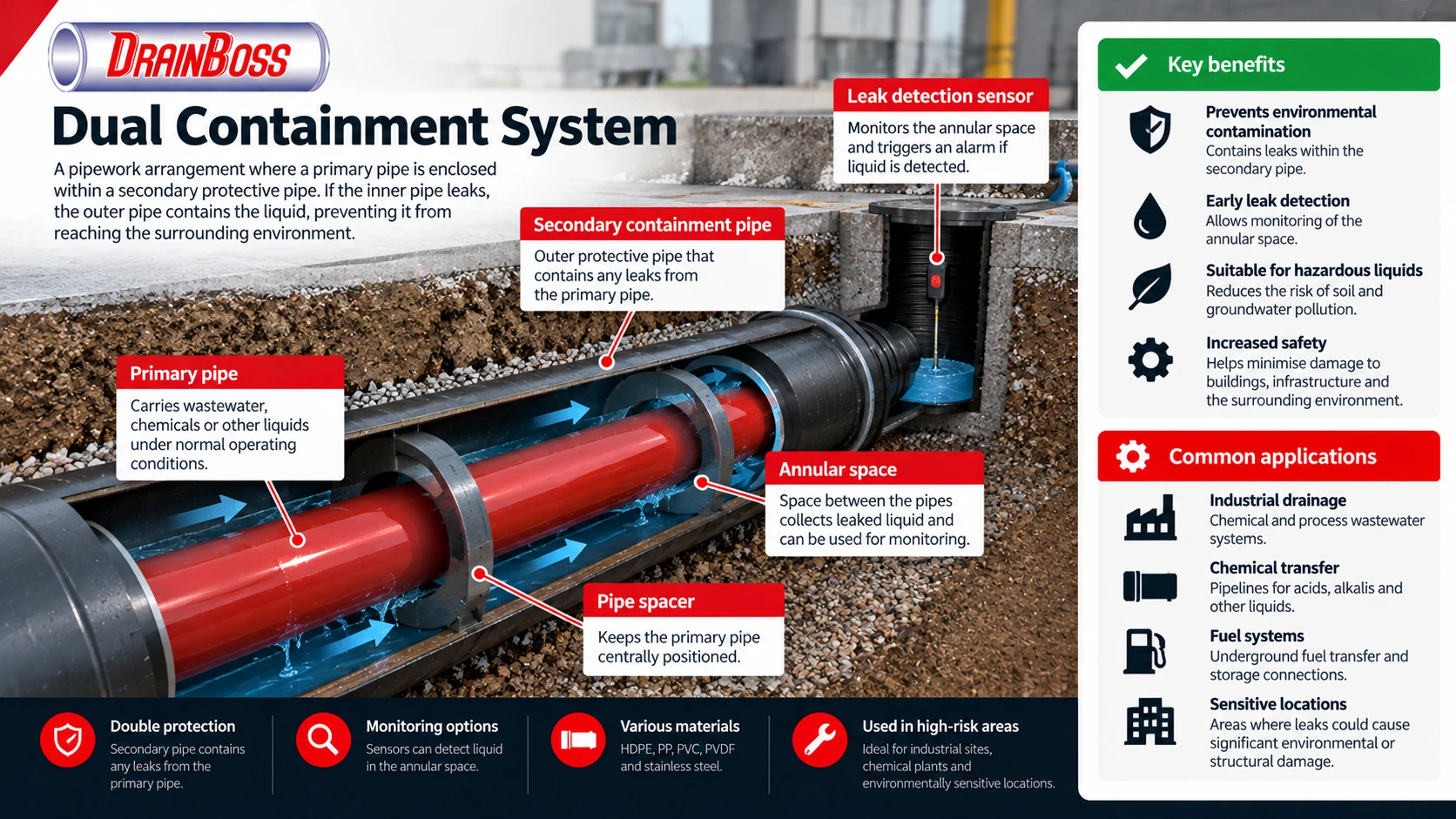
How a Dual Containment System Works
The operating principle of dual containment is based on separating the normal transport function from the protective containment function. The inner pipe carries the liquid under the required operating conditions, while the outer pipe provides a secondary boundary around it. Between these two pipes is an annular space that can collect leaked liquid or accommodate monitoring equipment.
During normal operation, the primary pipe remains intact and the secondary containment does not carry the process flow. If the primary pipe fails, liquid can escape into the annular space. The outer pipe is intended to retain that liquid within the containment system until the problem is detected and corrective action can be taken.
The effectiveness of this arrangement depends on the continuity of both containment boundaries. The outer pipe must provide adequate protection not only along straight sections but also around bends, joints, fittings and other components where leakage could occur. A system with an enclosed straight pipe but unprotected connections may leave important potential leakage points exposed.
The principal components of a dual containment system include:
-
Primary pipe. The inner pipe that transports wastewater, chemicals or other liquids under normal operating conditions.
-
Secondary containment pipe. The outer pipe or casing that provides an additional barrier against uncontrolled leakage.
-
Annular space. The gap between the two pipes, which can accommodate leaked liquid and, where specified, leak detection equipment.
-
Pipe supports and spacers. Components that maintain the position of the primary pipe within the secondary pipe while allowing for the required movement and drainage.
-
Double containment fittings. Bends, tees, reducers and connections designed to maintain the integrity of both pipe systems.
-
Leak detection equipment. Sensors, monitoring cables or other devices used to identify liquid entering the containment space.
-
Access and termination assemblies. Components that allow inspection, testing, drainage or connection to monitoring equipment where required.
The annular space is particularly important because it provides separation between the primary and secondary containment boundaries. Its dimensions must account for the pipe geometry, installation requirements and any intended leak detection or drainage arrangements. A larger annular space is not automatically better, as the appropriate clearance depends on the design of the complete system.
Some installations use spacers to maintain a consistent separation between the pipes. These components must be compatible with the operating environment and should not create unacceptable stress concentrations or prevent the intended movement of the inner pipe. In systems where leaked liquid is expected to drain towards a collection point, the arrangement of supports must also avoid unnecessary obstruction of the flow path.
The outer pipe is not necessarily designed to operate as a second full-capacity process pipeline. Its principal function is containment, although it must be capable of withstanding the loads and conditions associated with a credible primary pipe failure. Depending on the application, this may include internal pressure, external soil loading, groundwater pressure, temperature changes and chemical exposure.
Materials and Construction of Double Containment Pipework
Material selection is one of the most important aspects of dual containment design. Both pipes must be suitable for their intended functions, but they do not necessarily need to be manufactured from the same material. The primary pipe must be compatible with the transported substance, while the secondary pipe must withstand potential exposure to leaked liquid and the surrounding installation environment.
Plastic pipework is widely used in many double containment applications because of its chemical resistance and the availability of compatible fittings and jointing methods. However, suitability depends on the particular polymer, operating temperature, pressure, chemical concentration and expected service conditions.
Common materials include polyethylene, polypropylene, PVC, CPVC, PVDF and certain metallic materials. Not every material is suitable for every chemical or wastewater application, and chemical compatibility must be checked against the manufacturer’s technical information.
| Material | Typical characteristics | Design considerations |
|---|---|---|
| HDPE | Flexible, corrosion-resistant and suitable for many buried installations | Thermal expansion, pressure rating, chemical compatibility and joint quality |
| PP | Good resistance to many chemicals and suitable for certain industrial drainage systems | Temperature limits, jointing method and mechanical loading |
| PVC-U | Rigid thermoplastic used in drainage and selected chemical applications | Temperature limitations, impact resistance and chemical compatibility |
| CPVC | Thermoplastic with greater temperature capability than conventional PVC-U in suitable applications | Chemical exposure, pressure rating and installation requirements |
| PVDF | High chemical resistance and suitability for demanding industrial environments | Material cost, operating conditions and specialist jointing |
| Stainless steel | Mechanical strength and suitability for selected industrial services | Corrosion resistance, grade selection, welding and inspection |
Material selection should consider the full range of operating conditions rather than the normal temperature and chemical concentration alone. Cleaning agents, process changes and occasional abnormal discharges can expose pipework to conditions that differ from everyday operation. For industrial drainage, this is particularly important where several waste streams may enter the same collection system.
The jointing method also affects containment integrity. Thermoplastic systems may use butt fusion, electrofusion, socket fusion or other manufacturer-approved techniques, depending on the material and product design. Metallic systems may use welded connections or other engineered arrangements appropriate to the service.
Both containment boundaries require suitable joints. A properly installed primary pipe provides little overall protection if the secondary containment has defective connections that allow leaked liquid to escape. Joint design must also account for how the inner and outer pipes are assembled, tested and accessed during maintenance.
Thermal movement is another important consideration. Pipes expand and contract as their temperature changes, and different materials can respond at different rates. A long pipe run may therefore require suitable expansion allowances, flexible arrangements or engineered supports to prevent excessive stress.
For buried installations, the surrounding ground conditions influence the design of the outer pipe. Soil loading, traffic loading, groundwater pressure and the quality of bedding and backfill can affect its structural performance. A secondary pipe must be sufficiently robust for these conditions while preserving the intended protection of the primary pipe.
Leak Detection and Monitoring Within the Annular Space
Secondary containment provides an additional physical barrier, but its effectiveness improves when a leak can be detected promptly. Without monitoring, liquid may remain within the annular space for an extended period before the failure becomes apparent. This can complicate maintenance and, in some circumstances, allow the containment space to fill or become pressurised.
Leak detection arrangements vary according to the type of installation, the substance being transported and the consequences of a release. Some systems use electronic sensors, while others rely on inspection points, collection chambers or monitoring of the interstitial space.
A common arrangement involves placing liquid detection sensors at selected low points where leaked fluid is expected to collect. When liquid reaches the sensor, the monitoring equipment can generate an alarm. This provides an indication that the primary containment may have failed, although further investigation is normally required to confirm the source and location of the leak.
Other systems use continuous sensing cables installed within the annular space. Depending on the technology, these can detect the presence of certain liquids along a monitored section and may provide information about the approximate location of the leak. The equipment must be selected for the liquid involved, as a sensor designed for water may not be appropriate for every chemical.
Pressure-based and vacuum-based monitoring can also be used in specifically engineered systems. Changes in monitored pressure or vacuum may indicate a loss of integrity, but the suitability of these methods depends on the construction of the containment system and the conditions being monitored.
The principal monitoring approaches include:
-
Point liquid sensors. Detect liquid at a specific location, usually a collection point or low section of the annular space.
-
Continuous sensing cables. Monitor a defined length of pipework for contact with compatible liquids.
-
Pressure monitoring. Identifies changes in pressure within a suitably designed and monitored containment space.
-
Vacuum monitoring. Uses changes in maintained vacuum conditions to indicate a potential loss of containment integrity.
-
Inspection chambers. Provide physical access for checking designated collection or monitoring points.
-
Automated alarms. Transmit detection signals to local control panels or building management systems where integrated.
Monitoring equipment should be selected according to the required detection performance. A sensor located at one end of a long horizontal pipe may not identify a small leak quickly if the annular space does not provide a reliable drainage path towards that location. The pipe gradient, support arrangement and possible accumulation points must therefore be considered during design.
The distinction between detecting a leak and locating it is also important. A basic alarm may confirm that liquid has entered the secondary containment without identifying the precise defect. More sophisticated monitoring systems can provide additional information, but their accuracy depends on the technology and installation conditions.
Leak detection equipment requires periodic inspection and functional testing. Sensors can become contaminated, cables may be damaged and alarms can fail if electrical connections or control equipment deteriorate. Monitoring arrangements should therefore be included in the maintenance programme rather than treated as permanent components requiring no attention.
Applications in Drainage and Industrial Infrastructure
Dual containment systems are generally selected where the consequences of a leak justify the additional construction and maintenance requirements. They are not standard requirements for every domestic drain or conventional surface water pipe. Their use is more closely associated with controlled industrial processes, hazardous liquids and installations where environmental protection is a significant design consideration.
Industrial wastewater drainage is one application. Some manufacturing facilities generate wastewater containing chemicals, oils or other substances that could contaminate soil or groundwater if released from a buried pipe. Double containment can provide additional protection along sections where leakage would be difficult to detect or repair.
Chemical processing facilities may use double containment pipework to transfer acids, alkalis or other liquids between storage tanks, processing equipment and treatment systems. In these applications, both the primary and secondary pipes must be compatible with the substances being handled. The secondary containment must also be designed for the potential consequences of a primary pipe failure.
Laboratories and specialised industrial facilities can require similar protection for selected liquid waste streams. The exact arrangement depends on the chemical composition, discharge conditions and relevant safety requirements. Where different chemicals are transported, compatibility between the materials and possible mixtures must be assessed.
Buried pipelines beneath sensitive areas represent another potential application. If a pipe crosses land where excavation would be difficult or where leakage could affect groundwater, a secondary protective barrier may be incorporated into the design. However, a protective casing installed for mechanical protection is not automatically equivalent to a fully engineered dual containment system.
Fuel transfer systems and certain underground storage installations may also use double-wall pipework with interstitial monitoring. These systems are subject to their own technical and regulatory requirements, and their design should not be assumed to be identical to industrial wastewater pipework.
Dual containment may also be considered in facilities where a leak could interrupt essential operations. For example, buried process drainage beneath a production area may be difficult to access without disrupting equipment or stopping work. Secondary containment and monitoring can help identify problems before liquid reaches surrounding ground or structures.
The selection process should consider the substance being transported, the probability of leakage, the consequences of failure and the practical ability to inspect or repair the pipe. In some situations, accessible single-wall pipework installed within a suitable bunded or drained service area may provide an alternative means of managing leakage risk.
Installation, Testing and Maintenance Requirements
Dual containment pipework requires careful installation because two separate containment boundaries must function correctly. The primary pipe must transport the intended liquid, while the secondary pipe must remain capable of retaining leakage under the specified conditions. Installation defects in either component can compromise the overall protection.
Before installation, the pipe materials, fittings and jointing methods should be checked against the approved design. The installation team must also confirm that the intended monitoring equipment, supports and access arrangements are compatible with the selected system.
During assembly, the inner pipe must be positioned correctly within the outer pipe. Where spacers are used, their placement should maintain the required separation without restricting intended movement or obstructing drainage within the annular space. The assembly method must allow the secondary containment joints to be completed without damaging the primary pipe.
Testing is particularly important because defects can become difficult to access once the system is buried or enclosed. The primary pipe and secondary containment should be tested using methods appropriate to their materials, pressure ratings and intended operating conditions. Test pressures, durations and acceptance criteria must follow the applicable design specifications and manufacturer requirements.
A secondary containment pipe should not automatically be subjected to the same pressure test as the primary pipe. Its design pressure and structural capacity may differ, and inappropriate testing can damage components or create safety hazards.
For buried installations, bedding and backfill must provide adequate support to the outer pipe. Sharp objects, poorly compacted material and uneven support can create localised stresses. Where groundwater is present, buoyancy and external pressure may also require consideration.
Maintenance requirements extend beyond cleaning the primary pipe. The annular space, monitoring equipment and associated access points form part of the protective system and must remain functional.
Typical maintenance activities include checking alarm operation, inspecting accessible fittings, reviewing monitoring records and investigating unexpected liquid accumulation. Where the primary pipe carries wastewater containing sediment or grease, cleaning may also be required to maintain hydraulic performance.
A leak within a double containment system should be investigated rather than simply drained away and ignored. The presence of liquid in the annular space may indicate a defective primary pipe, joint failure or another source of ingress. The cause must be established before the system is returned to normal operation.
Repair methods depend on the pipe construction and accessibility. Some defects may be addressed by replacing a section of the primary pipe, while others require opening or replacing part of the secondary containment. Any repair must restore the integrity of both boundaries and preserve the intended monitoring arrangement.
Dual Containment Compared with Conventional Drainage Pipework
The main difference between dual containment and conventional single-wall drainage is the presence of an additional protective boundary. In a single-wall system, a defect can allow liquid to escape directly into the surrounding ground, void or building structure. In a dual containment system, the outer pipe is intended to intercept that leakage.
This additional protection comes with greater design complexity. Double containment systems require more materials, specialised fittings and careful coordination of installation and testing. They can also occupy more space because the secondary pipe has a larger external diameter than the primary pipe alone.
Maintenance access must be considered from the outset. Although secondary containment can reduce the consequences of leakage, the arrangement may make direct access to the primary pipe more complicated. The design should therefore provide a practical strategy for inspection, leak detection and eventual repair.
The system also has limitations. Secondary containment can fail through defective joints, mechanical damage, incompatible materials or excessive loading. If the annular space becomes filled with leaked liquid and the condition is not detected, the protective capacity may be reduced. Double containment should therefore be regarded as an additional risk-control measure rather than a guarantee against environmental release.
For ordinary domestic drainage, conventional pipework installed to the relevant standards is generally sufficient. Dual containment becomes more relevant where the transported liquid presents an elevated environmental or operational risk, where leakage would be difficult to detect, or where specific project requirements call for an additional barrier.
A well-designed dual containment system combines suitable pipe materials, reliable jointing, adequate secondary containment capacity and an appropriate monitoring strategy. Its long-term performance depends on preserving both containment boundaries and ensuring that any failure of the primary pipe can be identified and addressed before the surrounding environment is affected.