

Key Points:
- Blocked culverts restrict water flow, causing upstream water levels to rise and increasing the risk of property flooding during heavy rainfall.
- Leaves, sediment, rubbish and structural damage are common causes of culvert blockages, while recurring flooding may indicate insufficient drainage capacity.
- Culvert maintenance responsibilities in England generally depend on land ownership, watercourse classification and existing legal arrangements.
- Regular inspections, timely debris removal and professional culvert clearance help reduce flood risks. DrainBoss provides culvert clearance and drainage services across South East England.
A blocked culvert can turn heavy rainfall into serious property flooding by preventing water from following its normal drainage route. When branches, sediment or other obstructions restrict a culvert, water accumulates upstream and may overflow into gardens, driveways, roads and buildings. The problem can develop quickly during storms, particularly where a culvert receives runoff from a large surrounding area.
Unlike an open drainage channel, a culvert may be hidden beneath a road, driveway or landscaped area, making blockages difficult to identify. Floodwater can also appear some distance from the actual obstruction, complicating investigations. Understanding how culvert flooding develops, recognising the warning signs and arranging appropriate maintenance can help reduce the risk of property damage.
What Is a Culvert and How Does It Work?
A culvert is a pipe, tunnel or covered channel designed to carry water beneath a road, railway, driveway or embankment. It allows an existing watercourse or drainage channel to continue flowing without interrupting the use of the land above. Culverts are commonly constructed from concrete, steel or plastic, depending on their size, location and intended application.
Common configurations include circular pipe culverts and rectangular box culverts. Their dimensions and hydraulic capacity depend on the expected water flow, catchment characteristics and site conditions. Some carry water throughout the year, while others receive substantial flows only following rainfall.
Under normal conditions, water enters the culvert, travels through the enclosed section and discharges into the downstream watercourse. The system relies on sufficient capacity, suitable gradients and unobstructed entry and exit points.
Unlike a household drain, a culvert frequently forms part of a natural or artificial watercourse rather than carrying wastewater from a building. Because much of its structure is concealed, sediment accumulation, displaced sections and internal obstructions may remain undetected until water levels rise.
Our Services:
How Does a Blocked Culvert Cause Flooding?
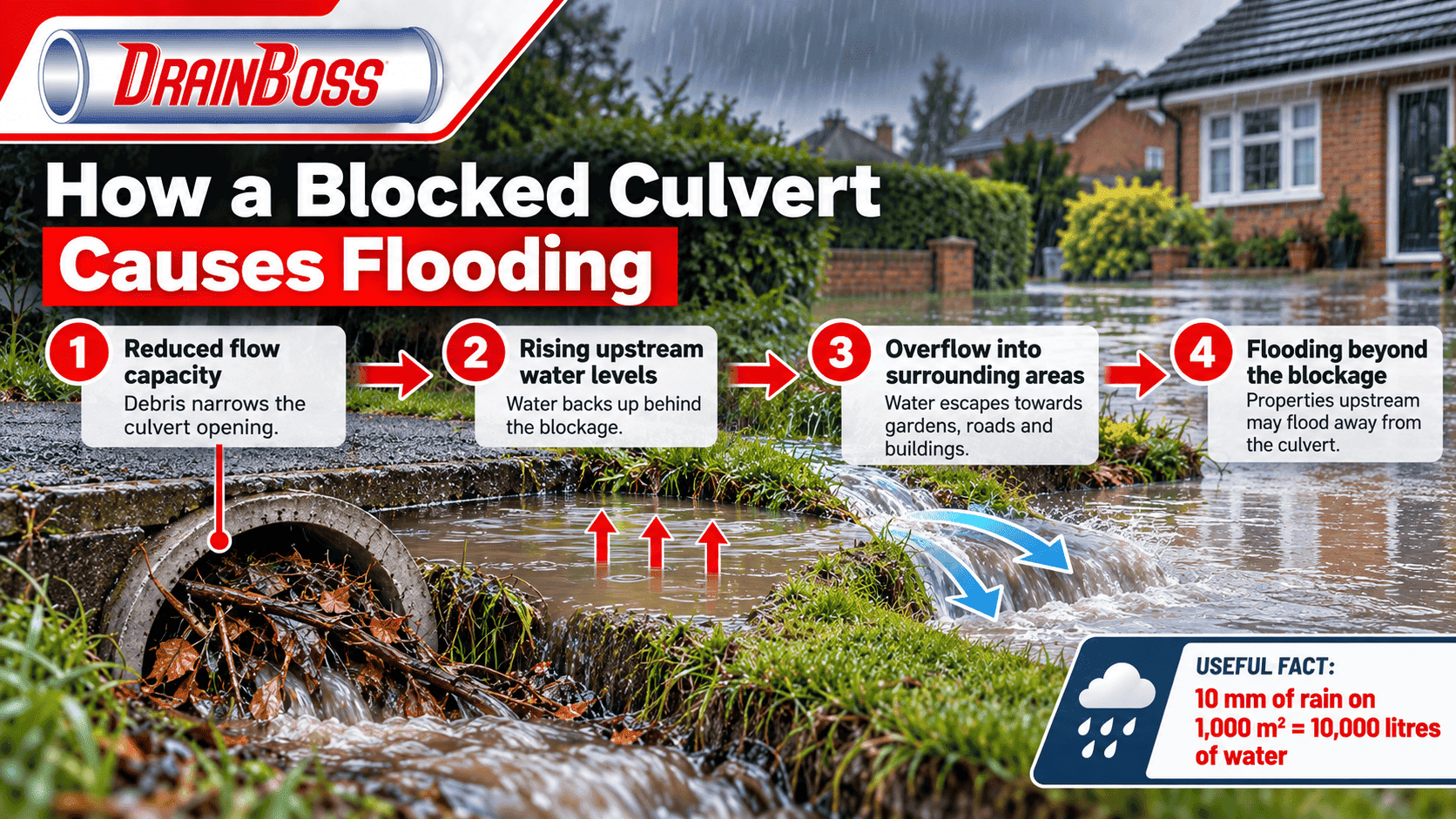
A blocked culvert increases flood risk by reducing the amount of water that can pass through a drainage channel. The obstruction creates additional resistance to flow, causing water levels to rise upstream. If the incoming volume exceeds the capacity of the restricted culvert, water can escape from the channel and spread across surrounding land.
Several connected processes determine how severe the flooding becomes:
- Reduced flow capacity. Branches, sediment or rubbish occupy part of the culvert opening. Even a partial blockage can significantly affect discharge, particularly when debris accumulates at the entrance.
- Rising upstream water levels. Water continues arriving from the upstream catchment but cannot pass through the obstruction quickly enough. This creates a backwater effect, with water levels rising behind the restriction.
- Overflow into surrounding areas. Once the water level exceeds the channel banks or another low point, water follows the surrounding ground towards roads, gardens and buildings. The exact route depends on local topography.
- Flooding beyond the blockage. Water may accumulate a considerable distance upstream. Properties experiencing flooding are therefore not necessarily located beside the obstructed culvert.
The amount of water reaching a culvert can increase rapidly during rainfall. For example, 10 mm of rain falling across a 1,000 m² area represents 10,000 litres of precipitation before allowing for infiltration, evaporation and other losses. A culvert serving a larger catchment may receive runoff from roads, fields, roofs and several connecting drainage channels.
Heavy rainfall also transports loose material into watercourses. Leaves, branches and rubbish can become trapped against an existing obstruction, progressively restricting the opening as the storm continues.
Floodwater can damage external surfaces, enter garages and ground-floor rooms, affect electrical installations and saturate surrounding soil. Where water flows rapidly across unprotected ground, it may also erode channel banks, undermine paving or wash material away from structures.
The consequences depend on the duration and depth of flooding, water velocity and the position of nearby properties. Clearing an obstruction can restore flow capacity, but it does not necessarily eliminate flood risk during rainfall that exceeds the system’s original design capacity.
What Are the Most Common Causes of Culvert Blockages?
Culvert blockages develop through the accumulation of transported materials, vegetation growth or structural deterioration. Some form gradually over months, while others develop during a single storm. Identifying the underlying cause is important because removing debris will not correct a collapsed or badly deformed culvert.
The most common causes include:
- Leaves and fallen branches. Vegetation carried downstream becomes trapped at culvert entrances, bends or existing restrictions. Large branches can form a barrier that collects smaller debris.
- Silt and sediment. Mud, sand and gravel settle where water velocity decreases. Deposits reduce the available flow area and may gradually restrict enclosed sections.
- Rubbish and fly-tipped materials. Plastic containers, packaging, timber and discarded objects can obstruct an entrance or become lodged inside the culvert.
- Blocked inlet screens. Trash screens may intercept large debris, but accumulated material can reduce the waterway opening. An inadequately maintained screen may create a greater restriction than the culvert itself.
- Tree root intrusion. Roots may enter through damaged joints or cracks and trap passing material. Continued growth can contribute to structural deterioration.
- Displaced or collapsed sections. Movement, corrosion, settlement or physical damage can change the shape of the culvert and restrict water flow.
Different materials produce different blockage patterns. Fine sediment generally accumulates over time, while branches and floating debris can cause sudden restrictions during periods of increased flow.
A blockage may also involve several causes simultaneously. Sediment can collect around a displaced joint, vegetation may become lodged against it, and further rubbish can then accumulate upstream.
Regular clearance of surface debris does not always resolve these combined problems. Repeated obstruction at the same location may indicate an underlying defect requiring further investigation.
What Are the Warning Signs of a Blocked Culvert?
Early signs of a culvert blockage are often visible around the inlet or outlet, particularly during rainfall. Changes in water levels, unusual sediment deposits and recurring localised flooding can indicate that water is not passing through the structure efficiently. These symptoms should be assessed before they develop into a more serious obstruction.
| Warning sign | Possible cause | Potential consequence |
| Water collecting at the entrance | Debris or an internal obstruction | Rising upstream water levels |
| Higher water levels upstream than downstream | Restricted passage through the culvert | Overflow into surrounding land |
| Repeated flooding after moderate rainfall | Persistent blockage or inadequate capacity | Recurring property flooding |
| Branches or rubbish around the inlet | Accumulation of transported debris | Rapid blockage during storms |
| Significant sediment deposits | Reduced flow velocity or restricted transport | Gradual reduction in capacity |
| Subsidence or cracking above a buried culvert | Possible structural deterioration | Further deformation or collapse |
| Water emerging from unexpected locations | Overflow following an alternative route | Flooding away from the obstruction |
A noticeable difference between upstream and downstream water levels may suggest a restriction, but it is not conclusive evidence. The result also depends on inlet geometry, water velocity and downstream conditions. A culvert operating under high flow can develop a substantial upstream water level even without a physical blockage.
Another warning sign is a change in flooding behaviour. If a previously unaffected garden begins flooding after ordinary rainfall, or water remains upstream for significantly longer than before, the culvert may need inspection.
Visible settlement above a culvert deserves particular attention. It can indicate a problem with the structure or surrounding ground, although excavation or specialist investigation may be necessary to establish the cause.
DrainBoss Expert Comment: A flooded culvert entrance does not necessarily mean the blockage is located there. The obstruction may be further inside the culvert, or high downstream water levels may be restricting discharge. Identifying the actual cause before attempting clearance helps avoid unnecessary work and recurring flooding.
Can a Culvert Cause Flooding Without Being Blocked?
Not every instance of culvert flooding is caused by accumulated debris. A completely clear culvert can still overflow if its hydraulic capacity is insufficient, downstream water levels are unusually high or its original design does not adequately accommodate present conditions.
One possible cause is insufficient culvert capacity. A structure may be too small to carry the volume of water reaching it during intense rainfall. Changes in surrounding land use, including additional roads, roofs and other impermeable surfaces, can increase runoff entering a watercourse.
Hydraulic design considers the expected flow and the probability of extreme rainfall. Some local authority guidance uses a flood event with a 1% annual exceedance probability, commonly called a 1-in-100-year event, together with an allowance for climate change. This is a design reference, not a guarantee that flooding will occur only once every 100 years.
High downstream water levels can also prevent water from leaving the culvert efficiently. If the receiving watercourse is already full, a backwater effect may reduce the hydraulic head available to move water through the structure. A submerged outlet is not automatically defective, but it can affect performance under certain conditions.
Structural problems provide another possible explanation. Deformation, settlement, poorly aligned sections or an unsuitable gradient can affect water movement and sediment transport. An abrupt transition at an inlet may also create unnecessary hydraulic resistance or encourage debris accumulation.
Where flooding persists after successful cleaning, the problem may require a hydraulic or structural assessment rather than further routine clearance.
What to Do If a Blocked Culvert Is Flooding Your Property
When a culvert overflows during heavy rain, the first priority is protecting people rather than attempting to remove the obstruction. Floodwater may conceal damaged ground, open chambers, sharp objects and electrical hazards. Water can also accelerate without warning if a blockage shifts or upstream conditions change.
If a blocked culvert appears to be causing flooding:
- Keep people and pets away from flooded ground, culvert openings and unstable banks. Do not walk or drive through flowing floodwater.
- Observe the direction of flow from a safe position. Identify where water is accumulating and which areas of the property are threatened.
- Record water levels, affected locations and visible debris where this can be done safely. Photographs and videos can help establish how flooding developed.
- Move valuables, vehicles and portable equipment to higher ground if safe. Use suitable flood barriers or air brick covers where available without redirecting water towards neighbouring property.
- Contact the responsible landowner or relevant flood risk authority. If the water threatens buildings or continues rising, explain the urgency and provide the location of the suspected culvert.
- Arrange professional investigation and clearance when conditions allow safe access. An obstruction inside an enclosed culvert should not be treated as an ordinary DIY drainage problem.
Do not enter a culvert, even if the opening looks large enough. Confined spaces can contain hazardous atmospheres, including oxygen deficiency and toxic gases, while water levels can rise suddenly. Entering without specialist procedures and equipment can be life-threatening.
Attempting to pull branches or other substantial debris from a flooded entrance is also dangerous. A sudden release can produce rapid water movement, dislodge unstable material or expose a person to powerful currents.
Where floodwater approaches electrical equipment, do not touch switches or attempt to isolate the supply while standing in water. Contact the appropriate utility provider and follow emergency advice. Call 999 if someone is in immediate danger.
Once conditions are safe, record the date, approximate rainfall, duration of flooding, visible damage and any previous incidents. Retain relevant correspondence and contact your insurer promptly if the property has been damaged.
Who Is Responsible for a Blocked Culvert in England?
Responsibility for culvert maintenance depends on ownership, the classification of the watercourse and any existing legal arrangements. A culvert passing beneath private land is not automatically maintained by the local council or Environment Agency. The relevant landowner may have responsibilities even when the culvert is completely underground.
The main distinctions are:
- Private landowners. A person who owns land containing or adjoining a watercourse is commonly described as a riparian owner. Such owners generally have responsibilities for maintaining their section and allowing water to flow without obstruction. Property deeds or other agreements may establish different arrangements.
- Culverts beneath neighbouring properties. Where a culvert passes through several properties, different owners may be responsible for different sections. A downstream obstruction can affect properties further upstream, so identifying the flooded location does not automatically establish responsibility.
- Highway drainage. Highway authorities maintain drainage assets they own or control. However, a ditch or culvert beside a public road may belong to an adjoining private landowner rather than the highway authority.
- Ordinary watercourses. The lead local flood authority, usually a county council or unitary authority, has relevant flood risk management and regulatory functions. Within an internal drainage district, an internal drainage board may be the appropriate organisation.
- Main rivers. The Environment Agency is the principal flood risk management authority for main rivers in England. This does not mean it owns or routinely maintains every culvert forming part of a main river.
Section 25 of the Land Drainage Act 1991 provides relevant authorities with powers to require remedial work where the proper flow of an ordinary watercourse is impeded. These powers do not mean that every reported private blockage will automatically be cleared by a public authority.
An owner who fails to address a known or reasonably foreseeable obstruction may face legal consequences if flooding causes damage to another property. Liability depends on the circumstances, including previous warnings, the nature of the obstruction and whether reasonable preventative action was possible.
Routine maintenance does not always require formal consent, but permission may be necessary for structural alterations, excavation or activities affecting the watercourse. Work on or near a main river may require an Environment Agency flood risk activity permit. Work affecting an ordinary watercourse may require consent under the Land Drainage Act 1991 from the relevant authority.
Before significant clearance or repairs, ownership, access rights and regulatory requirements should be established. Work must also avoid unnecessary damage to protected habitats, pollution and increased flood risk elsewhere.
Our Services:
How Is Professional Culvert Clearance Carried Out?
Professional culvert clearance begins by establishing the location, extent and nature of the obstruction. The appropriate method depends on the culvert’s dimensions, construction, condition and accessibility. High water levels, unstable ground or limited access may prevent work until suitable safety arrangements are in place.
The main stages of professional culvert clearance include:
- Inspection and blockage identification. Accessible inlet and outlet structures, inspection chambers and surrounding watercourse conditions are examined. Differences in water levels, visible sediment deposits and accumulated debris help identify likely restrictions.
- CCTV inspection where suitable. Camera equipment can provide information about internal deposits, displaced joints, root intrusion and structural defects. Its suitability depends on dimensions, water depth, visibility and flow conditions.
- Mechanical debris removal. Accessible obstructions can be removed using suitable equipment from a safe position. Excavators, grabs or other specialist tools may be required for substantial branches, sediment or large objects.
- High-pressure water jetting. Jetting can help remove sediment and certain deposits where the structure and site conditions permit. It may be unsuitable for damaged culverts or situations where released material could create downstream problems.
- Post-clearance assessment. After removing the obstruction, the structure and flow conditions are checked for remaining deposits, damage or other restrictions requiring further attention.
Larger or more complex culverts may require specialist inspection techniques. Any entry into a culvert must be assessed and controlled under appropriate confined-space safety procedures.
Clearance work must also consider the movement of released material downstream. Where substantial sediment or potentially contaminated debris is removed, appropriate collection and disposal arrangements may be necessary.
If a culvert contains collapsed sections, displaced joints or severe deformation, cleaning alone may not restore its original capacity. Structural repairs, replacement or reconstruction may be required following engineering assessment. Such works must account for watercourse conditions, potential effects on flooding and any necessary regulatory permissions.
DrainBoss Expert Comment: Removing visible debris does not always restore a culvert’s full drainage capacity. Sediment deposits, displaced joints or structural damage can continue restricting water flow after the initial blockage has been cleared. At DrainBoss, we recommend investigating recurring problems rather than repeatedly removing the same obstruction without identifying its underlying cause.
How Can Regular Culvert Maintenance Prevent Flooding?
Regular culvert maintenance aims to preserve the available waterway opening, identify deterioration and prevent small restrictions from developing into serious obstructions. The frequency of inspection should reflect local conditions rather than an identical timetable for every structure. A culvert beneath a heavily wooded catchment may need more attention than one receiving relatively little debris.
An effective maintenance programme should cover accessible inlets, outlets and connecting channels, as well as any existing inspection chambers. Particular attention should be given to sites with a history of flooding or repeated sediment accumulation.
Important preventative measures include:
- Inspections before periods of heavy rainfall. Check visible openings and surrounding channels, particularly during autumn when falling leaves can increase debris accumulation.
- Checks following significant storms. Look for branches, rubbish, new sediment deposits and structural damage once conditions are safe.
- Monitoring sediment accumulation. Investigate recurring deposits that reduce the effective flow area or indicate a problem with water movement.
- Maintenance of existing trash screens. Keep screens clear under a suitable maintenance arrangement. Any proposed new screen should be assessed because it can create an additional flow restriction.
- Structural condition monitoring. Check accessible headwalls, joints and surrounding ground for erosion, movement, cracking or settlement.
- Maintenance records. Record inspections, debris removal, previous flooding and repairs to identify recurring problems and support future assessments.
There is no universal inspection interval suitable for every culvert. Appropriate frequency depends on catchment characteristics, debris loads, accessibility, previous blockage history and the consequences of failure. Where a culvert has repeatedly caused flooding, a more detailed assessment may be necessary to establish why restrictions keep developing.
Preventative work should not unnecessarily remove stabilising vegetation or alter the natural channel. Vegetation can help reduce erosion and support wildlife, so maintenance should focus on material that creates a genuine obstruction or safety concern.
Property owners should also avoid treating a new inlet screen or larger replacement pipe as an automatic improvement. These changes can alter water levels and downstream conditions, and may require hydraulic assessment and regulatory consent.

Conclusion on Preventing Culvert Flooding
A blocked culvert can increase property flood risk long before the obstruction becomes obvious. Restricted flow causes water to accumulate upstream, while intense rainfall can quickly turn a partial blockage into an overflowing watercourse. Early warning signs, such as unusual water levels, repeated localised flooding and debris accumulation, should therefore be investigated rather than ignored.
Keeping culverts clear, monitoring their structural condition and maintaining accessible inlet and outlet areas can reduce avoidable flooding. However, repeated problems may indicate insufficient hydraulic capacity or structural damage rather than an ordinary blockage. Identifying the actual cause is essential before deciding whether cleaning, repairs or more extensive improvements are required.
DrainBoss is a family-run drainage company providing culvert clearance and drainage services across Sussex, Surrey, Kent, Hampshire and South London. The company offers drainage inspections, blockage clearance and repairs, supported by a 24/7 emergency service. If a blocked culvert is threatening your property or repeatedly causing flooding, DrainBoss can help investigate the drainage problem and identify an appropriate solution.
Can a partially blocked culvert cause property flooding?
Yes, a partially blocked culvert can cause flooding even when water continues flowing through it. Debris, sediment or vegetation reduces the available opening, limiting the volume of water that can pass through during heavy rainfall. As incoming flow increases, water may accumulate upstream and eventually overflow into surrounding land. The risk depends on the severity of the restriction, rainfall intensity and the capacity of the remaining opening.
Who should I contact if a blocked culvert is causing flooding?
The appropriate contact depends on who owns the culvert and the type of watercourse it carries. For an ordinary watercourse in England, the lead local flood authority or relevant internal drainage board can provide guidance, while the Environment Agency deals with main river flood risk matters. If the culvert forms part of highway drainage, the local highway authority may be responsible. Where private land is involved, the landowner or riparian owner should also be informed, and a drainage specialist may be needed to investigate the blockage.
Can I clear a blocked culvert on my own property?
Landowners can generally undertake appropriate routine maintenance, but the work must be safe and comply with relevant environmental and drainage requirements. Removing accessible surface debris may be possible under safe conditions, provided it does not involve entering the culvert, disturbing its structure or creating downstream problems. Excavation, structural alterations and certain activities affecting water flow may require permission from the relevant authority. Never enter a culvert or attempt major clearance while water levels are high, as sudden changes in flow and confined-space hazards can be life-threatening.
How often should a culvert be inspected to prevent flooding?
There is no single inspection interval suitable for every culvert, as maintenance requirements depend on local conditions and previous blockage history. Culverts near trees, agricultural land or areas with significant sediment movement may need more frequent attention. Accessible entrances and outlets should also be checked before periods of forecast heavy rain and after significant storms, once conditions are safe. Culverts with recurring obstructions or a history of property flooding may require a formal inspection and maintenance programme.
Does clearing a blocked culvert require permission in England?
Routine removal of accumulated debris does not always require formal consent, particularly when the work does not alter the watercourse or its structure. However, excavation, reconstruction, changes to culvert dimensions and other works affecting water flow may require ordinary watercourse consent or an Environment Agency flood risk activity permit, depending on the watercourse classification. Additional restrictions may apply where protected habitats, designated sites or neighbouring land are affected. Property owners should establish the applicable requirements before carrying out substantial clearance or repair work.
Can a blocked culvert cause flooding far away from the obstruction?
Yes, a blockage can cause water to accumulate upstream and flood properties some distance from the culvert itself. When the restricted passage cannot carry incoming water efficiently, upstream levels rise until water finds an alternative route across surrounding land. The distance affected depends on ground levels, channel characteristics, rainfall and the severity of the obstruction. This is why investigating only the flooded property may not reveal the actual cause of the problem.