

Key Points:
- A soakaway drainage system manages surface water by allowing it to infiltrate naturally into the ground rather than entering sewer networks.
- Its effectiveness depends on proper design, suitable soil conditions and correct placement within the site.
- Soakaways must only be used for surface water and should never be connected to foul drainage systems.
- When installed correctly, they provide a long-term, low-maintenance and environmentally responsible drainage solution.
Across the UK, managing surface water has become an increasingly important part of maintaining reliable drainage systems. What often appears as a minor issue, such as water pooling on a driveway or lawn, can indicate a wider imbalance in how rainwater is being handled on a property. When excess surface water is not properly controlled, it places pressure on surrounding ground conditions and existing drainage infrastructure.
Periods of heavy rainfall, which are becoming more frequent in many parts of the UK, intensify this problem. Water that cannot drain away efficiently begins to accumulate, leading to localised flooding, saturated soil and, in some cases, structural strain on buildings. At the same time, directing rainwater into the main sewer network adds further stress to public systems that are not designed to handle large volumes of surface runoff. This can contribute to system overload, increasing the risk of backups and environmental impact.
For this reason, modern drainage approaches focus on managing water at source rather than relying solely on centralised infrastructure. One of the most effective ways to achieve this is through the use of a soakaway drainage system. By allowing rainwater to disperse gradually into the ground, a soakaway helps restore a more natural balance, reducing pressure on both the property and the wider drainage network.
What is a Soakaway Drainage System?
A soakaway drainage system is an underground structure designed to manage excess surface water by allowing it to gradually infiltrate into the surrounding soil. Rather than directing rainwater into the main drainage network, the system provides a controlled point where water can collect temporarily and then disperse naturally into the ground.
As an infiltration system, its primary function is not to transport water elsewhere, but to return it to the soil in a measured and consistent way. This helps maintain ground balance while reducing the volume of water entering external drainage infrastructure.
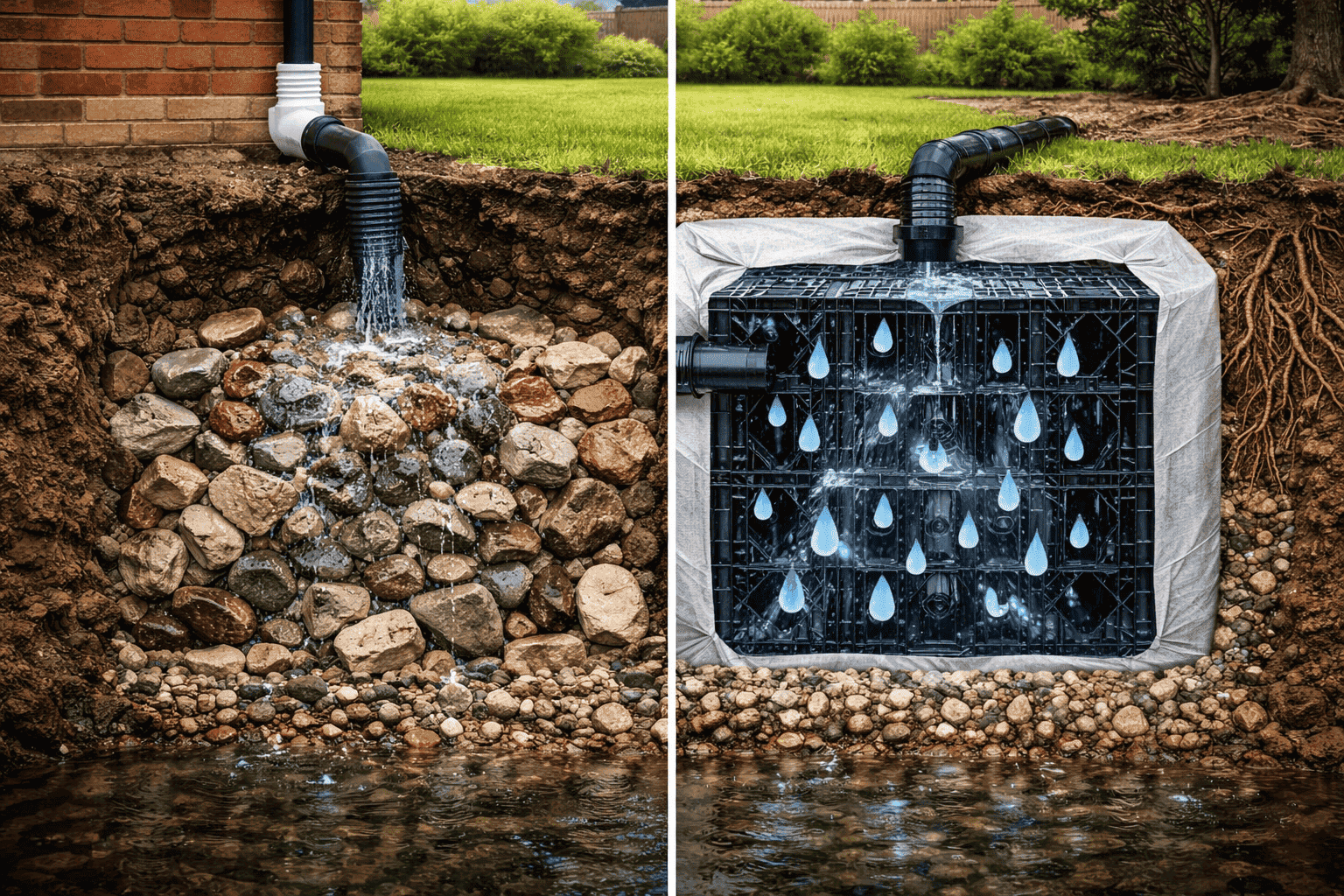
There are two main approaches to soakaway design. Traditional systems were typically formed by excavating a pit and filling it with rubble or coarse stone, creating voids through which water could pass. While simple in concept, these methods were often inconsistent in performance over time, as the gaps could become clogged with silt and surrounding soil.
Modern soakaways use modular crate systems that create a stable, high-capacity void underground. These structures are wrapped in a permeable membrane that allows water to pass through while preventing debris from entering. This approach provides greater efficiency, predictable performance and a longer operational lifespan compared to earlier methods.
What is a Soakaway Used For?
A soakaway is used to manage excess surface water in a controlled and localised way, particularly in areas where natural drainage is limited or inconsistent. By redirecting rainwater away from built surfaces and allowing it to disperse into the ground, it supports both property protection and wider drainage stability.
Its applications typically include:
- Roof and gutter drainage. Rainwater collected from roofs is directed through downpipes into the soakaway, preventing uncontrolled discharge around the base of the property.
- Driveways and patios. Hard surfaces that do not absorb water can quickly accumulate runoff. A soakaway helps remove standing water and maintain usable outdoor areas.
- Flood prevention. By managing water at source, soakaways reduce the likelihood of localised flooding and minimise the risk of water affecting foundations or lower ground levels.
- Reducing load on sewers. Diverting surface water away from the main drainage network helps prevent unnecessary strain on public sewer systems, particularly during periods of heavy rainfall.
- Sustainable drainage (SuDS). Soakaways form part of sustainable drainage strategies by supporting natural infiltration, helping to maintain groundwater levels and reduce environmental impact.
In each of these situations, the aim is to control how water behaves once it reaches ground level, ensuring it is managed efficiently rather than allowed to accumulate or overload existing systems.
How a Soakaway Works (Step-by-Step Explanation)
A soakaway operates by managing the movement of surface water in a controlled sequence, ensuring that sudden volumes of rainfall are handled gradually rather than all at once. Instead of allowing water to collect on the surface or overwhelm drainage systems, the process regulates how it is received, stored and released into the ground.
The system works through three main stages:
| Stage | What Happens | Purpose |
| Water enters the system | Rainwater is directed from surfaces such as roofs or paved areas into the soakaway via drainage pipes | To capture and redirect surface water away from areas where it would otherwise accumulate |
| Temporary storage | Water collects within the internal void of the soakaway structure | To hold excess water during peak flow and prevent immediate overload |
| Gradual infiltration | Stored water slowly disperses into the surrounding soil | To allow controlled absorption and maintain stable ground conditions |
The key principle behind this process is controlled release. Rather than forcing water through the system quickly, the soakaway allows it to disperse at a rate that the ground can naturally absorb. This reduces sudden pressure on both the soil and nearby drainage infrastructure, creating a more balanced and predictable flow over time.
Our Services:
Types of Soakaways
Soakaway systems can generally be divided into two main types, reflecting how drainage practices have developed over time. While both are designed to manage surface water, their performance and reliability differ significantly.
Traditional rubble-filled soakaways
This method involves excavating a pit and filling it with broken stone, brick or other coarse materials to create spaces where water can collect and disperse. It was widely used in older installations due to its simplicity and low material cost. However, the internal voids are irregular and tend to become compacted over time as fine particles settle between them, reducing the system’s ability to function effectively.
Modern crate systems
Contemporary soakaways are typically constructed using modular plastic crates that form a structured underground storage area. These units provide a consistent internal void and are designed to maintain their shape under ground pressure. When combined with a permeable membrane, they allow water to pass through while limiting the entry of silt and debris. This results in more predictable performance and improved durability.
Comparison of performance
| Feature | Traditional Soakaway | Modern Crate System |
| Storage efficiency | Irregular and limited | High and consistent void capacity |
| Resistance to clogging | More prone to blockage over time | Better protected with membrane |
| Structural stability | Can shift or compact | Designed to withstand ground loads |
| Lifespan | Shorter and less predictable | Longer and more reliable |
In practical terms, modern crate systems have become the preferred option for most installations due to their efficiency and long-term stability, particularly where consistent drainage performance is required.
Components of a Soakaway System
A soakaway system is made up of several interconnected components, each playing a specific role in ensuring that water is managed efficiently and that the system remains functional over time. The effectiveness of the installation depends not only on the main structure but also on how these elements work together.
The key components include:
- Soakaway crates or structural void. This forms the central body of the system, creating a defined space underground where water can be held before it disperses. The structure must remain stable under load while maintaining sufficient capacity for incoming flow.
- Drainage pipe. Pipework connects the source of surface water to the soakaway. It directs flow into the system in a controlled manner and ensures that water is delivered efficiently from roofs, channels or other collection points.
- Geotextile membrane. A permeable layer that surrounds the structure, allowing water to pass through while limiting the movement of fine particles. This helps protect the internal void from gradual contamination and loss of performance.
- Gravel or shingle backfill. Used around and beneath the structure to support stability and assist with water distribution. It also helps maintain consistent contact between the soakaway and the surrounding ground.
- Optional silt trap or catch pit. Installed upstream of the system, this component captures debris before it enters the soakaway. By reducing the amount of sediment reaching the structure, it helps preserve long-term efficiency.
Each of these elements contributes to the overall reliability of the system, ensuring that water is not only directed correctly but also managed in a way that supports consistent performance over time.
Where Should a Soakaway Be Installed?
The location of a soakaway is a critical factor in how effectively it performs. Even a well-designed system can fail if it is positioned incorrectly, as water movement is heavily influenced by ground levels, surrounding structures and site layout. Careful placement ensures that water is directed safely away from the property and dispersed under suitable conditions.
Key considerations include:
- Distance from the house. A soakaway should typically be installed at least 5 metres away from the building. This helps prevent excess moisture from affecting foundations or contributing to structural instability over time.
- Distance from property boundaries. Maintaining a suitable distance from neighbouring boundaries reduces the risk of water migration beyond the site and avoids potential disputes or unintended impact on adjacent land.
- Positioning at a lower level. Wherever possible, the soakaway should be located at a lower point than the area it is draining. This allows water to flow naturally into the system without requiring additional force or creating backflow risks.
- Avoiding problematic slopes. Steep or uneven ground can influence how water moves through the soil. Installing a soakaway in such conditions without proper assessment may lead to uneven distribution or localised saturation.
Selecting the right location is not simply a matter of convenience but a key part of ensuring that the system operates as intended and continues to perform reliably over time.
Ground Conditions & Percolation Testing
The performance of a soakaway is directly influenced by the ground in which it is installed. Unlike systems that transport water elsewhere, a soakaway depends entirely on the surrounding soil to absorb and disperse water at a consistent rate. For this reason, understanding ground conditions is essential before any installation is considered.
Soil type plays a central role in this process. Free-draining soils such as sand and loam allow water to pass through relatively easily, supporting steady infiltration. In contrast, clay-based soils retain water for much longer periods, significantly slowing down absorption. In such conditions, water may remain within the system for extended periods, reducing its effectiveness.
Infiltration is the key mechanism that allows a soakaway to function. If the soil cannot absorb water at an adequate rate, the system loses its ability to regulate flow. Instead of dispersing gradually, water begins to accumulate within the structure and surrounding ground. This can lead to saturation, surface pooling and, in some cases, localised flooding despite the presence of a soakaway.
Where ground conditions are unsuitable, problems tend to develop over time rather than immediately. The system may initially appear to function, but repeated exposure to rainfall can gradually overwhelm its capacity. This often results in persistent damp areas, reduced drainage performance and increased pressure on nearby structures.
To assess whether the ground is suitable, a percolation test is typically carried out. This evaluates how quickly water drains through the soil under controlled conditions, providing a measurable indication of infiltration capacity. The results help determine whether a soakaway is viable on the site and, if so, how it should be sized and positioned to perform effectively.
Comments from DrainBoss: Ground conditions are one of the most commonly overlooked factors in drainage design. In practice, many performance issues are not caused by the system itself, but by unsuitable soil that was not properly assessed at the outset. Taking the time to evaluate infiltration properly can prevent long-term drainage problems.
Installation Overview (Not DIY Guide)
The installation of a soakaway system follows a structured process that is designed to ensure long-term performance rather than short-term functionality. While the principles are straightforward, each stage requires careful consideration of ground conditions, system design and load requirements.
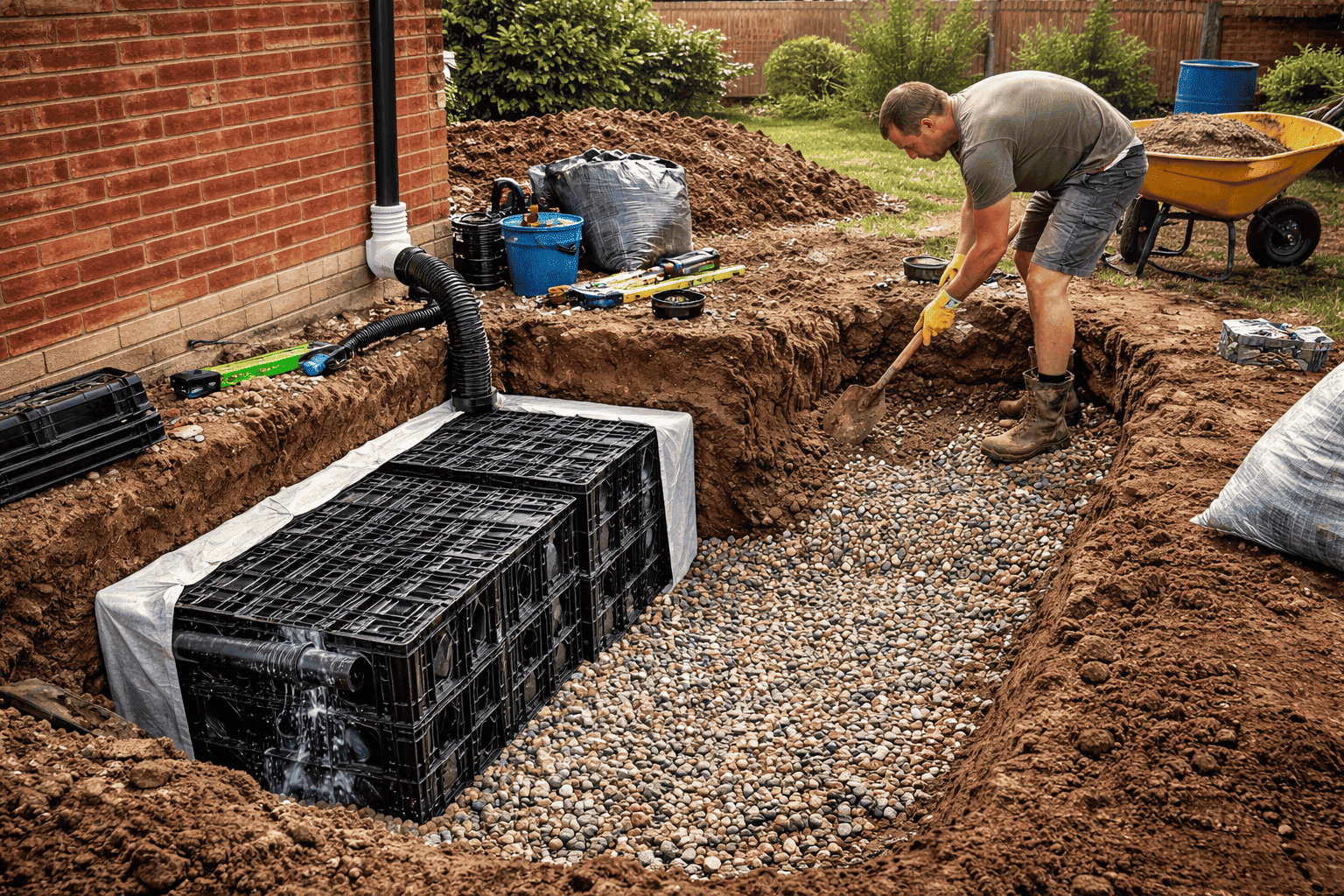
The process typically begins with excavation, where a pit is formed to accommodate the planned structure. The size and depth are determined by the required storage capacity and site-specific conditions, rather than fixed dimensions.
A base layer is then prepared using suitable granular material. This provides a stable and level foundation for the system, helping to distribute load evenly and support consistent water movement at ground level.
Once the base is in place, the crate structure is positioned within the excavation. The arrangement must align with the overall system design, ensuring that the available volume is used efficiently and that incoming flow can be managed without restriction.
The structure is then wrapped in a permeable membrane, which acts as a protective barrier. This stage is essential in preventing the ingress of fine particles while still allowing water to pass through into the surrounding soil.
Following this, the area is backfilled with appropriate material around and above the structure. This stabilises the installation and restores the ground surface while maintaining the integrity of the system below.
Finally, the soakaway is connected to the drainage network, allowing surface water to be directed into the system under controlled conditions. The connection must be properly aligned to ensure consistent flow and avoid unnecessary stress on the pipework.
Each stage contributes to the overall reliability of the installation, with the emphasis placed on durability, correct load handling and effective long-term drainage performance.
Can You Install a Soakaway Yourself?
In some situations, installing a soakaway may appear straightforward, particularly for smaller garden applications where access is simple and ground conditions are favourable. With basic tools and clear site conditions, a simple system for managing light surface water can be put in place without specialist equipment.
However, this is not always appropriate. Where the system needs to manage significant volumes of water, or where ground conditions are uncertain, a more considered approach is required. Installations near buildings, on sloped ground or in areas with variable soil structure introduce additional complexity that must be assessed properly before any work begins.
The main risk with self-installation is not the physical process itself, but the accuracy of the design. Incorrect sizing, poor positioning or unsuitable ground conditions can result in a system that does not perform as intended. In many cases, problems do not appear immediately but develop over time as the system becomes overwhelmed or begins to retain water.
There are also practical limitations to consider. Without proper assessment, it is difficult to determine whether the soil can support infiltration at the required rate or whether additional measures are needed. Mistakes at this stage can lead to ongoing drainage issues that are more difficult and costly to resolve later.
For this reason, while small-scale installations may be possible in controlled conditions, larger or more critical systems are typically better handled with professional input to ensure that the design and placement are appropriate for the site.
Regulations & Legal Considerations (UK)
In the UK, the use of soakaway systems is governed by clear regulatory principles that focus on protecting both the environment and public drainage infrastructure. Understanding these requirements is essential to ensure that any installation is compliant and functions as intended within the wider drainage framework.
A fundamental rule is that soakaways are designed for surface water only. They must not be used to discharge foul water or sewage under any circumstances. Directing wastewater into the ground without proper treatment is not permitted and can lead to serious environmental harm as well as legal consequences.
The Environment Agency provides guidance on how water should be managed, particularly in relation to pollution prevention and groundwater protection. These principles are reinforced by Building Regulations Part H, which set out how drainage systems should be designed and installed for residential properties. Together, they establish the requirement that surface water should be dealt with separately from foul drainage wherever possible.
In addition, soakaways form part of broader Sustainable Drainage Systems (SuDS) strategies. The aim of SuDS is to manage rainfall in a way that mimics natural processes, reducing rapid runoff and limiting the impact on sewer networks and watercourses. By encouraging local infiltration, soakaways support this approach when used in suitable ground conditions.
Compliance is not only a legal requirement but also a practical one. Systems that follow these principles are more likely to perform reliably, avoid environmental risks and integrate effectively with surrounding drainage infrastructure.
Benefits of a Soakaway System
A soakaway system offers a practical and efficient way to manage surface water at source, providing both immediate and long-term advantages when properly designed and installed. Its value lies not only in controlling water on a single property but also in supporting wider drainage stability.
The main benefits include:
- Flood risk reduction. By controlling how water is dispersed into the ground, a soakaway helps prevent localised flooding and reduces the likelihood of water accumulating around buildings or low-lying areas.
- Low maintenance requirements. Once installed correctly, the system operates passively without the need for regular intervention, aside from occasional checks to ensure upstream components remain clear.
- Cost-effective solution. Compared to more complex drainage systems, a soakaway provides a relatively straightforward approach with lower long-term operational costs.
- Environmentally responsible drainage. Supporting natural infiltration helps maintain groundwater balance and reduces the impact of surface runoff on the surrounding environment.
- Reduced pressure on drainage infrastructure. Managing water locally limits the volume entering public sewer systems, helping to prevent overload during periods of heavy rainfall.
Taken together, these benefits make soakaways a reliable option for managing surface water in a way that is both efficient and aligned with modern drainage practices.
Limitations and Common Problems
While soakaway systems are effective when properly designed, they are not without limitations. Understanding these constraints is important, as many issues arise not from the concept itself but from how the system is implemented and maintained over time.
One of the key limitations is that a soakaway cannot be easily unblocked. Unlike conventional drainage pipes, the structure is buried and not accessible for routine cleaning. If performance declines, the underlying cause is often difficult to address without significant excavation.
A common issue is clogging caused by silt and debris. Fine particles carried through the system can gradually accumulate within the structure or surrounding soil, reducing infiltration capacity. Over time, this restricts how effectively water can disperse, leading to slower drainage and potential surface pooling.
Problems are also frequently linked to poor design or incorrect sizing. If the system does not have sufficient capacity to handle expected water volumes, it may become overwhelmed during periods of heavy rainfall. Inconsistent installation or inadequate protection against sediment can further reduce efficiency.
Another critical factor is soil incompatibility. Where ground conditions do not support adequate infiltration, the system may retain water instead of dispersing it. This results in saturation around the installation area and can undermine the intended purpose of the soakaway.
These limitations highlight the importance of proper planning and assessment. A well-designed system can perform reliably for many years, but where key factors are overlooked, performance issues are likely to develop over time.
Comments from DrainBoss: In many cases, soakaway failures are linked to design or installation decisions rather than the system type. Once performance starts to decline, resolving the issue can be far more complex than the initial installation. A well-planned system is always more effective than one that is corrected later.
Soakaway vs Other Drainage Solutions
While a soakaway is an effective solution for managing surface water, it is not the only option available. Different drainage systems are designed for different purposes, and selecting the correct approach depends on site conditions, water type and overall system requirements.
Soakaway vs Attenuation Tank
A soakaway is designed to allow water to infiltrate directly into the surrounding soil. Its function depends entirely on the ground’s ability to absorb water over time. In contrast, an attenuation tank is used to store water temporarily and then release it in a controlled manner to another drainage point, such as a sewer or watercourse.
An attenuation system is typically used where infiltration is not possible or where discharge rates need to be strictly controlled. A soakaway, on the other hand, is more suitable where the ground can naturally absorb water and where local infiltration is preferred.
Soakaway vs Drainage Field
A drainage field serves a different purpose altogether. It is part of a wastewater treatment system and is used to disperse treated effluent from a septic tank or treatment plant into the ground. Unlike soakaways, which handle clean surface water, drainage fields are specifically designed to manage partially treated sewage under controlled conditions.
Because of this distinction, the two systems are not interchangeable. A soakaway must not be used for foul water, and a drainage field must be designed in accordance with wastewater regulations.
When to Use Each System
| System | Best Used When | Key Function |
| Soakaway | Suitable soil with good infiltration | Disperses surface water into the ground |
| Attenuation tank | Poor infiltration or controlled discharge required | Stores and releases water gradually to another system |
| Drainage field | Properties with septic or treatment systems | Disperses treated wastewater safely |
Choosing the right solution depends on how water needs to be managed on the site. In many cases, the decision is based on whether the ground can absorb water naturally or whether storage and controlled discharge are required instead.
Our Services:
Maintenance and Lifespan
A soakaway system is designed to operate with minimal ongoing maintenance, particularly when it has been installed correctly and supported by appropriate upstream protection. Unlike active drainage systems, it relies on natural processes rather than mechanical components, which reduces the need for regular intervention.
The most important aspect of maintenance is preventing debris from entering the system. This is where silt traps or catch pits play a key role. By capturing sediment before it reaches the soakaway, they help preserve the permeability of both the structure and the surrounding soil. Periodic inspection and cleaning of these upstream elements can significantly extend the operational life of the system.
Over time, however, some gradual reduction in performance can occur, particularly in environments where fine particles are consistently present. While the system itself is not designed for direct access, early signs of reduced efficiency can often be observed at surface level.
Typical indicators of developing issues include slower drainage after rainfall, persistent damp areas around the installation zone and occasional surface water accumulation where none was previously present. These signs suggest that infiltration capacity may be declining and should be assessed before more significant problems develop.
In terms of lifespan, a properly designed soakaway can remain effective for many years, often a decade or more depending on site conditions and usage. Longevity is largely determined by the quality of installation, the suitability of the ground and the level of protection against sediment ingress.
When You Need a Professional Drainage Assessment
In many cases, the success of a soakaway system depends less on the installation itself and more on the accuracy of the initial assessment. While smaller setups may appear straightforward, larger or more critical applications require a detailed understanding of site conditions and water behaviour.
A key factor is correct sizing. The system must be able to accommodate the expected volume of water based on roof area, surface coverage and rainfall intensity. Without proper calculations, there is a risk that the soakaway will either be undersized and overwhelmed or unnecessarily oversized.
A site survey is equally important. Ground conditions, levels, proximity to structures and existing drainage layouts all influence how the system should be positioned. These variables are not always obvious without proper evaluation, particularly on sites with mixed soil types or previous alterations.
From this, an appropriate system design can be developed. This includes determining the location, depth and configuration of the soakaway, as well as how it integrates with the rest of the drainage network. A well-designed system ensures that water is managed efficiently without creating secondary issues.
Many common problems arise from DIY installations that lack this level of assessment. Incorrect placement, inadequate capacity or unsuitable ground conditions can lead to poor performance that may only become apparent over time. In such cases, resolving the issue often requires more extensive work than the original installation.
Where conditions are uncertain or where the system plays a critical role in managing water around a property, a professional assessment provides the clarity needed to ensure reliable long-term performance.
Conclusion – Choosing the Right Drainage Solution
A soakaway can be an effective solution where ground conditions allow for consistent water absorption and where surface water needs to be managed locally. It is particularly suitable for properties with sufficient space, appropriate soil and a requirement to reduce reliance on external drainage systems. However, where infiltration is limited or site conditions are more complex, alternative solutions such as attenuation systems or engineered drainage designs may be more appropriate. The key to achieving reliable performance lies in selecting the right system for the specific conditions rather than applying a one-size-fits-all approach.
Proper design and assessment are essential in ensuring that any drainage solution performs as intended over the long term. At DrainBoss Plumbing & Drainage, a family-run company serving Sussex, Surrey, Kent, Hampshire and South London, systems are approached with a focus on practical performance, accurate diagnosis and long-term reliability. With over two decades of experience, 24/7 availability and clear fixed pricing with no call-out charges, the emphasis is on delivering solutions that are both effective and straightforward for property owners to manage.
Soakaway Drainage Systems FAQ
What size soakaway do I need?
The size of a soakaway depends on several factors, including the area being drained, the volume of rainfall and the infiltration rate of the soil. A larger roof or paved surface will require greater storage capacity to handle peak water flow. Without proper sizing, the system may struggle during heavy rainfall and become ineffective over time. For this reason, calculations based on site conditions are essential to ensure the system performs reliably.
Can a soakaway get blocked?
Yes, a soakaway can gradually lose efficiency due to the build-up of silt and fine debris. Unlike pipe systems, it cannot be easily accessed or cleaned once installed, which makes prevention particularly important. Over time, sediment can reduce the ability of water to disperse into the surrounding ground. This is why upstream protection, such as silt traps, plays an important role in maintaining performance.
How long does a soakaway last?
A well-designed soakaway can remain effective for many years, often exceeding a decade under suitable conditions. Its lifespan is influenced by factors such as soil type, installation quality and the level of protection from debris. Systems installed in favourable ground with proper filtration tend to last significantly longer. However, gradual reduction in performance may occur if sediment accumulates over time.
Do I need permission to install a soakaway?
In most domestic situations, a soakaway for surface water does not require formal planning permission. However, it must comply with UK Building Regulations, particularly in relation to drainage design and location. Additional restrictions may apply in protected areas or where ground conditions raise environmental concerns. It is always important to ensure that the installation meets current regulatory standards.
Can I connect a soakaway to my sewer system?
A soakaway should not be connected to the foul sewer system under any circumstances. Its purpose is to manage clean surface water, not wastewater or sewage. Connecting it incorrectly can lead to regulatory issues and compromise the performance of both systems. Surface water and foul drainage must always be kept separate in line with UK drainage principles.




2 responses
★★★★★
I didn’t realise soakaways could become ineffective just because of the soil type underneath. We had constant puddling near the patio at our old house and I suspect the drainage was never planned properly in the first place.
★★★★★
The section about not connecting soakaways to foul drainage was useful because a lot of homeowners genuinely don’t know there’s a difference. We added a small soakaway for gutter water a few years back and it definitely helped during heavy rain.