Key Points:
- A drain rat blocker creates a one-way barrier that allows wastewater to leave while preventing rats from travelling upstream through the same pipe.
- Correct placement, pipe size and flow direction are critical to effective rat blocker installation and normal drainage performance.
- CCTV drain inspection can help confirm the access route and identify cracks, displaced joints or other defects that may need repair first.
- A rat blocker protects a specific drainage route, so additional drain repairs or pest-control measures may still be needed where other entry points exist.
Rats can travel through underground sewer and drainage networks and may reach private drainage connected to a property. The problem develops when the drainage layout, damaged pipework, displaced joints or other defects provide a route beyond the sewer system. Where the drain is identified as an access route, a drain rat blocker can be fitted inside the pipe to create a mechanical barrier against rats travelling upstream.
A rat blocker for drains is designed to stop this movement without sealing the pipe or preventing wastewater from leaving the property. Correct positioning is therefore essential to maintain normal drainage flow. This guide explains how a drain rat blocker works, where it can be installed, when it may help with rats coming through drains, and when drainage repairs or other measures may also be required.
What Is a Drain Rat Blocker and What Does It Do?
A drain rat blocker, sometimes called a rat drain blocker or anti-vermin valve, is a mechanical device fitted directly inside drainage pipework. Unlike a plug or cap, it does not close the drain. Its purpose is to keep the pipe operational while preventing rats from travelling upstream from the sewer towards the property.
Most designs use a metal body with one or more hinged flaps. During normal drainage, wastewater and solids moving towards the sewer push the flaps open and pass through. Movement from the opposite direction is restricted because the flaps cannot open freely towards the property. This allows one device to perform two functions: maintain the normal discharge of wastewater and create a physical barrier against rodents using the pipe as an access route.
A rat blocker for a drain pipe must also be compatible with the pipe in which it is fitted. The rat blockers used by DrainBoss are made from high-grade stainless steel and can be fitted to clay, uPVC and cast-iron pipework. The pipe material, internal diameter and configuration therefore need to be considered when selecting a suitable blocker.
How Does a Drain Rat Blocker Work?
A rat blocker works on a simple one-way principle. In normal operation, wastewater travels from the property through the private drain and onwards towards the sewer. The flow pushes the hinged flap or flaps in the permitted direction, allowing water, toilet waste and other material carried by the drain to pass through. Once the flow has passed, the mechanism returns to its closed position.
The same movement is not possible in reverse. A rat approaching from the sewer side meets the closed side of the mechanism and cannot simply push the flap open towards the property. The device therefore acts as a one-way rat valve within an otherwise functioning drainage pipe.
In practical terms, the sequence is:
- Wastewater approaches the rat valve from the property side.
- The flow pushes the hinged mechanism open downstream.
- Waste and water pass through towards the sewer.
- The flap returns to its resting position.
- A rat approaching upstream from the sewer is stopped by the closed mechanism.
The installation direction is critical. A rat blocker must be positioned according to the actual direction of wastewater flow so that its flaps open downstream. Reversing the device would defeat the intended one-way function. The mechanism also needs enough clearance to open freely, which is one reason why the condition and dimensions of the drain matter when choosing an installation point.
Why Rats Come Through Drains and When a Rat Blocker Can Help
Public sewers and connected drains create continuous underground routes beneath towns and residential areas. Rats living within these networks can move into private drainage, but being present in a sewer does not by itself give them access to the inside of a building. There must be a route that allows them to progress from the drainage system towards the property.
Drainage defects can create such routes. Cracked pipes, displaced joints and redundant connections may provide openings from the drain into voids beneath or around a building. The layout of older or altered drainage systems can also leave connections that provide unintended access.
A rat blocker can help where rats are travelling upstream along an identifiable drain from the sewer side. By closing that route in the reverse direction, it can stop rats coming through the drain while wastewater continues to leave the property. It cannot, however, repair a damaged pipe or close a separate entry point elsewhere. Effective rat proofing therefore depends on establishing whether the drain itself is the relevant route before installing a barrier.
Our Services:
Where Is a Rat Blocker Installed in a Drain?
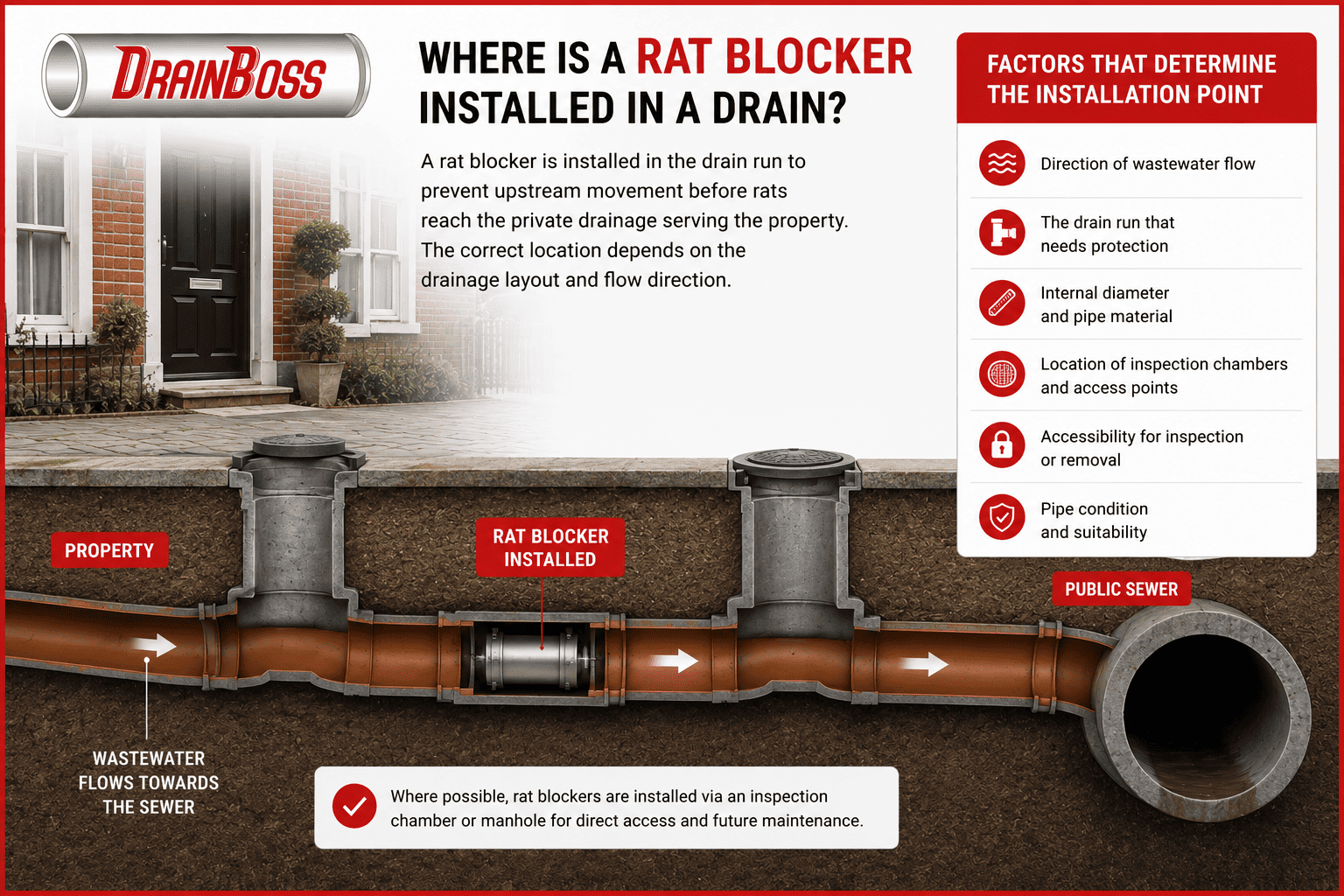
A rat blocker is normally positioned within a drain run where it can prevent upstream movement before rats reach the section of private drainage serving the property. The correct location depends on the drainage layout rather than simply choosing the nearest accessible pipe.
Several factors determine where to install a rat blocker:
- the direction in which wastewater flows towards the sewer;
- which drain run provides the route that needs to be protected;
- the internal diameter and material of the pipe;
- the location of inspection chambers and other access points;
- whether the device will remain accessible for inspection or removal;
- whether the pipe is in suitable condition to accept the device.
Where the drainage configuration permits, installation can be carried out through an inspection chamber or manhole. This provides direct access to the relevant pipe and avoids opening the drainage system unnecessarily elsewhere.
The blocker should not be placed in an arbitrary inaccessible section simply because there is space for it. Access remains important because the moving parts may later need to be checked, cleaned or removed during drainage work.
When Should a Drain Rat Blocker Be Installed?
Drain rat blocker installation is most appropriate when there is reasonable evidence that rats are using a particular drainage route to approach the property. It should not be treated as a universal solution whenever rats are found in or around a building.
Typical situations can be compared as follows:
| Situation | Is a rat blocker relevant? | What should be considered first? |
| Rats identified travelling through a specific drain | Often | Suitable location and flow direction |
| Rat activity found in an inspection chamber | Possibly | Whether that drain leads towards the affected property |
| Repeated internal rat activity with drainage suspected | Possibly | Confirm the actual route |
| Cracked or displaced drainage pipe found | Not by itself | Repair the structural defect |
| Known drainage route after defects have been repaired | Often | Whether a blocker adds useful upstream protection |
| Rats entering through an above-ground opening | No | The relevant building entry point |
Evidence that drainage may be involved can come from activity around inspection chambers, findings during drain inspection or a pattern of recurring rat entry after obvious above-ground access points have been dealt with. A CCTV survey may provide stronger evidence by showing the internal condition and layout of the pipework.
Preventative installation can also be considered where a vulnerable drainage route has already been identified. The important distinction is that the blocker should protect a defined route rather than being fitted on the assumption that every rat problem originates in the drains.
Should You Have a CCTV Drain Survey Before Rat Blocker Installation?
A CCTV drain survey is not automatically necessary before every rat blocker installation. It becomes particularly useful when the route taken by the rats is uncertain, the drainage layout is not known or there is reason to suspect defects within the pipework.
A camera inspection can help establish:
- which pipes connect the property to the downstream drainage system;
- the direction of flow through the relevant drain run;
- pipe diameter and, in many cases, the type of pipework present;
- cracks, displaced joints and other visible structural defects;
- redundant or unusual connections that may provide an alternative route;
- whether the proposed section is suitable for a rat blocker;
- whether repair work should take priority over installation.
This distinction matters because a CCTV drain survey for rats can change the recommended response. If the pipe itself provides a continuous route from the sewer towards the property, a blocker may be appropriate. If rats are escaping through a broken section of drain before reaching the proposed blocker position, fitting the device alone may leave the actual access point unresolved.
The purpose of inspection is therefore not simply to find somewhere to fit the blocker. It is to understand the drainage route well enough to decide whether rat blocker installation addresses the problem and where the device can operate without interfering with normal wastewater flow.
Comments from DrainBoss: A rat blocker is most useful when it is installed in the drain the rats are actually using. If the drainage layout or condition is unclear, a CCTV survey can help identify defects and establish whether fitting a blocker, carrying out a repair or using both measures is the appropriate approach.
Can a Rat Blocker Cause a Drain Blockage?
A correctly sized and fitted rat blocker for drains is designed to allow wastewater and normal waste to continue towards the sewer. The hinged flaps must have enough clearance to open fully with the direction of flow and return freely afterwards.
However, the blocker is an additional mechanical component inside the pipe. Wipes, sanitary products and other unsuitable items can catch on drainage components rather than passing through as intended. Debris already present in the pipe may also interfere with flap movement. The risk of problems increases if the device is the wrong size, is poorly positioned or cannot open through its full range of movement.
This is why installation should include an operational check rather than ending as soon as the blocker is secured. Water and suitable test material can be passed through the drain to confirm that the flaps open correctly and that waste continues downstream. If a rat blocker begins restricting flow, the device and surrounding pipework should be inspected rather than assuming that the blocker itself is necessarily the original cause of the blockage.
Comments from DrainBoss: Correct sizing and positioning are important because the blocker must prevent upstream access without interfering with normal drainage. After installation, the device should be checked to make sure the flaps move freely and wastewater continues to pass through the pipe as intended.
Rat Blocker Installation and Why Correct Fitting Matters
Rat blocker installation starts with the pipe rather than the device. The drain diameter, pipe material, internal condition and available access all affect which blocker can be used and where it can be positioned. A pipe containing significant damage or obstruction may need attention before a device is fitted.
Correct fitting involves several checks:
- identify the drain run that requires protection;
- confirm the direction of wastewater flow;
- select a blocker compatible with the pipe diameter and material;
- position and secure the device so that it cannot move from its intended location;
- check that the hinged parts move through their required range;
- test the drain after fitting to confirm that wastewater and waste pass downstream.
Some rat blocker designs are held inside the pipe by a secure friction fit, while installation methods vary according to the device and drainage configuration. For this reason, a generic DIY procedure for how to install a rat blocker is not appropriate for every drain.
The final test is particularly important. A drain rat blocker installation is only successful if the device provides the intended barrier while the drainage system continues to function normally.
Our Services:
Rat Blocker or Drain Repair Which Solution Is Needed?
A rat blocker and a drain repair solve different problems. A rat blocker for drains controls movement through an existing pipe by preventing rats from travelling upstream. A drain repair corrects a physical fault in the drainage system.
Repair may be required where inspection identifies problems such as:
- a cracked or broken pipe;
- a displaced joint;
- an open redundant connection;
- a damaged inspection chamber;
- a defective connection beneath or close to the building.
This distinction matters because rats do not necessarily need to travel through the complete drain run to reach a property. If they can leave the pipe through a structural defect before reaching the proposed blocker position, installing the device there will not close that opening.
In some cases, both measures are appropriate. The drainage defect can first be repaired to remove the unintended exit point, after which a blocker can protect the relevant drain against future upstream movement from the sewer. Effective rat proofing therefore depends on addressing the route that actually exists rather than treating a blocker as an alternative to necessary drain repair.

Are Rat Blockers Better Than Rat Traps and Poison?
Rat blockers, traps and rodenticides should not be treated as interchangeable solutions because they act at different stages of a rat problem. A rat blocker for drains is preventative: it restricts access through a specific drainage route. A trap is intended to capture or kill a rat that has already reached an accessible area, while rodenticide is a pest-control measure used to control an existing rodent population.
A blocker has the advantage of creating a physical barrier without requiring poison to be placed within the property. However, fitting one does not remove rats that are already inside a building, nor does it control rats elsewhere around the site.
This means the answer to “do rat blockers work?” depends on the objective. They can be effective for rat proofing drains where the protected pipe is a confirmed access route. Where rats are already present inside the property, drainage measures may need to be combined with appropriate pest-control work.
What Problems Will a Drain Rat Blocker Not Solve?
A drain rat blocker has a specific purpose: preventing upstream movement through the pipe in which it is installed. It does not seal every possible route into a building.
A blocker will not by itself resolve:
- broken or cracked drainage pipework;
- displaced pipe joints;
- open redundant drainage connections;
- defects in an inspection chamber;
- entry through gaps or openings above ground;
- access through another drain run that remains unprotected;
- rats that are already inside the property.
This is also why the question “can rats get past a rat blocker?” needs context. A correctly functioning device may prevent movement through its particular pipe, while rats could still reach the property by a separate route. Finding rats after installation does not automatically mean they have passed through the blocker.
The location of the access route therefore needs to be understood before relying on a blocker as the solution. Its role is to protect a defined section of drainage, not to make the entire property physically rat-proof.
Do Drain Rat Blockers Need Maintenance?
A drain rat blocker sits permanently within an active wastewater pipe, so its condition should be capable of being checked when necessary. The main points are whether the device remains securely positioned, whether its flaps move freely and whether debris has collected around the mechanism.
There is no useful universal inspection interval for every installation because drainage conditions and usage differ. Instead, the blocker should remain accessible so that it can be examined when there is a reason to suspect a problem.
Inspection is particularly sensible after a significant blockage, work on the drain or cleaning that may have affected the section containing the device. If drainage becomes slow, the blocker and surrounding pipework can also be checked for trapped material or restricted flap movement. Periodic access is therefore part of sensible maintenance, even though a correctly installed rat blocker for drains has no routine operating action for the property owner to perform.
Choosing the Right Approach to Stop Rats Coming Through Drains
A drain rat blocker can provide an effective physical barrier when rats are using a confirmed drainage route, but the installation needs to match the pipework and the actual point of access. Where the route is uncertain or drainage defects are present, inspection and any necessary repairs should come first. The aim is not simply to fit a device, but to protect the correct drain while maintaining unrestricted wastewater flow.
DrainBoss installs drain rat blockers for domestic and commercial drainage systems. The devices used are made from high-grade stainless steel and feature two independently suspended serrated flaps designed to allow waste to leave while preventing rats from travelling upstream. They can be fitted to clay, uPVC and cast-iron pipework, with correct positioning and secure fitting checked as part of the installation.
FAQ About Drain Rat Blockers and Installation
How does a drain rat blocker work?
A drain rat blocker works as a one-way mechanical barrier inside the drainage pipe. Wastewater and normal waste can move downstream towards the sewer by opening the hinged flap or flaps in the permitted direction. When a rat approaches from the sewer side, the mechanism prevents it from opening the device upstream towards the property. Correct orientation is essential because the blocker must follow the actual direction of wastewater flow.
When should a drain rat blocker be installed?
A drain rat blocker is most useful when there is evidence that rats are using a particular drain as an access route towards the property. It may also be considered after drainage defects have been identified and repaired, where the same route remains vulnerable to future upstream movement. Installation should not be based on the assumption that every rat problem originates in the drains. The drainage layout and likely point of access should be understood first.
Can rats get past a drain rat blocker?
A correctly fitted blocker is designed to prevent rats from travelling upstream through the pipe in which it is installed. However, it only protects that specific drainage route. Rats may still enter through another drain, a damaged pipe, a redundant connection or an opening above ground. If rat activity continues after installation, the wider drainage system and other possible entry points should be checked.
Can a rat blocker cause a drain blockage?
A suitable rat blocker should allow wastewater and normal waste to continue flowing towards the sewer. Problems can occur if the device is the wrong size, is positioned incorrectly or cannot open freely. Wipes, sanitary products and other unsuitable waste may also catch on components within the drainage system and interfere with movement. The drain should therefore be tested after installation to confirm that flow remains unrestricted.
Do I need a CCTV drain survey before rat blocker installation?
Not every installation requires a CCTV drain survey, but a survey can be useful when the drainage route or pipe condition is uncertain. It can help identify cracks, displaced joints, redundant connections and other defects that may be providing rats with an alternative route. It can also help confirm the relevant drain run, direction of flow and a suitable installation point. Where structural damage is found, repair may be more important than fitting a blocker immediately.
Can a rat blocker be fitted to clay or plastic drains?
Rat blockers are available for common drainage materials, including clay and uPVC pipework, and some designs can also be fitted to cast-iron drains. The important factors are the internal diameter, condition and configuration of the pipe. A device should be selected to match the specific drainage system rather than fitted on size assumptions alone. The installation point must also allow the mechanism to open and close correctly.
Will a drain rat blocker remove rats that are already inside the property?
No. A drain rat blocker is an access-control device, not a method for removing rats that have already entered a building. Its role is to prevent further upstream movement through a selected drain. If rats are already present inside the property, separate pest-control measures may be required alongside drainage work. The original access route should also be identified so that the problem does not continue.
Do drain rat blockers need maintenance?
A drain rat blocker does not normally require day-to-day operation, but it should remain accessible for inspection when necessary. The main checks are that the device remains securely positioned, the flaps move freely and debris has not collected around the mechanism. Inspection is particularly sensible after a serious blockage, drain cleaning or other work on the same drainage run. There is no single maintenance interval that is appropriate for every property because drainage conditions and usage vary.