

Key Points:
- Check gutters, downpipes, outdoor gullies, drainage channels and soakaways before storm season to reduce the risk of blockages and flooding.
- Watch for slow drainage, recurring overflows, standing water and damaged pipes that may indicate hidden drainage problems.
- Regular maintenance and professional inspections help identify drainage issues before heavy rainfall puts additional pressure on the system.
- DrainBoss provides CCTV drain surveys, high-pressure jetting, drain unblocking and repairs across Sussex, Surrey, Kent, Hampshire and South London.
Before storm season, homeowners should inspect gutters, downpipes, outdoor gullies, drainage channels, inspection chambers, underground pipes and soakaways. These components collect and carry rainwater away from buildings, driveways and gardens. Even a partial blockage can cause water to accumulate when rainfall becomes particularly intense.
A pre-storm drainage inspection helps identify restricted outlets, damaged connections and areas where surface water is likely to collect. Most visible checks can be completed from ground level, although underground problems may require specialist equipment. This guide explains what to inspect, which warning signs matter and when professional attention is necessary.
Why Checking Your Outdoor Drainage System Before Storm Season Matters
Heavy rainfall puts considerably more pressure on drainage systems than ordinary showers. For every 1 mm of rain falling on 1 m² of roof area, approximately one litre of water reaches the roof surface. A roof measuring 80 m² can therefore receive around 2,000 litres of rainwater during a 25 mm rainfall event, before accounting for losses and temporary storage.
A partially blocked drainage pipe may carry water adequately during light rainfall but struggle when several downpipes discharge simultaneously. Overflowing gutters can saturate external walls, while blocked gullies may allow water to collect around entrances and paved areas. Repeated exposure to standing water can contribute to dampness, erosion and deterioration of building materials.
However, not every overflow indicates a blockage. Surface water flooding can also occur when rainfall exceeds the capacity of functioning drainage systems or the surrounding ground is saturated. Regular inspections reduce avoidable restrictions but cannot eliminate flooding risks during exceptional weather.
Our Services:
How to Check Gutters and Downpipes Before Heavy Rain
Gutters and downpipes form the first part of most domestic roof drainage systems. Gutters collect rainwater along roof edges, while downpipes carry it towards ground-level drainage connections or designated discharge points. A restriction anywhere along this route can cause water to overflow before reaching underground drains.
Examine the guttering from ground level, preferably in daylight. Binoculars can help identify visible debris or damaged sections without using a ladder. Pay particular attention to areas beneath trees, roof valleys and outlets where several gutter sections meet.
The main guttering and downpipe checks include:
- Gutter channels. Look for leaves, moss, twigs and vegetation. Debris near an outlet can restrict flow even when most of the gutter appears clear.
- Gutter alignment. Check for sagging sections, loose brackets and separated joints. Water collecting in a section may indicate an incorrect fall.
- Roof outlets and hopper heads. Inspect accessible openings for moss and debris washed from the roof. Hopper heads can become obstructed and overflow.
- Downpipe joints. Look for cracks, missing clips and staining around connections. Persistent wet marks may indicate escaping water.
- Ground-level connections. Check that downpipes discharge into their intended drainage points. Displaced fittings can direct concentrated runoff towards external walls.
If possible, observe the system during ordinary rainfall. Water escaping from joints, spilling over gutter edges or collecting around downpipes provides evidence of a problem. However, satisfactory performance during a light shower does not guarantee sufficient capacity during a storm.
Avoid working at height in windy or wet conditions. Cleaning that requires ladders or roof access should be undertaken by suitably equipped professionals. Remember that clearing a gutter will not solve a blockage farther down the connected pipework.

How to Inspect Outdoor Drains and Gullies Before Storms
Outdoor gullies and drainage channels collect water from patios, driveways, paths and other paved surfaces. They are particularly exposed to leaves, soil, gravel and material washed across the ground. A blocked surface opening can cause localised flooding even when the underground pipe remains clear.
Start with gullies near external doors, garage entrances and the lowest parts of the property. These locations often receive runoff from larger surrounding areas. Check whether the paving directs rainwater towards the drainage opening rather than allowing it to collect against walls.
Inspect the following components:
- Yard gullies. Remove loose leaves and debris from accessible grates. Check whether water can enter the opening without obstruction.
- Trapped gullies. Look for excessive sediment or solid debris within safely accessible sections. Some trapped gullies normally retain water to maintain a seal, so standing water inside the trap does not automatically indicate a blockage.
- Driveway channel drains. Examine linear channels, removable grates, corners and outlet connections. Sediment can accumulate in low sections and reduce channel capacity.
- Patio drainage outlets. Check openings close to walls, thresholds and steps. Soil and decorative gravel can obstruct relatively small outlets.
- Inspection chamber covers. Look for cracks, movement, missing fixings or settlement in surrounding paving. Damaged covers should be repaired rather than temporarily concealed.
- Roadside gullies. Note visible obstructions near the property. Public road gullies are normally maintained by the relevant highway authority, and blocked drains should be reported rather than opened by homeowners.
Where a removable channel grate is designed for routine cleaning, follow the manufacturer’s instructions and wear suitable gloves. Remove accessible debris and inspect the outlet without forcing tools into connecting pipes. Never leave drainage openings uncovered or unattended.
A small amount of clean water can help confirm whether an accessible channel drains under normal conditions. However, this is not a full-capacity test and does not prove that the underground system can handle heavy rainfall. Stop testing if water backs up or spreads towards the building.
Heavy inspection chamber covers should not be lifted without appropriate equipment and competence. Never open chambers during flooding or attempt to enter underground drainage spaces. A routine homeowner inspection should focus on visible defects and safely accessible components.
DrainBoss Expert Comment: One of the most useful checks is to observe where rainwater collects during normal rainfall. If water pools around a clear gully, the problem may be deeper in the drainage system rather than at the surface. At DrainBoss, we recommend investigating recurring overflow before it causes problems during heavier storms.
How to Check Underground Drain Pipes for Blockages and Damage
Underground drainage pipes cannot usually be inspected directly, but their condition may become apparent through changes in drainage performance. A drain that repeatedly overflows, makes unusual noises or requires frequent clearing may have an obstruction or structural defect. Such problems should be investigated before periods of intense rainfall.
Start by identifying the drainage connections around the property. Roof water may discharge into a separate surface water system, a soakaway or, in some older properties, a combined sewer. Understanding the intended drainage route helps distinguish local restrictions from problems farther along the system.
The most useful warning signs include:
- Slow drainage. Water remains around an outdoor gully despite the surface opening being clear.
- Repeated blockages. The same drain becomes restricted shortly after cleaning, suggesting an unresolved cause.
- Gurgling noises. Unusual sounds from connected drainage fixtures may indicate restricted flow or changes in air pressure.
- Persistent odours. Sewage smells around foul drains or inspection chambers may indicate a blockage, defective seal or damaged pipework.
- Localised ground settlement. Depressions near a drainage route can indicate ground movement, although they do not prove a pipe has collapsed.
- Wastewater backing up. Sewage emerging from a drain requires prompt investigation, particularly if several fixtures are affected.
Tree roots are another potential concern, especially around older drainage systems. Roots can enter through defective joints, cracks or other openings. Once inside, they may restrict flow and trap debris.
Visible external pipework also deserves attention. Check for damaged fittings, unsupported sections and leaking connections. Exposed water-carrying pipes may need frost protection during freezing weather, although insulation does not improve rainwater drainage capacity.
A CCTV drain survey can identify root intrusion, displaced joints, fractures and hidden obstructions. It is particularly useful when a drain repeatedly blocks or continues to perform poorly after clearance. Persistent problems should be investigated rather than ignored until the next storm.
How to Check Soakaways and Garden Drainage Before Heavy Rain
Soakaways receive rainwater and allow it to infiltrate the surrounding soil. They generally contain underground storage space, such as drainage crates or stone-filled voids, connected to surface water pipes. Their performance depends on storage capacity, soil permeability and groundwater conditions.
Most soakaways cannot be inspected visually without specialist access. Instead, look for changes in drainage performance around connected downpipes and the soakaway location. Warning signs include persistent waterlogging, overflowing connecting gullies and unusually wet ground after rainfall has stopped.
These symptoms may indicate an obstructed inlet, insufficient capacity or poor infiltration conditions. However, prolonged wet weather can saturate the surrounding soil and temporarily reduce performance without a physical blockage. Observations across several rainfall events are more useful than a single puddle.
French drains, gravel trenches and buried perforated pipes also require attention. Their effectiveness depends on suitable installation and a functioning discharge route. Simply adding gravel to waterlogged ground does not guarantee effective drainage.
Before storm season, check:
- Soakaway inlet connections for debris, damaged fittings and evidence of overflow.
- Accessible French drain outlets for sediment, vegetation and other obstructions.
- Gravel drainage strips for accumulated soil that could restrict infiltration.
- Garden drainage channels for blockages at their lowest points.
- Retaining walls and landscaped slopes for erosion or water emerging from unexpected locations.
- Patios and lawns for depressions where water repeatedly collects.
Pay attention to where garden drainage ultimately discharges. A French drain without a suitable outlet may simply transfer water from one saturated area to another. New connections to sewers or watercourses can require permissions and should be assessed before alterations are made.
For drainage improvements in England, Building Regulations guidance generally prioritises suitable infiltration systems for rainwater disposal, followed by a watercourse and then a sewer where earlier options are not reasonably practicable. New soakaways require assessment of soil conditions, capacity and proximity to buildings.
Avoid excavating around existing soakaways without identifying underground services and drainage connections. Persistent waterlogging warrants an assessment to establish whether the problem involves the inlet pipe, soakaway capacity, ground conditions or surface levels.
How to Reduce Surface Water Flood Risk Around Your Home
Checking drainage components is only part of preparing for severe rainfall. Water also needs a suitable route across external surfaces when drainage systems temporarily reach capacity. Poor ground levels can direct runoff towards buildings even when nearby gullies remain clear.
Pay particular attention to basement steps, garage entrances, light wells, low thresholds and paved surfaces sloping towards walls. Previous flood marks, sediment deposits and repeated puddles help identify vulnerable locations.
Practical measures include:
- Keep drainage channels at garage entrances and basement steps unobstructed.
- Maintain paving and landscaping so runoff follows the intended drainage route.
- Check that water butt overflow pipes discharge to a suitable location. A water butt may already be full when heavy rain begins.
- Prevent excessive sediment and soil from accumulating on permeable paving.
- Consider suitable sustainable drainage measures, such as rain gardens, where conditions allow.
- Investigate recurring pooling near foundations rather than redirecting water to another vulnerable area.
Flood barriers and non-return valves may help where a specific flooding risk has been identified. However, they must be selected for the actual source of flooding. A valve intended to reduce sewer backflow will not prevent rainwater entering through a low doorway.
Homeowners in England can also check the government’s long-term flood risk information, including surface water risk. Such assessments describe wider flood exposure rather than diagnosing an individual property’s drains. They should complement, not replace, drainage inspections.
Our Services:
When to Arrange a Professional Drain Inspection Before Storm Season
Professional inspection is worth considering when routine cleaning fails to restore normal drainage or when underground damage is suspected. The objective is to identify the cause before deciding whether cleaning, repair or replacement is necessary. A functioning system without warning signs does not automatically require specialist investigation.
A CCTV drain survey allows an engineer to inspect accessible underground drainage pipes using a camera. It can reveal root intrusion, displaced joints, fractures, heavy deposits and standing water caused by obstructions or inadequate falls. Surveys are particularly useful when blockages recur in the same location or drainage problems remain unexplained.
High-pressure drain jetting serves a different purpose. It uses water delivered through specialist nozzles to remove suitable deposits and obstructions. The cleaning method, pressure and nozzle must be appropriate for the pipe’s material, dimensions and condition.
Professional drain cleaning may be needed when:
- An outdoor gully continues overflowing after accessible debris has been removed.
- Sediment or other deposits restrict an underground pipe.
- A drain repeatedly blocks because material remains inside the system.
- Water backs up through connected drainage points.
- Previous clearance has not fully restored normal drainage.
Jetting cannot repair fractured pipes, displaced joints or collapsed sections. Where structural damage is suspected, the drain should be assessed before selecting a cleaning or repair method.
It is also important to distinguish blockages from insufficient drainage capacity. An unobstructed system can still struggle during exceptionally heavy rainfall. Repeated cleaning will not resolve an underlying design or capacity problem.
DrainBoss Expert Comment: Repeated drain blockages should not be treated as isolated incidents. Our experience at DrainBoss shows that recurring problems can be associated with damaged joints, root intrusion or deposits that have not been fully removed. Identifying the underlying cause helps determine whether cleaning, CCTV inspection or structural repair is the appropriate solution.
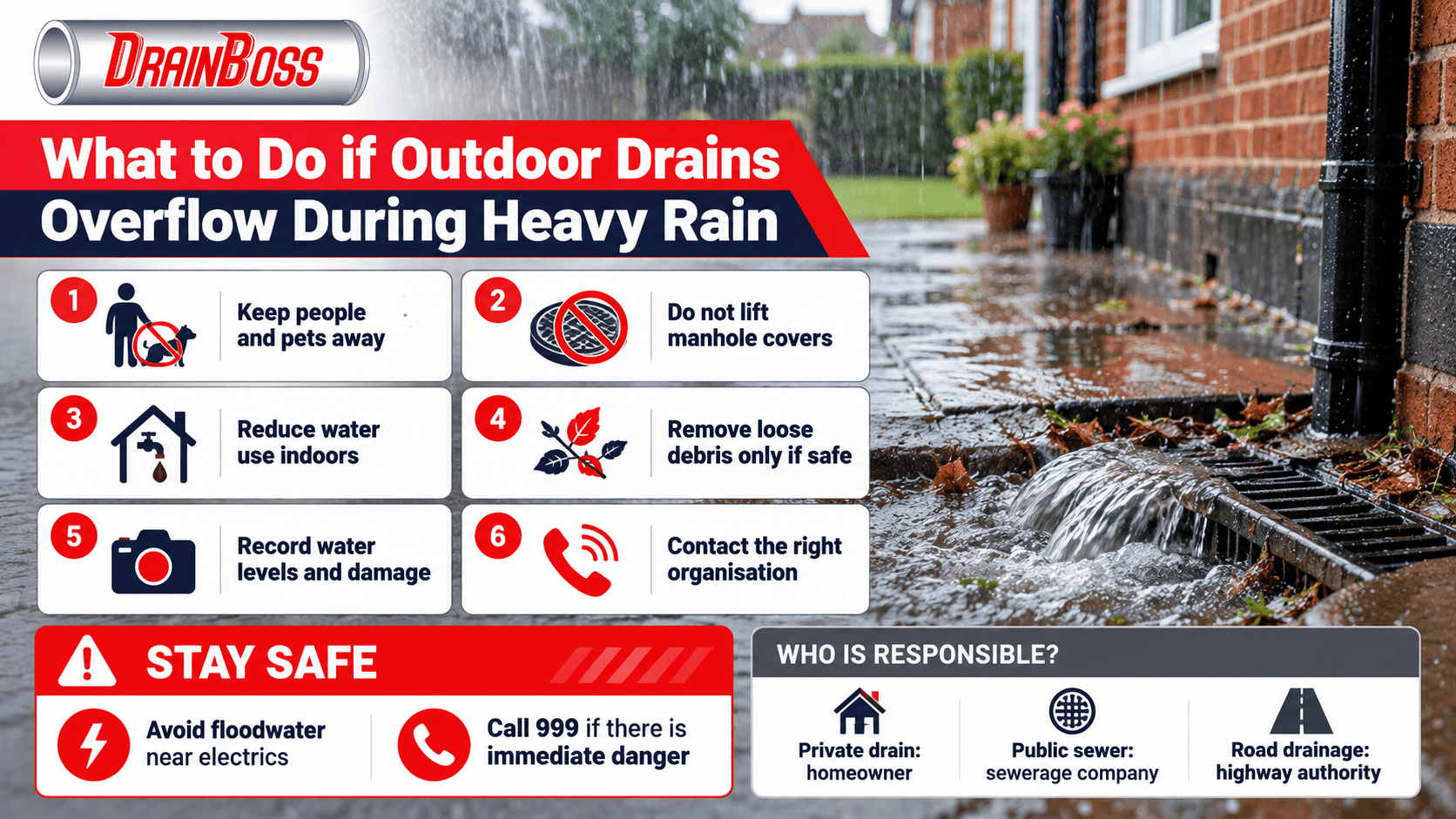
What to Do if Outdoor Drains Overflow During Heavy Rain
If outdoor drains begin overflowing during a storm, personal safety comes first. Floodwater may conceal damaged surfaces, open chambers or electrical hazards, while sewage-contaminated water presents a health risk. Avoid entering flooded areas to investigate the source.
The immediate response depends on whether rainwater is collecting on the surface or wastewater is backing up from the drainage system.
If outdoor drainage starts overflowing:
- Keep people and pets away from flooded areas, particularly around inspection chambers and electrical equipment.
- Do not lift manhole covers or attempt to clear underground blockages during flooding.
- If sewage is backing up, minimise toilet flushing and the use of connected appliances until the problem is assessed.
- Remove loose surface debris only where this can be done safely without entering floodwater.
- Record affected drainage points, water levels and visible damage. Photographs may help with later investigations and insurance claims.
- Contact the appropriate organisation if flooding continues or water threatens the building.
If floodwater reaches electrical installations, do not touch switches or equipment while standing in water. Isolate utilities only where safe. Call 999 if there is an immediate danger to life.
Responsibility depends on the drainage system involved. In England and Wales, drains serving an individual property within its boundary are generally the owner’s responsibility. Public sewers and most lateral drains outside property boundaries are maintained by sewerage companies, while highway drainage is normally managed by the relevant highway authority.
If several neighbouring properties experience sewage backing up, the public sewer may be affected. However, this is not conclusive evidence, and responsibility should be confirmed with the relevant organisation.
For extensive flooding, investigate wider drainage conditions rather than assuming the nearest gully is blocked. Surface water can overwhelm functioning systems, particularly when the ground is saturated or downstream drainage capacity is restricted.
Outdoor Drainage Maintenance Checklist Before and After Storms
An effective outdoor drainage maintenance checklist should cover the entire route taken by rainwater, from the roof to the final discharge point. The aim is to identify defects, keep accessible openings clear and arrange investigations where necessary.
| Drainage component | What to check | Warning signs | Recommended action |
| Gutters | Channels, joints and outlets | Overflow, sagging, debris | Clear debris and repair defects |
| Downpipes | Connections, clips and outlets | Leaks, disconnections | Repair fittings and check discharge |
| Yard gullies | Grates and accessible traps | Debris, backing up | Remove accessible material |
| Channel drains | Grates, channels and outlets | Sediment, pooling | Clean channels and check flow |
| Inspection chambers | Covers, frames and surrounding paving | Cracks, movement, settlement | Arrange repairs |
| Underground pipes | Drainage performance | Recurring blockages | Investigate if necessary |
| Soakaways | Connections and surrounding ground | Persistent waterlogging | Assess capacity and infiltration |
| Garden drainage | Outlets and surface levels | Erosion, blocked discharge | Clear outlets or assess layout |
Inspect accessible drainage components before autumn leaf fall becomes heavy and again after substantial leaves have accumulated. Additional checks are sensible before forecast storms, provided conditions are safe. Properties with nearby trees or previous drainage problems may require more frequent attention.
After severe rainfall, inspect the system once conditions are safe. Look for debris around grates, displaced covers, damaged downpipe connections and unexpected water flow routes. Record recurring problems rather than repeatedly clearing the same opening without investigating the cause.
Conclusion
Preparing outdoor drains for storm season means checking more than visible grates and gutters. Roof drainage, ground-level outlets, underground pipes and soakaways must work together to manage rainfall. Clear openings, sound connections and suitable discharge routes reduce avoidable restrictions, although even well-maintained systems can be overwhelmed by exceptional weather.
The most important warning signs are repeated overflow, slow drainage, wastewater backing up, damaged covers and persistent waterlogging. Problems that return after routine cleaning may indicate underground defects or insufficient drainage capacity. Identifying the cause before heavy rainfall is more effective than repeatedly addressing the same symptoms.
For problems requiring professional attention, DrainBoss provides drain unblocking, high-pressure water jetting, CCTV drain surveys, gutter cleaning and drain repairs. The family-run company serves domestic and commercial properties across Sussex, Surrey, Kent, Hampshire and South London, with a 24/7 emergency service. Its drainage specialists can investigate persistent faults, clear suitable obstructions and recommend repairs where necessary.
How often should outdoor drains be checked before storm season?
Outdoor drains should be inspected before periods of heavy rainfall, particularly during autumn when falling leaves can obstruct gullies and drainage channels. A further inspection after substantial leaf fall helps identify newly accumulated debris. Properties surrounded by trees or with a history of drainage problems may need more frequent checks. It is also advisable to inspect accessible drainage points after major storms.
Which parts of an outdoor drainage system are most likely to become blocked?
Gutter outlets, downpipes, yard gullies and driveway channel drains are particularly vulnerable because they collect leaves, moss, soil and other debris. Narrow outlets and bends can accumulate material that restricts water flow. Underground pipes may also become blocked by sediment, roots or other obstructions. Regularly clearing accessible drainage openings reduces the likelihood of preventable blockages.
How can I tell if an underground drain is blocked before heavy rain?
Common warning signs include slow drainage, recurring overflow, gurgling noises and unpleasant smells around foul drainage connections. Water backing up through an outdoor gully can also indicate a restriction farther along the pipework. However, similar symptoms may result from downstream drainage problems rather than a local blockage. A CCTV drain survey can help identify the cause when problems persist.
Can outdoor drains overflow during a storm even if they are clear?
Yes, outdoor drains can overflow when rainfall exceeds the capacity of the drainage system. This is particularly likely during intense downpours when large quantities of water reach gullies and underground pipes within a short period. Saturated ground or high water levels in downstream drainage systems can also prevent rainwater from draining away efficiently. Keeping drains clear improves their performance but cannot guarantee protection against exceptional flooding.
How do I know if my soakaway is working properly?
A functioning soakaway should accept incoming rainwater and gradually release it into the surrounding soil. Persistent waterlogging, repeated overflow at connected gullies or standing water above the soakaway may indicate a problem. However, drainage performance can temporarily deteriorate when the ground is saturated after prolonged rainfall. If these symptoms occur repeatedly, the soakaway's inlet connections, capacity and ground conditions should be assessed.
Should I lift an outdoor drain cover to inspect the drainage system?
Homeowners can visually inspect drain covers and clean removable grates designed for routine maintenance. Heavy manhole covers should not be lifted without appropriate equipment and competence because they can cause injury or expose hazardous openings. Underground inspection chambers may contain dangerous gases and should never be entered by homeowners. During flooding, covers must remain closed and any suspected problem should be reported to a competent drainage specialist.
Is professional drain cleaning necessary before every storm season?
Professional cleaning is not automatically necessary if outdoor drains are functioning normally and show no signs of obstruction. Removing leaves and debris from accessible grates and drainage channels may be sufficient for routine maintenance. However, recurring blockages, persistent slow drainage or wastewater backing up can indicate problems requiring specialist attention. High-pressure jetting may remove suitable obstructions, while CCTV inspection can help identify underlying structural defects.