

Key Points:
- Septic tanks treat wastewater and offer a more sustainable long-term solution for most properties.
- Cesspits are simple storage systems and are typically used only where site conditions limit other options.
- Installation cost is only part of the picture, as ongoing maintenance can significantly affect total expenses.
- The right choice depends on soil conditions, available space and how the property is used.
For many properties across the UK, particularly in rural or semi-rural areas, connection to the mains sewer system is not always available. In these situations, wastewater must be managed independently on-site, which is where systems such as cesspits and septic tanks come into consideration. The choice between them usually arises during new construction, property renovation or when an existing drainage system no longer performs reliably.
At first glance, selecting between a cesspit and a septic tank may seem like a straightforward decision based on cost or convenience. In reality, it is an engineering choice that depends on ground conditions, available space, usage patterns and long-term performance requirements. Each system behaves differently under load, and what works for one property may not be suitable for another.
In this guide, we will break down how cesspits and septic tanks operate, explain the key differences between them and outline the conditions in which each system is most appropriate. The aim is to provide a clear, practical understanding of which option is better, and more importantly, why.
Definition of a Cesspit
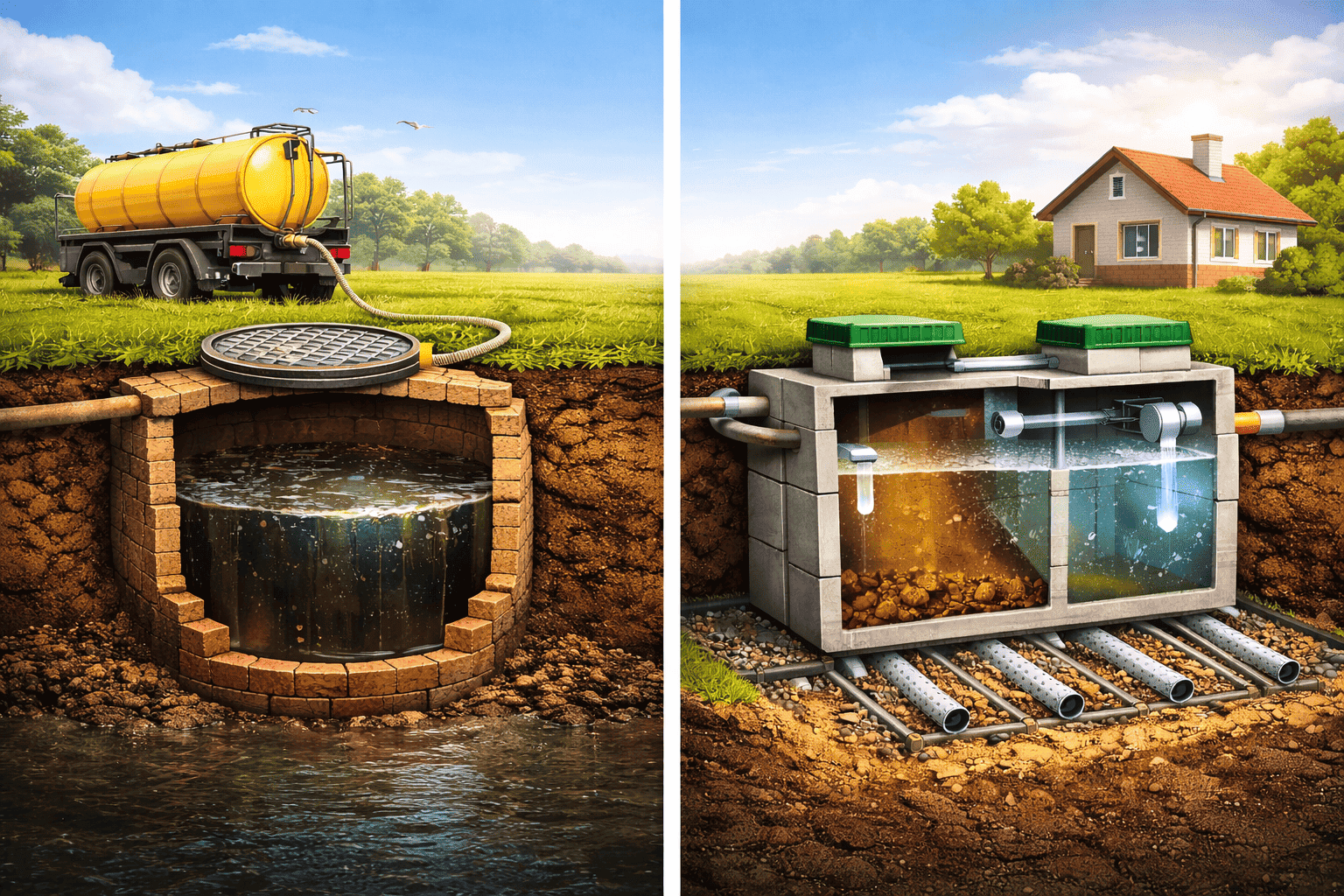
A cesspit, sometimes referred to as a cesspool, is a fully sealed underground tank designed for the containment of wastewater and sewage. It is typically installed in locations where no connection to a mains sewer is available and where alternative drainage solutions may be limited.
Unlike other systems, a cesspit does not process or discharge waste. Its sole purpose is to store all incoming wastewater until it is removed by a licensed waste contractor. Because of this, the system relies entirely on regular emptying to remain functional and prevent overflow.
Key characteristics of a cesspit include:
- A sealed underground structure with no outlet pipe
- No internal treatment or breakdown of waste
- Full retention of all wastewater and solids within the tank
- Dependence on frequent emptying to maintain capacity
- Simple design with minimal internal components
This type of system is often considered a basic containment solution rather than a treatment system, which has a direct impact on how it performs over time and how it must be maintained.
Definition of a Septic Tank
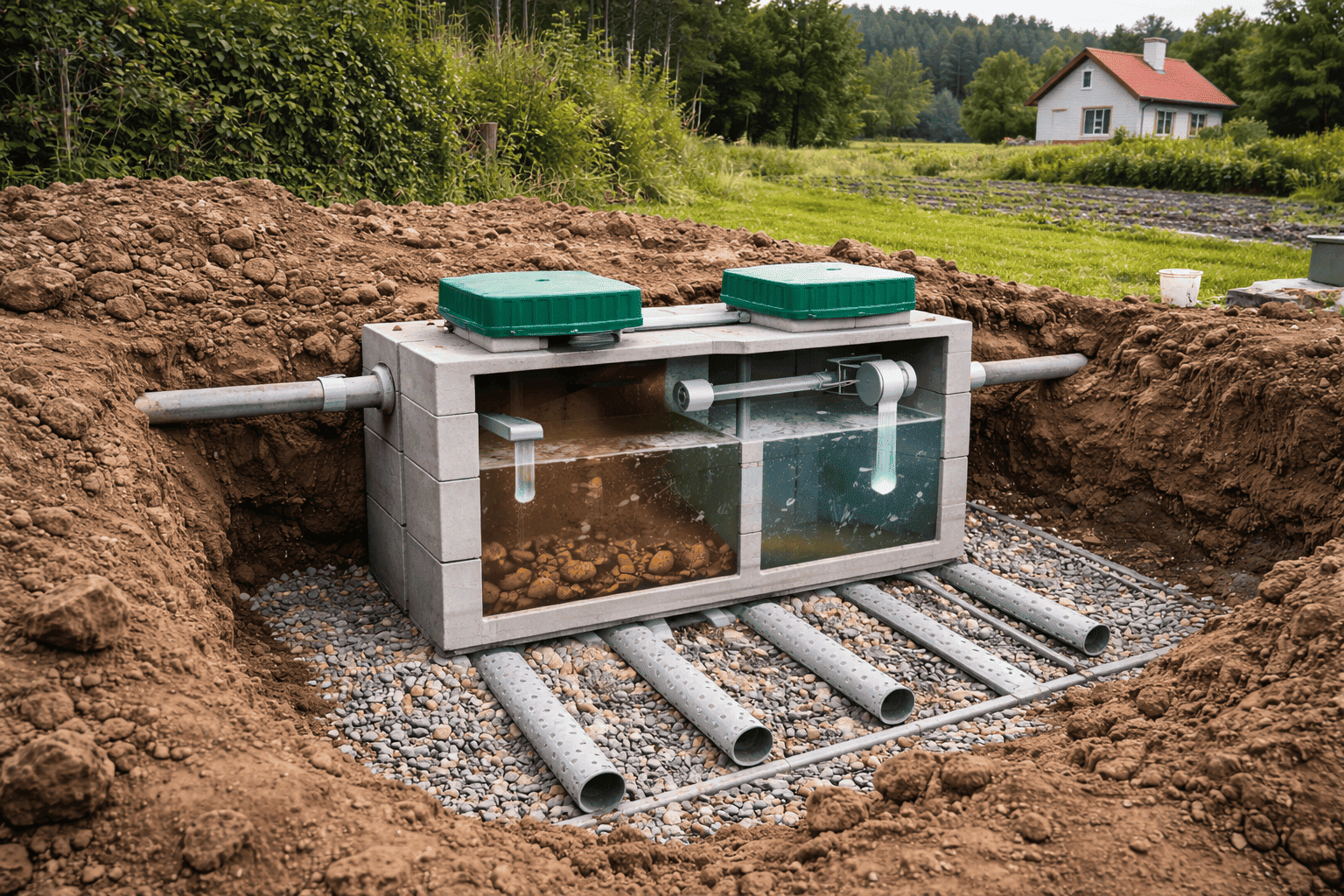
A septic tank is an underground wastewater treatment system designed to both collect and partially treat sewage on-site. It is commonly used for properties without access to the mains sewer, offering a more advanced solution compared to simple storage systems.
The system operates by separating solids from liquids and allowing naturally occurring bacteria to break down organic matter within the tank. The treated liquid, known as effluent, is then discharged into a drainage field or soakaway, where it undergoes further filtration through the surrounding soil.
The structure and function of a septic tank can be summarised as follows:
| Component | Function |
| Inlet pipe | Carries wastewater from the property into the tank |
| Primary chamber | Allows solids to settle and begin biological breakdown |
| Secondary chamber | Further separates remaining particles and clarifies the effluent |
| Bacterial activity | Breaks down organic waste through anaerobic processes |
| Outlet pipe | Discharges treated liquid into the drainage field or soakaway |
| Drainage field | Disperses and filters effluent safely into the ground |
By combining treatment and controlled discharge, a septic tank operates as an integrated system rather than simple containment. This distinction plays a key role in how it performs over time, particularly in terms of maintenance, environmental impact and long-term reliability.
How Each System Works in Practice
Understanding how these systems behave under everyday use is essential when comparing their suitability. While both collect wastewater from a property, the way they handle that waste over time is fundamentally different.
How a Cesspit Operates
In practical terms, a cesspit functions as a closed storage unit that continuously accumulates all incoming wastewater. Every flush, sink discharge or appliance output is directed into the tank, where it remains without any form of processing or reduction.
As usage increases, the liquid level inside the cesspit rises steadily. There is no mechanism to reduce volume or release treated water, which means capacity is directly linked to how quickly the tank fills. Once it approaches its limit, the system must be emptied to prevent overflow or backflow into the property.
Because of this, the performance of a cesspit depends almost entirely on a strict emptying schedule. Delays or inconsistencies in maintenance can quickly lead to operational issues, especially in properties with higher daily usage.
How a Septic Tank Operates
A septic tank works as a staged system where wastewater is managed through separation and natural processes. When waste enters the tank, heavier solids settle at the bottom while lighter materials form a layer above. This creates a clearer liquid zone between them.
Within this environment, naturally occurring bacteria begin to break down organic matter, reducing the volume of solid waste and stabilising the contents. This ongoing biological activity allows the system to manage waste more efficiently over time.
The partially treated liquid is then directed out of the tank into a drainage field or soakaway. Here, it is dispersed into the surrounding ground, where further filtration occurs naturally. This continuous cycle of separation, treatment and discharge enables the system to operate without the need for frequent emptying, provided it is correctly maintained.
Our Services:
Key Differences Between a Cesspit and a Septic Tank
Although both systems are used for properties without access to mains drainage, their performance, maintenance and long-term implications differ significantly. Understanding these differences is essential when deciding which option is more suitable.
Treatment vs Storage
A cesspit is designed purely for storage. All waste remains inside the tank until it is removed. In contrast, a septic tank actively treats wastewater by separating and breaking down organic material, reducing the volume of solids over time.
Drainage and Outlet
Cesspits are fully sealed and do not include any form of outlet or discharge. This means all incoming waste stays within the tank. Septic tanks, however, are connected to a drainage field or soakaway, allowing treated liquid to exit the system and disperse safely into the ground.
Maintenance Requirements
Because a cesspit retains all waste, it requires frequent emptying to maintain capacity. The exact frequency depends on usage, but regular servicing is essential. A septic tank operates more gradually, with solids accumulating over time and requiring periodic desludging rather than constant emptying.
Installation vs Long-Term Cost
Cesspits are generally simpler and less expensive to install due to their basic design. However, ongoing emptying costs can make them significantly more expensive over time. Septic tanks involve a higher initial investment, particularly where drainage fields are required, but typically result in lower running costs.
Environmental Impact
The sealed nature of a cesspit means there is a higher risk of overflow or leakage if not properly maintained. This can lead to contamination issues. Septic tanks, by treating and dispersing wastewater, offer a more controlled and environmentally stable solution when correctly installed and maintained.
Cesspit vs Septic Tank: Pros and Cons
When comparing these two systems, it is useful to look at their advantages and limitations side by side. Each option has specific strengths, but also clear trade-offs that affect long-term performance and suitability.
Cesspit
Pros:
- Lower installation cost compared to more complex systems
- Simple design with minimal components
- Suitable for short-term or occasional use
Cons:
- Requires frequent emptying to remain operational
- High ongoing costs due to regular servicing
- Increased risk of overflow if not maintained correctly
- No treatment of wastewater
Septic Tank
Pros:
- Treats wastewater through natural biological processes
- Lower running costs over time
- More environmentally stable when properly installed
- Suitable for continuous, long-term use
Cons:
- Higher initial installation cost
- Requires appropriate ground conditions for effective drainage
This comparison highlights that the decision is not only about initial setup, but also about how the system will perform and what it will require over its lifetime.
Maintenance and Emptying Requirements
Ongoing maintenance is one of the most important factors to consider when choosing between these systems. Their performance over time depends not only on design, but also on how consistently they are serviced.
A cesspit requires frequent emptying because it stores all incoming waste without reducing its volume. The exact interval depends on tank size and property usage, but in many cases emptying may be needed on a monthly basis or even more often. If servicing is delayed, the system can reach capacity quickly, increasing the risk of overflow or internal backup.
A septic tank operates on a different maintenance cycle. Because part of the waste is broken down and liquid is discharged into the ground, the accumulation of solids happens more gradually. Instead of frequent emptying, the system requires planned desludging at intervals of several years, depending on usage and tank size. Regular inspections are also important to ensure that the drainage field continues to function correctly.
Maintenance is critical for both systems because it directly affects reliability and safety. Poorly maintained tanks can lead to blockages, unpleasant odours, environmental issues and disruption to the property. Establishing a consistent servicing schedule is essential to keep the system operating as intended and to avoid costly problems over time.
Cost Comparison: Short-Term vs Long-Term
Cost is often one of the first considerations when choosing between a cesspit and a septic tank. However, focusing only on the initial installation can give a misleading picture. A more accurate comparison looks at both short-term and long-term financial impact.
Installation Cost
A cesspit is generally less expensive to install due to its simple design and lack of additional components such as drainage fields. This can make it appear to be the more economical option at the outset.
A septic tank requires a more complex setup, including excavation, internal chambers and a suitable drainage area, which increases the initial investment.
Running Cost
Ongoing costs differ significantly between the two systems. A cesspit generates regular servicing expenses because it must be emptied frequently. These costs accumulate quickly, especially in properties with consistent daily usage.
A septic tank, by contrast, has lower routine costs. Maintenance is less frequent and typically limited to periodic desludging and inspection.
Lifetime Cost
When viewed over several years, the overall cost profile often shifts. While a cesspit starts with a lower upfront cost, its continuous servicing requirements can result in substantially higher total expenditure.
A septic tank usually balances its higher installation cost with reduced maintenance expenses, making it more cost-effective over the lifespan of the system.
Why a Cesspit Often Becomes More Expensive
The key factor is dependency on regular emptying. Each service visit adds to the cumulative cost, and there is no reduction in waste volume to offset this. Over time, these repeated expenses can exceed the initial savings made during installation.
In contrast, a septic tank manages waste internally and reduces reliance on external servicing, which helps stabilise long-term costs.
Comments from DrainBoss: In practice, cost is often underestimated at the planning stage. We regularly see properties where a lower upfront choice leads to significantly higher servicing expenses over time. A clear understanding of long-term costs helps avoid unnecessary financial strain.
Environmental and Regulatory Considerations
Environmental impact is a key factor in modern drainage decisions, particularly in the UK where regulations are increasingly focused on protecting groundwater and surrounding ecosystems. The type of system installed can influence not only day-to-day performance but also compliance with current standards.
One of the main concerns with any wastewater system is the risk of contamination. A cesspit, by design, holds all waste in a sealed structure, but this also means that any failure in maintenance or structural integrity can lead to overflow or leakage. In such cases, untreated sewage may enter the surrounding ground, creating potential hazards for both the environment and nearby water sources.
Regulatory expectations in the UK have become more stringent in recent years, especially regarding the discharge of untreated or poorly managed wastewater. Systems that do not provide any form of treatment are generally viewed as less sustainable and may face tighter restrictions depending on location and usage. Property owners are increasingly expected to ensure that their drainage arrangements do not pose a risk to the environment.
Septic systems are typically considered a more acceptable solution under current standards because they incorporate a level of treatment before discharge. By reducing the volume of solids and releasing partially treated effluent into the ground, they offer a more controlled and lower-risk approach. When properly installed and maintained, they align more closely with environmental guidelines and long-term regulatory direction.
For these reasons, environmental and compliance considerations often favour septic systems over cesspits, particularly for permanent residential use.
When a Cesspit Might Be the Right Choice
Although it is often viewed as a less advanced solution, there are situations where a cesspit is the only practical option. In these cases, the decision is usually driven by site limitations rather than preference.
A cesspit may be suitable under the following conditions:
- Poor soil conditions. If the ground has low permeability, such as heavy clay, wastewater cannot disperse effectively. This makes the installation of a drainage field unworkable, leaving a sealed storage system as the only viable solution.
- No space for a soakaway. Septic systems require sufficient land to install a drainage field at a safe distance from buildings and water sources. Where space is restricted, this may not be achievable.
- Temporary or intermittent use. For sites that are not in constant use, such as construction projects or seasonal properties, a cesspit can provide a short-term solution without the need for a more complex system.
- Planning or regulatory constraints. In some cases, local conditions or planning limitations may prevent the installation of a system with discharge, making a fully contained option necessary.
In these scenarios, a cesspit is typically chosen as a practical response to constraints rather than as a preferred long-term solution.
When a Septic Tank Is the Better Option
In most cases, a septic tank is the more suitable choice where site conditions allow. Its ability to manage wastewater over time makes it particularly effective for properties with consistent usage and adequate space.
A septic tank is generally the better option in the following situations:
- Permanent residential use. Properties that are occupied year-round generate a steady volume of wastewater. A system that can process and manage this flow continuously is more reliable and practical over time.
- Suitable ground conditions. Where the soil allows for effective drainage and a soakaway can be installed, a septic system can operate as intended without placing unnecessary strain on the tank itself.
- Sufficient space on the property. The presence of enough land to accommodate a properly designed drainage field is essential. This ensures that treated effluent can disperse safely and consistently.
- Environmental and sustainability requirements. For properties where reducing environmental impact is a priority, a system that incorporates treatment and controlled discharge provides a more responsible solution.
In these conditions, a septic tank offers a balanced approach to wastewater management, combining functionality with long-term stability.
Common Mistakes When Choosing a System
Selecting a drainage system without a full understanding of site conditions and long-term requirements can lead to ongoing issues. Many problems arise not from the system itself, but from incorrect assumptions made at the decision stage.
Some of the most common mistakes include:
- Choosing based on installation cost alone.Focusing only on the upfront price can result in selecting a system that becomes expensive to maintain over time. Without considering ongoing servicing requirements, the initial saving may quickly be offset by future costs.
- Ignoring ground conditions. The performance of any drainage system is closely linked to the characteristics of the soil. Failing to assess permeability, water levels or ground stability can lead to poor functionality and increased risk of failure.
- Underestimating maintenance requirements. Every system requires regular attention, but the level of maintenance varies significantly. Assuming that servicing can be delayed or minimised often leads to reduced performance and potential system overload.
Avoiding these mistakes requires a practical understanding of how each system operates within its environment, rather than relying on general assumptions or short-term considerations.
Our Services:
Why Site Assessment Is Essential
Choosing an appropriate wastewater system requires a clear understanding of site-specific conditions. Without proper assessment, even a well-designed system may not perform as expected.
Several key factors need to be evaluated before making a decision:
- Soil testing. The ability of the ground to absorb and filter water is critical, particularly for systems that rely on drainage. Testing identifies permeability, composition and seasonal variations that may affect performance.
- Drain surveys. Existing pipework, connection points and flow patterns should be inspected to understand how wastewater moves across the site. This helps identify limitations and potential risks within the current layout.
- Layout planning. The position of the tank, drainage field and surrounding structures must be carefully considered. Distances from buildings, boundaries and water sources all influence how the system can be installed and how it will operate.
Selecting a system without this level of assessment introduces uncertainty. Conditions that are not immediately visible, such as subsurface water levels or soil structure, can significantly affect long-term performance. A considered evaluation ensures that the chosen solution is aligned with the physical characteristics of the site rather than based on assumption.
Comments from DrainBoss: Every property presents different conditions below ground level, even within the same area. Without proper assessment, systems may underperform or fail prematurely. Taking the time to evaluate the site properly ensures the system works reliably from the outset.
Conclusion: Which One Is Better?
In most situations, a septic tank is the better option. It provides a more balanced and sustainable approach to wastewater management, particularly for properties with continuous use and suitable ground conditions. A cesspit, while still a valid solution, is generally chosen only where site limitations prevent the installation of a drainage field or where other constraints make treatment systems impractical. The final decision should always be based on the specific characteristics of the site rather than a general preference.
If you are unsure which system is right for your property, professional guidance can make a significant difference. DrainBoss Plumbing & Drainage is a family-run company with over two decades of experience, offering 24/7 support across Sussex, Surrey, Kent, Hampshire and South London. With no call-out charges and clear fixed pricing agreed in advance, you can get straightforward advice and reliable service when planning, installing or maintaining your drainage system.
Cesspit vs Septic Tank: Frequently Asked Questions
What is the main difference between a cesspit and a septic tank?
The main difference lies in how each system handles wastewater. A cesspit is designed purely to store waste, meaning everything that enters the tank remains there until it is removed. A septic tank, on the other hand, separates and partially treats wastewater before allowing the liquid to discharge into the ground. This difference affects maintenance, cost and overall system performance.
Which system is cheaper to install and maintain?
A cesspit is usually cheaper to install because of its simpler design and lack of additional components. However, the ongoing cost of frequent emptying can make it more expensive over time. A septic tank requires a higher initial investment, particularly where a drainage field is needed. Despite this, its lower maintenance frequency often results in reduced long-term costs.
How often does a cesspit or septic tank need to be emptied?
A cesspit typically needs to be emptied regularly, often every few weeks or months depending on usage and tank size. This is because it stores all incoming waste without reducing its volume. A septic tank requires emptying far less often, usually every one to three years, as part of planned maintenance. The exact frequency depends on the size of the system and the level of usage.
Are septic tanks better for the environment than cesspits?
Septic tanks are generally considered more environmentally stable because they treat wastewater before it is released into the ground. This reduces the risk of pollution and helps manage waste more effectively. A cesspit does not provide any treatment, which means any failure or overflow can pose a greater environmental risk. Proper maintenance is essential for both systems, but septic tanks tend to align better with modern environmental expectations.
Can I install either system on any property?
Not every system is suitable for every site, as ground conditions and available space play a major role. A septic tank requires soil that can support a drainage field and enough space for proper installation. A cesspit may be used where these conditions cannot be met, but it comes with higher maintenance demands. A proper site assessment is always necessary to determine which option is viable.




2 responses
★★★★★
I ended up choosing a septic tank a few years ago mainly because the emptying costs for a cesspit looked too unpredictable long term. The part about soil conditions was interesting though, as I hadn’t realised how much that affects the decision.
★★★★★
We still have a cesspit at our cottage and the maintenance side can definitely become a hassle if the property gets used more than expected. It’s useful to see the comparison laid out properly because a lot of people assume both systems work in basically the same way.