
Key Points:
- Professional flood water pumping is most appropriate when water is rising, entering buildings, failing to drain naturally, or may be contaminated.
- Heavy rain can expose hidden drainage problems such as blocked gullies, silt build-up, damaged pipes, root intrusion, or failed pumps.
- Removing standing water does not always solve the cause, so drain clearance, jetting, or CCTV inspection may still be required.
- Regular maintenance of gutters, gullies, surface water drains, and pumping equipment can reduce the risk of repeat flooding.
Heavy or prolonged rainfall can deliver water faster than the ground and drainage system can absorb or carry it away. Once soil becomes saturated, additional rainfall is more likely to remain on the surface and flow towards low points such as basements, cellars, garages, driveways and external gullies. Blocked drains, restricted gullies, inadequate surface water drainage or failed pumps can make the situation worse, allowing standing water to accumulate even after the heaviest rain has passed.
A small amount of clean rainwater may sometimes be manageable with basic water removal and improved drainage. Professional flood water pumping becomes more appropriate when water is deep, continues to rise, cannot escape through the existing drainage system or has entered a building. The source and condition of the water also matter. Floodwater mixed with sewage, oils or other contaminants requires greater care than clean surface water, while repeated flooding may indicate an underlying drainage problem that needs investigation after the water has been removed.
Why Heavy Rain Can Cause Serious Flooding Around a Property
Flooding becomes more likely when rainfall exceeds the rate at which water can soak into the ground or leave through the drainage network. During prolonged wet weather, the spaces within the soil gradually fill with water. Once the ground approaches saturation, infiltration slows and a greater proportion of each new rainfall event becomes surface run-off. This water follows the gradient of the land and collects at low points, which may include paved areas, driveways, basement entrances and ground immediately beside a building.
Hard surfaces add to the problem because roofs, concrete, paving and tarmac allow little or no infiltration. Rain falling across these surfaces is concentrated into gutters, downpipes, gullies and surface water drains. The drainage system must therefore handle water collected from an area considerably larger than the drain opening itself.
Its available capacity may already be reduced. Leaves can cover gully grates, while silt and debris accumulate below ground and restrict flow. Deposits, roots, displaced joints or damaged pipework can further reduce the usable cross-section of underground drains. Even a system without a blockage has a finite hydraulic capacity, so exceptionally intense rainfall can temporarily exceed the rate at which it can discharge water.
Pumps introduce another potential point of failure where drainage depends on mechanically lifting water from a low area. A pump that loses power, develops a fault or receives water faster than its rated capacity can allow the level to rise rapidly. Heavy rainfall can also expose drainage defects that produced few symptoms in dry weather because the system had previously been operating well below its maximum capacity.
Our Services:
What to Do Immediately When Flooding Occurs
Before attempting to remove water, establish where it appears to be coming from and whether the source is still active. Water moving across the ground after heavy rain suggests a different problem from an overflowing foul drain, groundwater entering below ground level or an internal plumbing leak. Identifying the likely source helps determine whether pumping alone can control the situation or whether the incoming flow must first be stopped.
The immediate priorities are:
- Avoid entering water where electrical equipment may be affected. Floodwater may have reached sockets, appliances, cables or other electrical installations. Do not enter the affected area simply to reach the consumer unit if doing so requires passing through standing water.
- Treat water of uncertain origin cautiously. Water backing up from foul drainage can contain sewage, while surface flooding may carry oils, waste, silt and other contaminants picked up from roads, yards and surrounding land.
- Check whether the water level is stable. Marking or photographing the waterline can help establish whether it is continuing to rise. A rising level indicates that water is entering faster than it is escaping.
- Document visible damage before major clean-up begins. Where it is safe to do so, photograph the affected rooms, external areas, water levels and damaged items. This provides a record of the incident and may be useful for an insurance claim.
- Keep people away from unsafe areas. Flooded basements, plant rooms, garages and similar enclosed spaces should not be entered where electrical, structural or contamination hazards have not been assessed.
The objective at this stage is not to start pumping as quickly as possible regardless of conditions. It is to establish whether the area can be approached safely, whether water is still entering and whether the flooding involves clean rainwater or potentially contaminated drainage.
When Professional Flood Water Pumping Is Required
The amount of water is only one factor in deciding whether professional pumping is appropriate. The rate at which water is entering, where it has accumulated, whether it can discharge naturally and what it may contain are equally important. A shallow pool whose level is falling presents a very different problem from water that continues to rise despite the rainfall becoming lighter.
| Situation | Why professional pumping may be required |
| Water is deep or continuing to rise | The incoming flow may exceed the rate achievable with small domestic equipment, increasing the area affected while removal is attempted. |
| Gullies remain full or drains are backing up | Pumping may be needed to control standing water while the restriction preventing normal drainage is identified and cleared. |
| Water returns after initially falling | Repeated accumulation suggests that the source is still active or that there is insufficient drainage capacity to carry the water away. |
| A basement, cellar or garage is flooding | Below-ground and low-lying spaces can act as collection points, with little opportunity for water to escape by gravity. |
| Water has entered occupied or operational areas | Faster removal may be necessary to limit the time that floors, walls, equipment and stored materials remain exposed to water. |
| Sewage or other contamination is suspected | Ordinary household clean-up may expose occupants to contaminated water and affected materials. |
| Commercial or working areas are affected | Flooding of shops, warehouses, service yards, car parks or construction areas can restrict access, interrupt operations and create additional safety hazards. |
Professional pumping is particularly relevant when several of these conditions occur together. For example, an underground car park receiving continued surface run-off while its drainage outlets are overwhelmed presents both a water-volume problem and an access problem. Similarly, pumping a flooded cellar without considering a backed-up drain may provide only temporary relief because water can begin accumulating again as soon as pumping stops.
The aim is therefore not simply to remove visible water. Effective flood water pumping must reduce the level at a controlled rate, provide a suitable route for the extracted water and take account of whatever is preventing the affected area from draining normally. Once the immediate accumulation is under control, the underlying drainage problem can be assessed more accurately.
DrainBoss Comment: In practice, the key warning sign is not simply how much water is visible, but whether the level is still rising or returning after removal. If water cannot escape through gullies or drains, pumping may need to be combined with drainage clearance rather than treated as a standalone solution.
DIY Water Removal vs Professional Flood Pumping
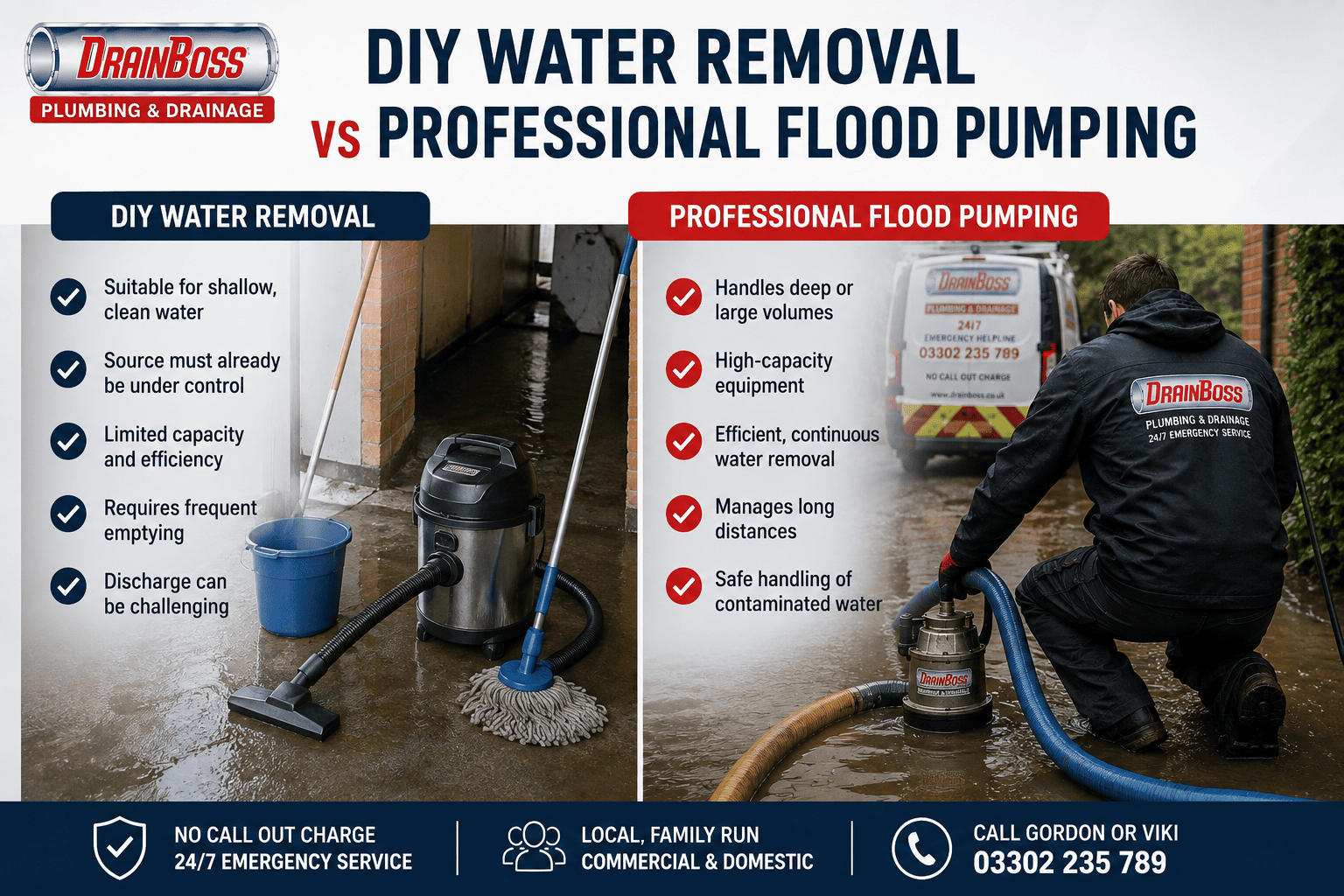
Not every accumulation of rainwater requires specialist pumping. If the water is shallow, clean, no longer entering the area and well away from electrical installations, it may be practical to remove it with a wet vacuum, mop or similar household equipment. The important distinction is that the source must already be under control. Removing a few litres left on a floor is very different from trying to keep pace with water that is still flowing into a cellar or garage.
Household equipment becomes inefficient as the volume and depth increase. Wet vacuums have limited tank capacities and require repeated emptying, while ordinary pumps vary considerably in the amount of water they can move and the minimum depth at which they can operate. There is also the question of discharge. Extracted water must be directed somewhere suitable without simply transferring the flooding to another part of the property or sending contaminated water into an inappropriate drainage route.
Pump selection therefore depends on the conditions rather than water depth alone. Submersible pumps operate while positioned in the water and are suited to removing substantial volumes. Low-level or puddle pumps are designed to continue extracting water at shallower depths and can be useful during the later stages of removal. Larger flooding incidents may require higher-capacity equipment capable of moving water continuously over longer distances or dealing with water containing suspended material. Professional pumping becomes valuable when the required capacity, access or discharge arrangements exceed what can be managed safely with domestic equipment.
How Professional Flood Water Pumping Works
Professional water removal begins with an assessment rather than immediately placing a pump into the flooded area. The source and approximate depth of the water, the size of the affected area, access for equipment and the likely discharge route all influence how pumping should be organised. The condition of nearby gullies and drains is also relevant because an apparently straightforward surface flood may be associated with a drainage restriction.
Suitable pumping equipment can then be positioned and water transferred to an appropriate discharge point. The process needs to account for the rate at which water is still entering. If inflow continues, the equipment must remove water fast enough to produce a net reduction in level rather than simply maintaining the existing flood. Access may also change as the level falls, allowing previously submerged areas and drainage points to be examined.
Where blocked gullies or underground drains are preventing normal discharge, water removal can be combined with drain clearance. Silt, leaves and compacted debris may require physical removal, while high-pressure water jetting can be used where appropriate to clear deposits and restore flow through the pipework. Pumping and drain clearance perform different functions: one removes accumulated water, while the other restores a route through which subsequent water can escape.
Once standing water has been reduced, the drainage system can be assessed under better conditions. If the drains begin carrying water normally after clearance, the incident may have been caused by a temporary obstruction combined with unusually high rainfall. Continued poor flow or another rapid rise in water level points towards a problem that requires further investigation.
Why Pumping the Water Out May Not Fix the Cause
Flood pumping deals with the immediate consequence of excess water, but it does not automatically correct the condition that allowed the flooding to develop. A property can appear clear after pumping and then flood again during the next period of heavy rainfall if the available drainage capacity remains restricted.
Organic debris is one common example. Leaves entering gullies and drains can combine with silt and other material to reduce the space available for water. A pipe does not have to be completely blocked to cause problems. A partial restriction may pass normal everyday flows without obvious symptoms but struggle when large quantities of rainwater arrive within a short period.
Structural and other underground defects can produce a similar effect. Displaced joints, deformation, root intrusion, damaged pipe sections and accumulated deposits can all reduce flow or create points where debris collects. These problems are difficult to diagnose from the surface, particularly while the affected area remains underwater.
A CCTV drain survey may therefore be appropriate where flooding has occurred repeatedly, normal flow does not return after cleaning or there is no obvious explanation for the restriction. A camera inspection can show the internal condition of accessible pipework and help distinguish between removable deposits and defects that may require repair. This avoids treating repeated flood water pumping as a permanent solution when the actual cause lies elsewhere in the drainage system.
DrainBoss Comment: Repeated flooding in the same area usually deserves further investigation. Once the standing water has been removed, checking the drainage system can help establish whether restricted flow, damaged pipework or another defect is reducing its ability to cope with heavy rainfall.
What If the Flood Water Contains Sewage?
Floodwater is not necessarily clean simply because the incident followed heavy rain. When a sewer becomes surcharged, the water level inside it rises because the system is receiving flow faster than it can discharge it. If foul drainage is affected, contaminated water may emerge through drains, gullies or toilets and mix with surface run-off. Once this happens, the resulting floodwater should be treated cautiously even if sewage is not clearly visible.
Contact with contaminated water can expose people to harmful microorganisms, while the water itself can spread contamination across floors, walls, equipment and stored items. Surface run-off may also carry oils, animal waste, chemicals, silt and other pollutants from roads, yards and surrounding land.
Water extraction and contamination clean-up are therefore separate tasks. Pumping removes the standing liquid, but it does not disinfect surfaces or make contaminated porous materials safe. After extraction, affected areas may require specialist cleaning and disinfection, while some materials may need to be removed. The drainage system should also be checked to establish how sewage reached the flooded area and whether further surcharge or backflow remains possible.
What to Do After the Flood Water Has Been Removed
Removing standing water is only the first stage of recovery. Moisture can remain within flooring, plaster, masonry, timber, insulation and other absorbent materials long after the surface appears dry. Ventilation can assist where conditions permit, while dehumidifiers and air-moving equipment can help remove moisture from enclosed areas. Wet carpets, cardboard and other absorbent materials should not simply be left in place to dry if they are holding moisture against floors or walls.
Attention should then return to the drainage system. Gullies should accept water and empty normally, drainage channels should be checked for sediment, and any pumps involved in controlling groundwater or surface water should be tested. Floodwater can transport silt and debris into drainage points, so a system that worked before the incident may still require cleaning afterwards.
During the following days, the affected area should be monitored for:
- persistent damp patches or staining;
- swollen, distorted or deteriorating materials;
- damaged wall or floor finishes;
- musty odours or condensation that does not reduce;
- drains or gullies that remain slow after the flood;
- another rise in water during subsequent rainfall.
Repairs and redecoration should wait until affected materials have dried sufficiently. Covering residual moisture with new finishes can conceal rather than resolve the problem.
Our Services:
Emergency Flood Cleanup and Pumping Services
How to Reduce the Risk of Flooding During Future Heavy Rain
Flood prevention starts with maintaining the routes intended to move rainfall away from the property. Gutters and downpipes should discharge freely, while gullies and surface water drains need to remain clear of leaves, sediment and other material that reduces their capacity. Slow drainage should be investigated before severe weather rather than accepted as normal until an overflow occurs.
Repeated standing water deserves particular attention. If the same driveway, patio, garden or basement entrance floods after heavy rain, the location of the water provides useful evidence about how run-off is moving across the property. The cause may involve inadequate falls, restricted drainage, insufficient drainage capacity or a defect further along the system. Simply pumping the area each time does not address that pattern.
Where pumps protect a basement, cellar or another low point, they should be maintained and tested periodically. The pump, controls, float mechanism and discharge route all need to function when rainfall is at its heaviest. A system that has remained unused for months should not be assumed to be operational without checking it.
Properties with a known flood risk may also benefit from measures designed either to keep water out or reduce the damage if it enters. Depending on the property and source of flooding, these can include flood barriers, suitable non-return valves and improvements to surface water management. Any drainage alteration should be based on the actual cause of the flooding rather than installed as a generic solution.
Where flooding cannot reasonably be prevented in every circumstance, recoverability becomes important. Water-resistant floor and wall materials, raising vulnerable electrical equipment or appliances where appropriate, and choosing finishes that are easier to clean and dry can reduce disruption after a future incident. The most effective approach is therefore not a single flood defence measure, but a combination suited to the property’s drainage, level, construction and established flood risk.
When to Get Professional Help After Heavy Rain
Flood water pumping is most effective when it addresses both the immediate accumulation of water and the reason it cannot drain away normally. If water continues to rise, enters a basement or other part of the building, returns after removal or may contain sewage, delaying action can increase the area affected. Once the water has been removed, checking gullies, underground drains and pumping equipment can help determine whether heavy rainfall alone caused the incident or exposed an existing drainage problem.
DrainBoss provides emergency flood cleanup and pumping services for domestic and commercial properties, alongside drain unblocking, high-pressure water jetting, CCTV drain surveys and drain repairs where further investigation is required. The company operates a 24/7 emergency service across Sussex, Surrey, Kent, Hampshire and South London, so if heavy rain has left standing water that is not draining safely, contact DrainBoss for professional assistance.
Frequently Asked Questions About Flood Water Pumping After Heavy Rain
How do I know if I need professional flood water pumping?
Professional pumping should be considered when standing water is substantial, continues to rise or cannot escape through the normal drainage system. It may also be necessary when water has entered a basement, cellar, garage or occupied part of a building. The source of the water is important because flooding associated with sewage or an overflowing foul drain requires greater care than a small amount of clean rainwater. If the water returns after being removed, the underlying drainage problem should also be investigated.
Can flood water be pumped out while it is still raining?
Yes, pumping can sometimes begin while rainfall continues, particularly when delaying removal would allow the water level to rise further. However, the rate of incoming water must be considered because a pump needs to remove water faster than it is entering to reduce the flood level. Continued heavy rainfall can also affect where extracted water can be discharged safely. The conditions at the property therefore need to be assessed rather than assuming that pumping should wait until the rain stops.
Can I pump flood water out myself?
Small quantities of clean water may be manageable with a suitable wet vacuum or pump if the source has stopped and there are no electrical or contamination hazards. Larger volumes create additional issues involving equipment capacity, safe access and the destination of the extracted water. DIY pumping is not appropriate where sewage contamination is suspected or entering the flooded area could expose you to electrical hazards. Professional assistance is also advisable if the water continues to rise despite attempts to remove it.
Why does flood water return after it has been pumped out?
Water can return when the source of the flooding remains active or the drainage system is still unable to discharge incoming water effectively. A partially blocked drain, restricted gully, damaged underground pipe or continuing groundwater ingress may allow the same area to fill again. Pumping removes accumulated water but does not automatically remove these causes. Repeated flooding after pumping is therefore a reason to investigate the drainage system rather than repeatedly extracting the water alone.
Can blocked drains cause flooding during heavy rain?
Yes. A partial blockage reduces the amount of water a drain can carry, which may not cause noticeable problems during normal conditions. Heavy rainfall increases the flow entering gullies and surface water drains, making the reduced capacity much more significant. Leaves, silt, debris, roots and deposits can all contribute to restrictions. In some cases, flooding during a storm is the first obvious indication that a drainage system has an existing problem.
What should I do if flood water contains sewage?
Avoid unnecessary contact with the water and keep other people away from the affected area. Sewage-contaminated floodwater can spread microorganisms and contaminate floors, walls, furnishings and other materials. Removing the standing water does not complete the clean-up because affected surfaces and materials may also require appropriate cleaning and disinfection. The drainage problem that allowed sewage to escape or back up should be investigated as part of the response.
Where can flood water be pumped to?
The discharge point depends on the source and condition of the water, the property layout and the drainage available at the site. Extracted water should not simply be moved to another location where it can flow back towards the building or flood neighbouring land. Contaminated water requires particular care because it may not be suitable for discharge through the same route as clean surface water. A suitable discharge arrangement should therefore be established before large-scale pumping begins.
Should drains be inspected after flooding?
Not every flood requires a CCTV drain survey, especially where exceptional rainfall clearly exceeded the capacity of an otherwise functioning system. Inspection becomes more useful when flooding is recurrent, drains remain slow after cleaning or water returns without an obvious explanation. CCTV can identify internal problems such as displaced joints, root intrusion, deformation or damaged sections of pipe. Finding the underlying restriction can help determine whether cleaning, repair or another drainage measure is required before the next period of heavy rainfall.