
Key Points:
- Recurring drain blockages are usually caused by an underlying issue, such as grease build-up, tree root intrusion, damaged pipework or poor drainage design, rather than a new blockage.
- Warning signs like repeated blockages, slow drainage, gurgling sounds and bad odours often indicate that professional investigation is needed.
- High-pressure water jetting, CCTV drain surveys and targeted drain repairs provide longer-lasting solutions than repeated DIY drain clearing.
- DrainBoss offers 24/7 drainage services, fixed pricing, no call-out charges and experienced City & Guilds qualified engineers to diagnose and resolve recurring drainage problems.
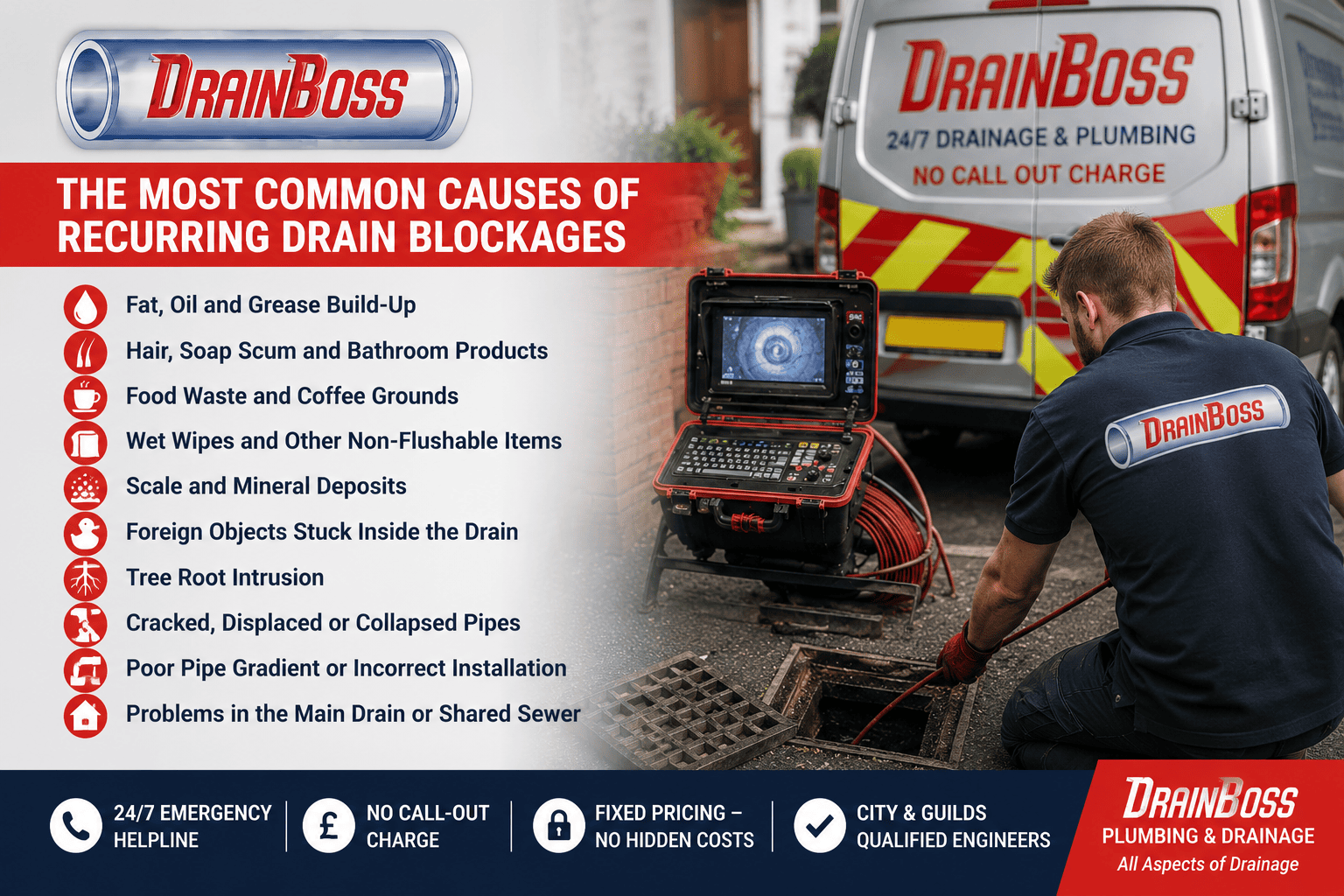
The Most Common Causes of Recurring Drain Blockages
Recurring drain blockages rarely happen without a reason. In most cases, the problem develops gradually as waste accumulates, the condition of the pipe deteriorates or an external factor begins interfering with the normal flow of wastewater. Understanding the most common causes can help identify whether a simple cleaning is likely to be effective or whether further investigation may be required.
Fat, Oil and Grease Build-Up
Fat, oil and grease are among the leading causes of recurring kitchen drain blockages. Although they enter the drain as liquids, they cool and solidify as they travel through the pipework. Over time, these deposits coFew household problems are as frustrating as clearing a blocked drain only to find that the same blockage returns days or weeks later. While an occasional blockage is usually caused by a temporary build-up of waste, recurring drainage problems often indicate that the underlying cause has not been identified or fully resolved. Simply restoring the flow of water does not always remove the conditions that allow another blockage to develop.
Recurring drain blockages can result from grease deposits, hair, wet wipes, tree root intrusion, damaged pipework or poor drainage design. In this guide, we explain why drains keep blocking, the warning signs that suggest a more serious issue, and when professional solutions such as high-pressure water jetting, CCTV drain surveys or drain repairs may be needed to provide a lasting solution rather than another temporary fix.
Why Do Drains Keep Blocking?
A drain that blocks repeatedly is usually showing that the original problem has never been fully resolved. Although water may begin flowing again after the blockage has been cleared, this often means that only part of the obstruction has been removed or that a narrow channel has been created through it. The remaining material continues to restrict the pipe, making it easy for new debris to become trapped in exactly the same place.
In other cases, the blockage is only a symptom of a more significant drainage defect. Cracked pipes, displaced joints, tree root intrusion or poor pipe gradients can all interrupt the normal flow of wastewater and create points where waste naturally accumulates. Unless these underlying issues are identified and corrected, the drain is likely to continue blocking regardless of how often it is cleaned.
It is also important to remember that different parts of a drainage system can contribute to recurring problems. A kitchen sink may repeatedly block because grease has narrowed the waste pipe, while an outside drain may overflow because roots have entered an underground sewer. Even if the symptoms always appear at the same fixture, the actual cause may be located much further along the drainage line. This is why persistent blockages should be investigated rather than treated as isolated incidents.
The good news is that most recurring drainage problems can be resolved once the true cause has been identified. Professional drainage engineers do not simply remove the immediate obstruction. They assess the condition of the pipework, determine why waste is collecting in the first place and recommend the most appropriate long-term solution, whether that involves thorough cleaning, high-pressure water jetting, a CCTV drain survey or structural repairs.
Why Cleaning the Drain Doesn’t Always Solve the Problem
Clearing a blocked drain often restores the flow of water, but this does not necessarily mean the problem has been solved. In many cases, only enough material has been removed to allow wastewater to pass through again. Grease, scale, soap residue or compacted debris may still be attached to the inside of the pipe, gradually collecting more waste until the blockage returns.
Recurring blockages can also indicate that the obstruction is only a symptom of a more significant drainage problem. Cracked pipes, displaced joints, tree root intrusion and sections of pipe with an incorrect gradient can all create areas where waste naturally collects. As long as these conditions remain, clearing the blockage alone is unlikely to provide a permanent solution.
If a drain continues to block despite repeated cleaning, one or more of the following may be happening:
- The original blockage was only partially removed.
- Deposits remain on the pipe walls and continue trapping debris.
- A structural defect is restricting the normal flow of wastewater.
- Tree roots or damaged joints are catching waste inside the pipe.
- The blockage is located further along the drainage system than expected.
- The same DIY method is being used without addressing the underlying cause.
For occasional, localised blockages near a plughole, household methods may be sufficient. However, when the same drain blocks repeatedly, continuing to rely on plungers, drain cleaners or drain snakes usually becomes less effective over time. Identifying why the blockage keeps returning is generally more important than clearing it again, as resolving the underlying cause is what prevents the problem from recurring.
Our Services:
at the inner walls of the pipe and gradually reduce its internal diameter.
Once grease has accumulated, it easily traps food particles, detergent residue and other debris. This creates a progressively thicker obstruction that restricts water flow and causes the same kitchen drain to block repeatedly. Professional high-pressure water jetting is often used to remove grease deposits from the full circumference of the pipe rather than simply creating a small opening through the blockage.
Hair, Soap Scum and Bathroom Products
Bathroom drains are particularly vulnerable to gradual build-up. Hair combines with soap scum, shampoo residue, conditioner, shaving foam and cosmetic products to form dense clumps inside waste pipes. These deposits usually develop slowly, which is why showers and bathroom sinks often become progressively slower before eventually blocking.
Cleaning around the plughole may remove visible hair, but material located deeper inside the waste pipe can continue collecting additional debris. If the same shower or basin regularly drains slowly, there may already be a significant accumulation further along the pipe.
Food Waste and Coffee Grounds
Many kitchen drain blockages are caused by food that should never have entered the drainage system. Coffee grounds, rice, pasta, flour, vegetable peelings and small food scraps can settle inside the pipe, particularly where grease has already begun to accumulate.
Some starchy foods, such as rice and pasta, absorb water and expand after entering the drain, while fine particles can become trapped against existing deposits. Even if a sink appears to clear normally for a period, repeated disposal of food waste can gradually create a blockage that becomes increasingly difficult to remove.
Wet Wipes and Other Non-Flushable Items
Only toilet paper and human waste should be flushed into a domestic drainage system. Wet wipes, paper towels, sanitary products, cotton pads, cotton buds and nappies do not break down quickly enough to move safely through underground pipework.
Instead, these materials can become lodged inside bends, joints or damaged sections of pipe, where they collect additional waste passing through the system. Products marketed as “flushable” may still remain intact for long enough to contribute to recurring blockages, particularly in older drainage systems.
Scale and Mineral Deposits
In some properties, mineral deposits gradually build up on the internal surface of drainage pipes. This is more common in older drainage systems and in areas supplied with hard water, where dissolved minerals leave a rough coating inside the pipe.
Unlike a single obstruction, scale develops along extended sections of pipework, steadily reducing the available flow area. The rough surface also makes it easier for grease, soap residue and other debris to adhere, increasing the likelihood of recurring blockages.
Foreign Objects Stuck Inside the Drain
Not every blockage is caused by gradual build-up. Objects accidentally entering the drainage system can create a permanent obstruction that repeatedly traps passing waste. Common examples include children’s toys, cleaning cloths, pieces of plastic, excessive toilet paper, building debris or items dropped into inspection chambers during maintenance work.
Because these objects often remain fixed in one location, the drain may appear to clear after each blockage is removed, only for waste to collect around the obstruction again. A CCTV drain survey is often the quickest way to confirm whether a foreign object is responsible.
Tree Root Intrusion
Tree roots naturally grow towards moisture and can enter underground drains through small cracks, displaced joints or deteriorated seals. Once inside the pipe, the roots continue expanding and create a network that traps toilet paper, grease, leaves and other debris carried by wastewater.
Root intrusion is a common cause of recurring blockages in outside drains, particularly at properties with mature trees or large shrubs nearby. If left untreated, root growth can eventually cause significant structural damage to the pipe.
Cracked, Displaced or Collapsed Pipes
Drainage pipes can become damaged as a result of age, ground movement, heavy vehicle loads or poor installation. Even relatively small cracks or displaced joints can interrupt the smooth flow of wastewater by creating edges where debris begins to collect.
More serious structural defects, such as partially collapsed pipes, can significantly restrict the passage of wastewater and cause repeated blockages in the same location. In these situations, clearing the blockage provides only temporary relief because the damaged section of pipe continues trapping waste until it is repaired or replaced.
Poor Pipe Gradient or Incorrect Installation
Drainage systems rely on gravity to carry wastewater away from a property. If a pipe has been installed with an insufficient fall, or if part of the pipe has settled over time, water may not flow quickly enough to transport solid waste efficiently.
Sections where wastewater collects, sometimes referred to as bellies or low spots, allow debris to settle instead of continuing through the system. These areas gradually become collection points for grease, silt and other waste, increasing the likelihood of recurring blockages despite repeated cleaning.
Problems in the Main Drain or Shared Sewer
Sometimes the cause of recurring blockages is located beyond the individual waste pipe serving a sink, shower or toilet. Restrictions within the property’s main drain, a shared lateral drain or the public sewer can affect several fixtures at the same time and produce symptoms throughout the building.
If multiple drains begin emptying slowly, toilets gurgle when sinks are used, or wastewater backs up through different fixtures, the problem may lie further downstream rather than inside a single branch pipe. In these situations, a professional inspection is usually needed to determine the exact location and cause of the restriction, and establish whether the affected section is privately owned or maintained by the local water company.
How the Location of the Blockage Can Help Identify the Cause
The location of a recurring blockage can often provide valuable clues about what is happening inside the drainage system. While a professional inspection may still be required to confirm the diagnosis, recognising where the problem occurs can help narrow down the most likely cause and determine the most appropriate solution.
| Drain location | Most likely causes | Typical solution |
| Kitchen sink | Grease, food waste | High-pressure water jetting |
| Bathroom sink | Hair, soap scum | Drain cleaning |
| Shower | Hair, soap residue | Drain cleaning |
| Toilet | Wet wipes, foreign objects | Drain unblocking |
| Outside drain | Tree roots, silt, leaves | CCTV drain survey and high-pressure water jetting |
| Several drains | Main drain or shared sewer restriction | CCTV drain survey |
Although these are the most common scenarios, drainage systems are not always straightforward. For example, a blockage that appears to affect only one appliance may actually originate much further along the underground pipework. If the same location continues to block despite repeated cleaning, a more detailed investigation is usually the most effective way to identify the true cause.
Signs That the Problem Is More Than a Simple Blockage
A single blockage does not necessarily indicate a serious drainage problem. However, recurring symptoms often suggest that there is more than a temporary build-up inside the pipework. The sooner these warning signs are investigated, the greater the chance of resolving the issue before it leads to more extensive repairs.
You should consider a professional drainage inspection if you notice any of the following:
- The blockage returns shortly after it has been cleared.
- Several drains in the property are affected at the same time.
- Gurgling sounds come from sinks, toilets or showers.
- Unpleasant drain odours keep returning.
- An outside drain or inspection chamber overflows.
- Water drains away much more slowly than normal.
- Wastewater backs up into another fixture.
- The ground above the drainage line becomes unusually wet or begins to sink.
- Drainage problems become noticeably worse during or after heavy rainfall.
While one of these symptoms alone may have a relatively simple explanation, several occurring together often point to a deeper obstruction or a structural defect within the drainage system. In these situations, professional equipment such as CCTV drain surveys can identify the source of the problem far more accurately than repeated attempts to clear the drain without knowing what is causing the blockage.
DrainBoss Expert Tip: At DrainBoss, one of the most common mistakes we see is waiting until a recurring blockage turns into an emergency. Many customers have experienced slow drainage or occasional gurgling for weeks or even months before the system finally backs up. Investigating these warning signs early is often quicker, less disruptive and more cost-effective than dealing with a complete blockage.
How DrainBoss Finds the Real Cause
Recurring drain blockages are rarely resolved by simply removing the visible obstruction. At DrainBoss, our approach focuses on identifying why the blockage developed in the first place. By combining specialist equipment with experienced engineers, we can distinguish between routine build-up, structural damage and other hidden drainage defects before recommending the most effective solution.
Professional Drain Unblocking
The first step is restoring the flow of wastewater by removing the immediate obstruction. Depending on the location and nature of the blockage, this may involve specialist drain cleaning equipment designed to clear debris safely without causing unnecessary damage to the pipework.
Professional drain unblocking also allows our engineers to assess how the system behaves once the obstruction has been removed. If drainage remains slow or signs of a deeper problem are present, further investigation can be carried out immediately.
High-Pressure Water Jetting
Where recurring blockages are caused by accumulated deposits rather than a single obstruction, high-pressure water jetting is often the most effective solution. Water is delivered at high pressure through specialist nozzles that clean the entire internal surface of the pipe.
Unlike methods that simply create a passage through the blockage, water jetting removes grease, sludge, soap deposits, silt and loose debris from the pipe walls. This helps restore the pipe’s original carrying capacity and significantly reduces the risk of the same deposits causing another blockage.
CCTV Drain Survey
If recurring blockages suggest an underlying structural problem, a CCTV drain survey allows the inside of the drainage system to be inspected without excavation. A high-definition camera is guided through the pipework, providing a clear view of its condition.
This inspection can identify issues such as cracked pipes, displaced joints, tree root intrusion, collapsed sections, scale deposits, foreign objects and areas where wastewater is collecting instead of flowing freely. Because the exact cause is confirmed before repair work begins, unnecessary excavation and guesswork can often be avoided.
Drain Repairs and Drain Relining
Where damage is found, clearing the blockage alone is unlikely to provide a lasting result. Depending on the condition of the pipe, DrainBoss may recommend either a localised repair, drain relining or, where necessary, excavation and pipe replacement.
Drain relining allows many damaged pipes to be repaired internally by installing a structural liner that seals cracks and restores the pipe without extensive digging. For more severe defects, targeted excavation enables the damaged section to be replaced while minimising disruption to the surrounding property.
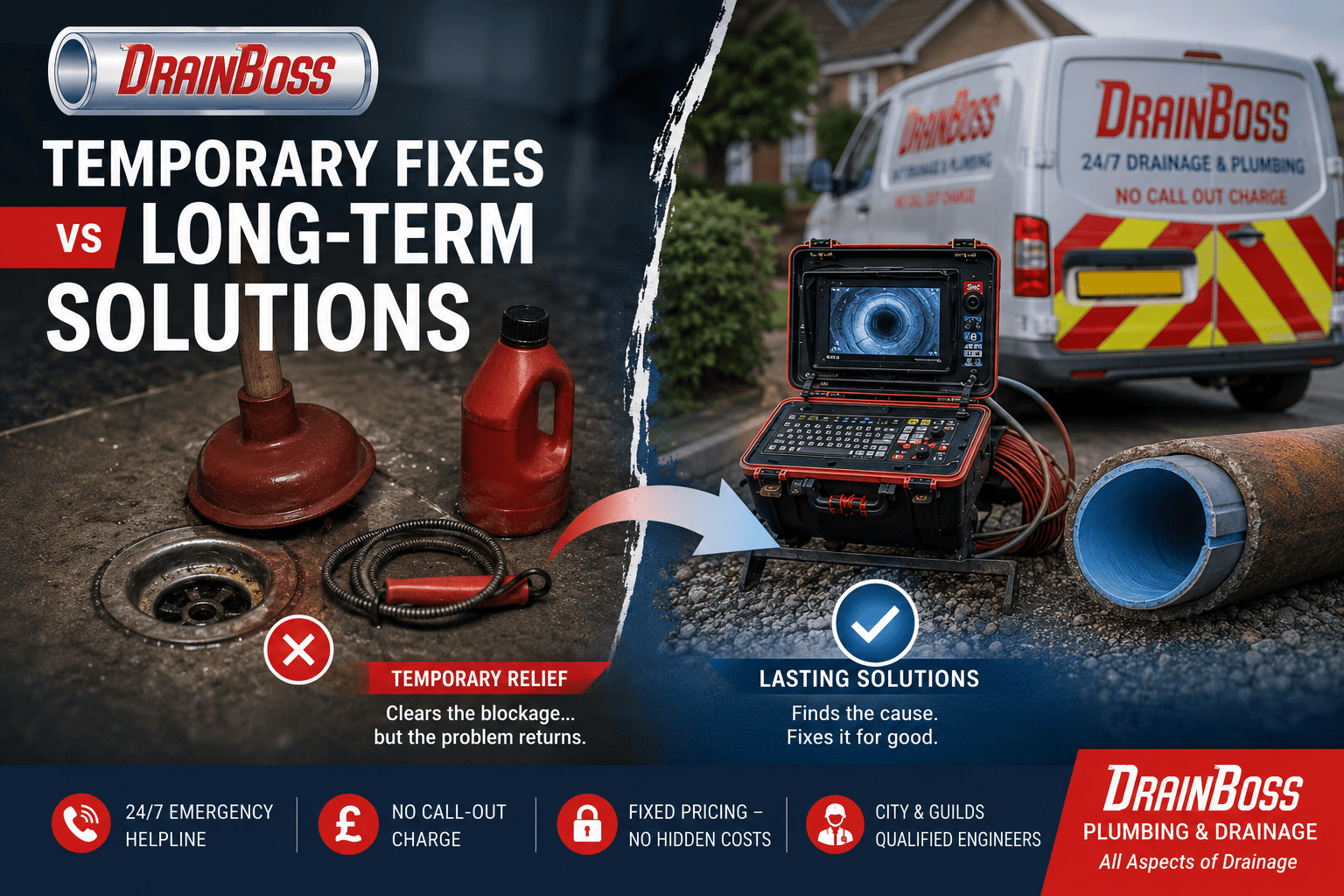
Temporary Fixes vs Long-Term Solutions
Not every drainage problem requires major repair work, but it is important to understand the difference between methods that provide temporary relief and those that address the underlying cause. The most appropriate solution depends on why the blockage has developed in the first place.
| Method | What it does | Long-term solution? |
| Plunger | Removes a nearby blockage by creating pressure | No |
| Chemical drain cleaner | Dissolves some organic deposits | No |
| Drain rods | Breaks up or pushes an obstruction further along the pipe | Sometimes |
| High-pressure water jetting | Thoroughly cleans the internal walls of the pipe | Usually |
| CCTV drain survey | Identifies the underlying cause of recurring blockages | Yes |
| Drain repair or relining | Corrects structural defects within the drainage system | Yes |
While household tools can be effective for minor, isolated blockages, they are rarely sufficient when the same drain continues to cause problems. A professional diagnosis makes it possible to select the most appropriate solution, helping to prevent repeated call-outs, unnecessary expense and ongoing disruption.
Can a Recurring Blockage Damage Your Drainage System?
Ignoring a drain that repeatedly blocks can lead to far more serious problems than occasional inconvenience. As wastewater struggles to pass through a restricted section of pipe, pressure increases behind the blockage and places additional strain on the drainage system. The longer the underlying issue remains unresolved, the greater the likelihood of secondary damage developing.
One of the most common consequences is wastewater backing up into sinks, showers, baths or toilets. In more severe cases, blocked drains can overflow externally or cause internal flooding, resulting in damage to flooring, walls and furnishings. Standing wastewater also creates hygiene concerns, particularly if sewage enters living areas.
Repeated blockages can also accelerate the deterioration of underground pipework. Debris trapped inside damaged pipes retains moisture, encourages root growth and increases stress around cracked joints or weakened sections. If leakage occurs beneath the ground, water may gradually wash away surrounding soil, increasing the risk of localised ground movement. While subsidence has many possible causes and is not a common outcome of every blocked drain, persistent underground leaks should never be ignored.
Another consequence is the gradual increase in repair costs. A blockage that could initially have been resolved through professional cleaning may eventually require drain relining, excavation or pipe replacement if the underlying defect continues to worsen. Investigating recurring drainage problems early is usually far less disruptive and less expensive than dealing with emergency repairs after a complete failure.
Who Is Responsible for a Drain That Keeps Blocking?
Responsibility for a blocked drain depends on where the affected pipe is located and who uses it. In England, a private drain that serves only one property is generally the responsibility of the property owner. This includes internal waste pipes, underground drains within the property’s drainage system and pipework that has not yet joined a shared drain or public sewer.
If the blockage occurs in a shared lateral drain that carries wastewater from more than one property, or within the public sewer network, responsibility will usually fall to the local water company rather than an individual homeowner. Problems affecting several neighbouring properties at the same time, overflowing shared manholes or suspected public sewer blockages should therefore be reported to the relevant water company.
If it is unclear where the blockage is located, a professional drainage inspection can often determine whether the problem lies within the property’s private drainage system or further downstream. This helps ensure that the correct organisation is contacted and avoids unnecessary repair costs.
Our Services:
How to Prevent Your Drains from Blocking Again
Although not every drainage problem can be prevented, simple maintenance and good everyday habits can significantly reduce the likelihood of recurring blockages. Preventative measures are particularly effective where problems are caused by everyday waste rather than structural defects.
Good drainage practices include:
- Never pour fat, oil or grease down sinks or drains.
- Dispose of wet wipes, sanitary products and paper towels in a bin rather than flushing them.
- Fit drain strainers in kitchen sinks, showers and baths to catch food particles and hair.
- Remove leaves, mud and other debris from outside drain covers and gullies.
- Clean plugholes and accessible traps regularly before deposits become excessive.
- Arrange periodic professional drain cleaning or high-pressure water jetting if your property has a history of recurring blockages.
- Investigate repeated drainage problems promptly instead of relying on repeated DIY clearing.
These measures can greatly reduce the build-up of everyday waste, but they cannot correct damaged pipework, tree root intrusion or poor drainage design. If the same drain continues to block despite good maintenance, identifying the underlying cause remains the most effective way to prevent the problem from returning.
DrainBoss Expert Tip: Good maintenance habits can significantly reduce the risk of everyday blockages, but they cannot correct damaged pipework or hidden structural defects. If the same drain continues to block despite careful use and regular cleaning, it is usually a sign that the drainage system needs professional inspection rather than more frequent DIY maintenance.
When Should You Call a Drainage Engineer?
Minor blockages close to a plughole can often be cleared using simple household methods. However, if the same problem keeps returning or the symptoms become more widespread, continuing with DIY solutions is unlikely to achieve a lasting result. Repeated use of chemical drain cleaners or drain rods may also increase the risk of damaging older or already weakened pipework without addressing the real cause of the blockage.
Professional assistance should be considered if you notice any of the following:
- The same drain blocks repeatedly despite previous cleaning.
- More than one drain is affected at the same time.
- Water backs up into sinks, baths, showers or toilets.
- Outside drains or inspection chambers begin overflowing.
- Persistent drain odours remain after the blockage has been cleared.
- Gurgling sounds continue throughout the drainage system.
- You suspect tree roots, damaged pipework or a collapsed drain.
- The blockage cannot be reached or removed using normal household methods.
An experienced drainage engineer can determine whether the problem is caused by a simple obstruction, a build-up of deposits or a structural defect within the drainage system. Early investigation often prevents further damage and helps avoid more extensive and costly repairs later. If recurring blockages are disrupting your home or business, arranging a professional inspection is usually the quickest route to a reliable long-term solution.
Final Thoughts
If the same drain keeps blocking, the blockage itself is rarely the real problem. In most cases, recurring drainage issues are caused by an underlying condition that has not yet been identified, whether that is grease build-up, tree root intrusion, damaged pipework or another hidden defect. Identifying and resolving the root cause is the only reliable way to restore proper drainage, reduce the risk of future disruption and avoid increasingly expensive repairs. Acting early can also help protect your property from problems such as wastewater back-ups, flooding and structural damage.
At DrainBoss, we provide professional drain unblocking, high-pressure water jetting, CCTV drain surveys, drain repairs and drain relining for domestic and commercial properties across Sussex, Surrey, Kent, Hampshire, Brighton and South London. As a family-run, Trading Standards Approved and CHAS Accredited company, with City & Guilds qualified engineers, fixed pricing and no call-out charges, we focus on delivering long-term drainage solutions rather than temporary fixes. If your drains keep blocking, contact DrainBoss today and let our experienced team identify the real cause and restore your drainage system to full working order.
Frequently Asked Questions About Recurring Drain Blockages
Why does the same drain keep blocking even after I have cleared it?
If the same drain keeps blocking, it usually means the underlying cause has not been removed. The blockage may have been only partially cleared, or there could be a structural issue such as damaged pipework, tree root intrusion or an incorrect pipe gradient. Repeated blockages should be investigated rather than treated as separate incidents, as identifying the root cause is the most effective way to prevent the problem from returning.
Can a recurring blocked drain indicate damaged pipework?
Yes. While many recurring blockages are caused by grease, hair or other accumulated debris, persistent problems can also indicate cracked pipes, displaced joints or partially collapsed drains. These defects create areas where waste collects more easily, leading to repeated obstructions. A CCTV drain survey is usually the most reliable method of confirming whether structural damage is present.
Is it safe to keep using chemical drain cleaners?
Chemical drain cleaners can sometimes help with minor organic blockages, but they are not designed to solve recurring drainage problems. Frequent use may also affect certain types of pipework, particularly if the drainage system is older or already damaged. If you find yourself using drain cleaner regularly, it is usually a sign that the underlying cause should be professionally investigated instead.
How can I tell if the blockage is in the main drain rather than inside my home?
A blockage affecting the main drain often produces symptoms in more than one part of the property. You may notice several sinks draining slowly, toilets gurgling, wastewater backing up through different fixtures or an outside inspection chamber overflowing. These signs usually indicate that the restriction is located further downstream than an individual appliance waste pipe and should be professionally assessed.
When should I arrange a CCTV drain survey?
A CCTV drain survey is recommended when blockages keep returning despite repeated cleaning, when multiple drains are affected or when there are signs of damaged pipework or tree root intrusion. The survey allows engineers to inspect the inside of the drainage system without excavation and identify the exact cause of the problem. This makes it possible to recommend the most appropriate repair or maintenance solution instead of relying on repeated temporary fixes.